|
 Gen info Gen info
- Pilea, with 600-715 species, is the largest genus of flowering plants in the nettle family Urticaceae.
-
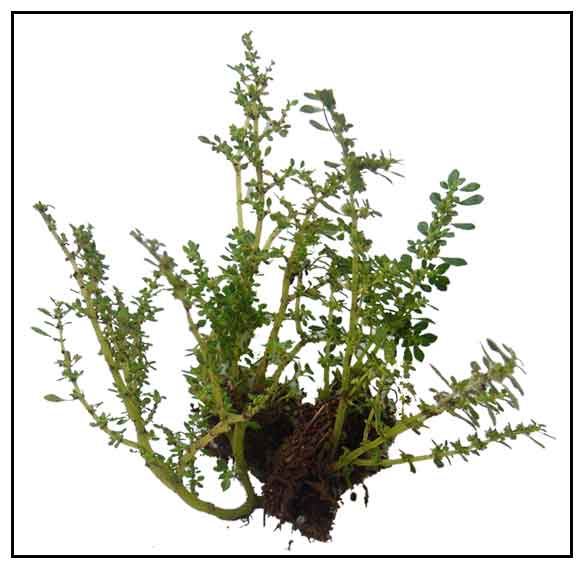
Pilea microphylla is an annual plant belonging to the family Urticaceae. It is an annual plant native to Florida, Mexico, the West Indies, and tropical Central and South America. It has been introduced to various tropical and subtropical regions around the world, including the Philippines. (7)
- It is commonly known as Artillery Plant, because the male flower forcefully eject pollen.
- Etymology: The genus name Pilea is Latin, meaning "felt cap", referring to the calyx covering the achene.
(21)
Botany
• Alabong is a small,soft, smooth
herb, 10 centimeters or less in height. Stems are slender, angular, green with
a tint of purple, and angular. Leaves occur in two rows, petioled, somewhat elliptical
in shape, 2 to 5 millimeters in length. Flowers are very small and crowded in
small inflorescences (cymes) which are greenish or tinged with red and less than
1 millimeter in length.
 Distribution Distribution
- Naturalized. (19)
-
In and about towns, on
damp walls, etc., throughout the Philippines.
- Native of tropical America.
-
Now found in most tropical countries.
- Considered an invasive species in many countries.
Constituents
- Study yielded flavonoids quercetin (reported DPP-IV inhibitor), rutin, chlorogenic acid (reported lipid lowering property) along with others (luteolin-7-O-glucoside, apigenin- 7-O-glucoside, isorhoifolin). (see study below) (9)
- Study of whole plant yielded six phenolic compounds: (1) quercetin-3-O-rutinoside (2) 3-O-caffeoylquinic acid (3) luteolin-7-O-glucoside (4) apigenin-7-O-rutinoside (5) apigenin-7-O-@b-d-glucopyranoside and (6) quercetin. (see study below) (11)
Properties
- Studies have suggested antioxidant, antidiabetic, radioprotective, antimicrobial, cytoprotective, antigenotoxic, antidepressant properties.
Parts utilized
Entire plant, stems, leaves.
 Uses Uses
Folkloric
- Entire plant infusion is used as a
diuretic.
- Used for diarrhea and asthma.
- Crushed leaves applied to sores and bruises.
- In the Antilles, sweetened decoction of roots used as diuretic.
- In Jamaica, entire plant used for women
in labor; used for infertility and inflammation. (4)
- In Brazil, used as a diuretic.
- In Guatemala, used for urinary problems.
- In Jamaican and Chinese medicine, used for diabetes.
- In western Panama, stem decoction drunk for diarrhea.
- In Trinidad and Tobago, leaves used for inflammation and as womb cleanser. (18)
- In Indian folk medicine, used for treatment of burns, scalds, and wounds.
Others
- Grown as ground cover.
Studies
• Antioxidant
/ Radioprotective: An ethanolic extract of Pilea microphylla
was found inhibit iron-induced lipid peroxidation. In screening for in vivo radioprotection in Swiss albino mice, it showed 80% protection. The fraction also protected livers of irradiated mice from depletion of endogenous antioxidant enzymes, provided general protection to the intestine from acute radiation effects. (1)
• Non-Phenolic Antioxidant
Activity: Results indicated that the antioxidant activity was not correlated with phenolic content and suggests that non-phenolic compounds may be responsible for the free radical scavenging activity. DPPH radical scavenging activity % at concentration 1000 µg/ml for methanol, chloroform, diethyl ether, ethyl acetate and butanols extracts were 46.990, 47.161, 60.687, 8.620, and 18.340, respectively, and total phenolic content of 15.20, 36.40, 55.70, 42.10, 23.90, respectively. (2)
• Antibacterial: Study found PM active against Staphylococcus aureus. • In one study, P. microphylla exhibited a variety of antimicrobial activity against pathogenic microorganisms. The majority of crude extracts were active against Gram-positive bacteria such as B. cereus, B. subtilis, and methicillin-resistant Staph aureus.
• Antioxidant: Screening study demonstrated P. microphylla contained different levels of total phenolic, total flavonoid and possessed diverse antioxidant properties. It was most potent when subjected to detailed free radical scavenging.
• Antioxidant / Antimicrobial / Toxicity Study: In a testing of 9 extracts, the methanol extract showed the highest antioxidant activity. A chloroform extract showed highest total phenolic contents. An extract showed antibacterial activity against Gram positive and Gram negative bacteria without antifungal and anti-yeast activity. A extract showed no toxicity against brine shrimp (LC50 of 3880 mug/ml). (5)
• Antidiabetic: Screening in alloxan-induced diabetic rats showed that Pilea microphylla had beneficial benefits on blood glucose levels in normal and diabetic rats and also demonstrated significant protection from other metabolic aberrations cause by alloxan. (6)
• Flavonoid Rich Fraction / Antidiabetic: Study evaluated the antidiabetic potential of a flavonoid rich fraction in C57BL/KsJ-db/db mice. Study yielded flavonoids quercetin (reported DPP-IV inhibitor), rutin, chlorogenic acid (reported lipid lowering property) along with others (luteolin-7-O-glucoside, apigenin- 7-O-glucoside, isorhoifolin). An overall antidiabetic effect could be the result of a combination of several constituents acting in concert restoring homeostasis in energy consumption and utilization. (9)
• Radioprotective / Cytoprotective / Antigenotoxicity: Study compared the cytoprotective and antigenotoxic activity of the polyphenolic fraction with its active polyphenolic constituents against
γ-radiation in V79 cells. Results showed radioprotection probably from a synergistic effect of the phytochemicals present in the herbal extract rather than any single component. (10)
• Phenolic Compounds and Prevention of Radiation-Induced DNA Damage / Antioxidant: Study yielded six phenolic compounds: (1) quercetin-3-O-rutinoside (2) 3-O-caffeoylquinic acid (3) luteolin-7-O-glucoside (4) apigenin-7-O-rutinoside (5) apigenin-7-O-@b-d-glucopyranoside and (6) quercetin. Pre-treatment with compounds 1-3 and 6 in V79 cells attenuated radiation-induced formation of reactive oxygen species, lipid peroxidation, cytotoxicity and DNA damage, correlating the antioxidant activity of polyphenols with their radioprotective effects. (11)
• Improvement in Sperm Parameters and DNA Fragmentation: Study investigated the effects of PM in a rat model of varicocele. Results showed Pilea microphylla improves sperm parameters and DNA fragmentation in varicocelized rats. PM can reduce the damage to sperm DNA but not chromatin condensation. (13)
• Antidepressant: Study evaluated various crude extracts (methanol, chloroform, and ethyl acetate) of Pilea microphylla on depression in mice. Results showed an antidepressant effect in animal models. The effect of acute or repeated administration was similar to that produced by fluoxetine and haloperidol. (14) Study evaluated selected crude extracts of P. microphylla in two models predictive of antidepressant activity i.e., the mouse forced test (FST) and tail suspension test (TST). Results showed significant anti-depressant like effects at high doses, with significant decrease of immobility at 100 mg/kg. Results suggest a potential resource for natural psychotherapeutic agent against depression. (16)
• Antidiabetic / Flavonoids: Study evaluated the antidiabetic potential of flavonoid rich fraction of PM and its possible mechanism of action in C57BL/KsJ-db/db mice. The presence of flavonoids viz., quercetin (reported DPP-IV inhibitor), rutin, chlorogenic acid (reported lipid lowering property) along with others (luteolin-7-O-glucoside, apigenin-7-O-glucoside, isorhoifolin) in PM1 reversed the disturbed metabolic milieu in C57BL/KsJ-db/db mice. (15)
• Antidiabetic / Anti-Inflammatory: Study evaluated the anti-inflammatory and anti-diabetic effects of methanolic extract of P. microphylla in mice. Anti-inflammatory effect was observed in doses of 250 and 500 mg/kg with 74.18% and 72.17% inhibition of paw edema respectively, compared to standard drug Diclofenac-Na with 80.42% inhibition. Antidiabetic effect was observed in alloxan induced diabetic mice using same doses on oral glucose tolerance test (OGTT) with lowering of plasma glucose level compared with standard drug Metformin. (22)
• Antidiabetic / Anti-Inflammatory: Study of methanolic extract of P. microphylla demonstrated moderate antioxidant activity and inhibitory effects on acetylcholinesterase and lipase enzymes, with IC50s of 46.69 mg L-1m 132,531 mg L-1 and 25.148 mg L-1, respectively, for antioxidant, acetylcholinesterase and lipase inhibitory assays. The extract also exhibited phytotoxic activity by inhibiting root growth. (23)
Availability
- Wildcrafted.
- Occasionally cultivated as a dish garden plant or cover plant.
- Plants available in the cybermarket.
|