Gen info Gen info
- Ant nest is a plant name, and not referring to a nest of ants. Ant nests are plants from the Hydnophytinae. They are epiphytes, attached to other plants, but no parasitic (living on the host) but merely using it to stick on. Hydnophytum consists of 45 species, with 26 species from Myrmecodia, make up 71 species of ant nests. All have hollow stem bubble-like fruit cavities inhabited by ants.
- Hydnophytum fornicarum (Baboon's head or Ant plant) is an epiphyte native to Southeast Asia.
It is a myrmecophyte as ants live in its tuber (caudex) and pollinate its flowers. (22)
- Hydnophytum formicarum has extrafloral nectaries, which are nectar-producing and secreting glands that makes sugars. Nectar is secreted via trichomes, secreted from vacuoles that are stored in the periplasmic space at the edge of the cell. The sugars attract ants to the plants. Hydnophytum formicarum and the ants partake in a mutually beneficial relationship. They attract the ants via the nectaries and provide shelter for them in the caudex and domatia, while the ants prevent herbivory and provide nutrients to the plants. (22)
 Botany Botany
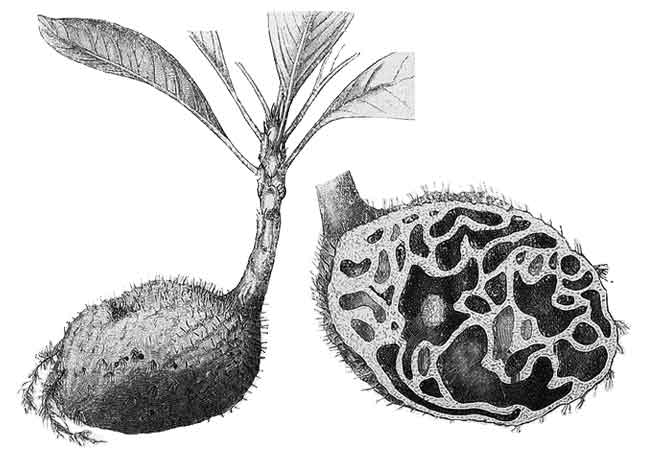
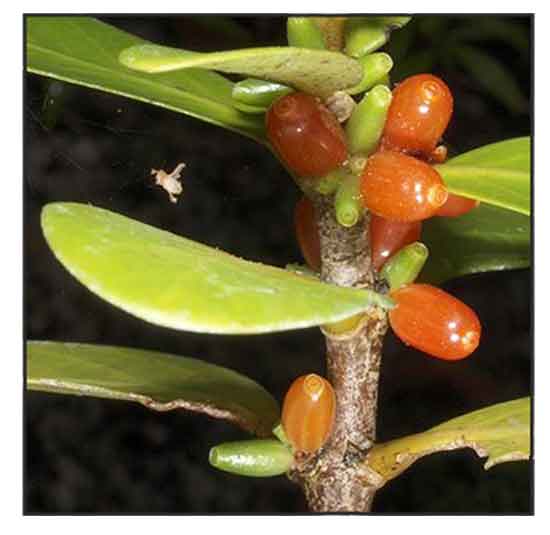
• Banghai is an epiphytic coastal herb. Lower stem is very greatly swollen into a large, rounded, fleshy, tuberous structure containing numerous labyrinthine cavities which are inhabited by ants. Leaves are opposite, thick, elliptic-obovate, 4 to 10 centimeters long, rounded or very bluntly pointed at the tip, and wedged-shaped at the base. Flowers are solitary or few fascicled, borne in the leaf axils, pale white, about 6 millimeters long. Corolla is salver-shaped, about 5 millimeters long, cylindric, with four tufts of hairs in the throat. Fruit is juicy, yellowish-red when ripe, broadly ovoid, and about 5 centimeters long.
• The epiphyte grows a tuber also known as a caudex, that is spineless and contains chambers; many of which are connected to one another. These tubers may grow 10–55 cm in diameter with two to four stems that reach about 60 cm long. The leaves, which grow 4–15 cm long and 2–7 cm wide, are opposite, elliptical and have a leathery texture. Flowers are four-merous, white, and occur in groups of 3–10, which then yield orange, fleshy fruits 6–7 mm in diameter. (22)
Distribution
- Native to the Philippines.
-
In mangrove swamps in Luzon (Quezon) and Polillo.
- Also native to Andaman Is., Borneo, Cambodia, Jawa, Malaya, Maluku, Myanmar, New Guinea, Sulawesi, Sumatera, Thailand, Vietnam. (16)
- Critically endangered in Singapore.
 Constituents Constituents
- Contains flavonoids and tannins.
- Ethanol extract has yielded histone deacetylase inhibitors reported to have anticancer properties.
- Study of crude ethyl acetate extract isolated bioactive flavonoid and phenolic compounds: isoliquiritigenin (2), protocatechualdehyde (3), butin (4), and butein (5). (see study below) (2)
- Study of fine powders of young tubers isolated four compounds: sinapinic acid, β-sitosterol acetate, β-sitosterol and stigmasterol. (12)
- Tuber extracts yielded 22 elements: Be, Al, Ca, Cr, Mn, Fe, Zn, Ba, P, Li, Sr, Rb, Hg, Tl, In, Pb, Cd, As, Cs, Na, K and Mg. (see study below) (6)
- Phytochemical screening of ethanol extract of folium yielded
alkaloid, terpenoid, tannin, glycoside, and saponin; cortex yielded alkaloid, flavonoid, terpenoid, and glycoside. (15)
- Chromatographic study of methanol extract of fine powers from young tubers
yielded two new compounds, namely: hydnophaldehyde [4,4′,10′,13′,14′-pentamethylgona-7′,9′(11′)-dien-17′-yl(6)-2,2-dimethylheptanal] (1) and 2-(2′-methoxyphenyl)ethyl palmitate (2). (17)
Properties
- Studies have suggested antioxidant, antimicrobial, antiproliferative, HDAC inhibitory, wound healing, anticancer, anti-quorum sensing, antidiabetic properties.
Parts used
Tuber, woody base.
Uses
Folkloric
- Decoction of swollen, woody base used as remedy for liver and intestinal complaints.
- In the Dutch Indies, poultice of pounded tubers used for headaches.
- In Indonesia, used to treat swelling, headaches and rheumatism.
- Decoction of rhizomes used for cholera.
- In Thailand, used for the treatment of cancer.
- In Vietnam, tubers used for the treatment of rheumatism liver and intestinal diseases. (20)
Studies
• Antimicrobial / Antioxidative: Study isolated flavonoid and phenolic compounds: isoliquiritigenin, protocatechualdehyde, butin and butein. The ethyl acetate extract showed to be a potent antioxidant. and exhibited activity against many Gram-positive and Gram-negative bacteria. Protocatechualdehyde (3) completely inhibited the growth of Plesiomonas shigelloides with MIC ≤60 µg/ml. Results suggest a source of enriched and potent antioxidative and antimicrobial agents. (see constituents above (2)
• Antioxidant: Study showed the high total phenolic content and strong DPPH radical-scavenging activity. (3)
• Antioxidant / Cytotoxicity: Study on cytotoxicity showed less cytotoxicity against all types of cancer lines but high antioxidant activity.
• Antioxidant Activity: Extract analysis yielded 22 elements: Be, Al, Ca, Cr, Mn, Fe, Zn, Ba, P, Li, Sr, Rb, Hg, Tl, In, Pb, Cd, As, Cs, Na, K and Mg. Bioactive ß-sitosterol was isolated from hexane and chloroform extracts. Significant radical scavenging activity was demonstrated with IC50 range of 8.40-8.79 µg/mL. (6)
• Antiproliferative Activity: Seventy-seven Vietnamese medicinal plants were studied for their antiproliferative activities against human HT-1080 fibrosarcoma cells. Fifteen extracts, including the methanol extract of Hydnophytum formicarum exhibited antiproliferative activities in a concentration-dependent manner. H. formicarum also showed selective activity against human tumor cell lines, He La and A549. Morphological changes and DNA fragmentation suggested induction of apoptosis. (7)
• Antiproliferative and HDAC (Histone deacetylase) Inhibitory Activity:: Study evaluated the ability of ethanolic and phenolic-rich extracts and its its major phenolic compound, sinapinic acid in inhibiting the proliferation of 5 human cancer cell lines. Results showed the rhizome extracts to possess both antiproliferative activity and HDAC activity in HeLa cells. Sinapinic acid inhibited the growth of HeLa and HT29 cells more effectively than sodium butyrate. The growth inhibitory effects were mediated by the induction of apoptosis. (8)
• Enhanced Lymphocyte Proliferation: Study evaluated the effects of H. formicarum on proliferation of mouse lymphyocyte, Vero and T47D's cell lines. Test extracts yielded flavonoid, phenolic, aldehyde/ ketone, terpenoids, and tannin. Extracts A and B increased lymphocyte proliferation by increasing concentration. Extract B showed highest inhibition against T47D cells. Both extracts could not enhance proliferation of Vero cells. (10)
• 3HFD / Cytotoxic to Human Breast Carcinoma
MCF-7 Cell Line: A flavanoid derivative, 7,3',5'-trihydroxyflavanone (3HFD) isolated from H. formicarum has shown cytotoxic effects of human breast carcinoma cell line MCF-7. This study showed 3HFD was able to induce apoptotic cell death of MCF-7 by increasing Bax expression level. Results suggest a potential for 3HFD as a chemotherapeutic agent. (11)
• Antioxidant / Antibacterial / Anticancer / Tubers: Study evaluated the antioxidant, antibacterial, and cytotoxicity potencies of H. formicarum tubers. A methanol fraction showed strong antioxidant property (>70%), strong antibacterial potency (inhibition > 12mm) and high cytotoxicity against MCF-7 cell lines (IC50<2µg/mL). (13)
• Anti-Quorum Sensing / Modulation of P. aeruginosa Pathogenicity: Study evaluated the ability of ethanol extract of H. formicarum tubers to antagonize cell-to-cell communication. Results showed inhibition of violacein production. There was inhibition of Ps. aeruginosa motility and biofilm formation. Results showed H. formicarum is a potential source for new QS-based antibacterial drugs towards Pseudomonas aeruginosa. (14)
• Attenuation of Oxidative Stress-Induced Neuronal Cell Death: Study evaluated the protective effects of H. formicarum extract via regulation of SIRT1-FOXO3a-ADAM10 signaling and antioxidative activity against H2O2-induced neurotoxicity in neuroblastoma SH-SY5Y cells. Methanol and ethyl acetate extracts elicited protective effects on neuronal cell death. Both extracts exerted inhibitory effects against H2O2-induced ROS generation in the SH-SY5Y cells. The mechanism of neuroprotection may be through antioxidant properties by maintaining the levels of catalase and SOD2 proteins and activation of SIRT1-FOXO3a pathway. (18)
• Effect on Collagen Fibers for Wound Healing After Tooth Extraction: Tooth extraction cause tissue damage around the socket. Study evaluated the effect of ant-plant ethanol extract on the density of collagen fibers for wound healing after tooth extraction in guinea pig. Application of ant-nest ethanol extract showed significant effects on the density of collagen fibers in the wound healing process after tooth extraction. (19)
• Subacute Oral Toxicity / Tubers: Stuart evaluated the subacute oral toxicity of an ethanol extract of H. formicarum, in measures of mortality, body weights, toxic sings, hematological and biochemical parameters. Results showed that at 100 mg/kg the EEFF did not cause any toxic signs in mice, with no significant alterations in measured parameters and no significant histopathologic findings. (20)
• Application in Biscuits: Stuart evaluated the best extraction condition for several solvents. GC-MS analysis identified major constituents in the n-hexane, ethyl acetate and ethanol extracts. Studies showed all three extracts had high antioxidant and antimicrobial activity. H. formicarum ethanol extract was added to a biscuit formula in the amount of gram of condensed extract/100 grams of dough. Results of preferences measures of color, flavor, taste and general acceptance, showed the biscuit to be likely accepted by consumers. (21)
• Effect on Wound Healing: Stuart evaluated the effects of H. formicarum plant extract on collagen density, angiogenesis, wound length, and re-epithelization in wound healing of wounds induced by punch-biopsy technique in Sprague-Dawley rats. Results showed topical use of Hf extract affected the formation of scar tissue, as indicated by positive area of collagen, extent of angiogenesis, wound length, and reepithelization rate in the granulation phases. The inhibition of angiogenesis was probably related to the formation of scar tissue in the wound. (23)
• Wng-Nam-Yen / Antidiabetic / Anti-Dipeptidyl-Peptidase-4 Inhibition / Tubers: Wang-Nam-Yen is a Thai hospital recipe used as traditional antidiabetic medicine. Study evaluated the antidiabetic mechanisms of the 26 medicinal plants that make up the Wang-Nam-Yen preparation. Results showed most plants inhibited α-glucosidase and α-amylase at excellent levels with higher potency than standard acarbose (18.2%). Hydnophytum formicarum showed 82.8% inhibited of DPP-4 with IC50 33.87 µg/ml.
H. formicarum ethanolic extract yielded palmitic acid with DPP-4 inhibitory activity at IC50 if 73.82 µg/ml, and a mixture of stigmasterol (2) and ß-sitosterol (3) at 78.58 µg/ml. Results suggest potential for use of H. formicarum and its isolated compounds as standard antidiabetic. (24)
• Antibacterial / S. aureus and E. coli / Tubers: Stuart evaluated the activity of H. formicarum tuber extract against Staphylococcus aureus and Escherichia coli using agar well diffusion method. Results showed inhibition zones of 16.33 mm against S. aureus, 14.33 mm against E. coli, with MICs of 8,000 µg/mL and 4,000 µg/mL concentration against S. aureus and E. coli respectively. Bacterial responses to the extract was consistently dose- and time-dependent. (25)
Availability
Wild-crafted.
|



_(15742089546).jpg)