|  Gen
info Gen
info
- There are many species,
hybrids and horticultural varieties of begonia, widely cultivated in
the Philippines for its ornamental foliage and flowers. There are three
types: (1) Fibrous rooted with dull or bright green leaves or variegated
in hybrids (2) rhizomatous, with thick underground stems and large and
long-stalked leaves (3) tuberous-rooted with their attractive showy
flowers.
- Angel wing name derives from the large leaves shaped like wings of an angel; a common name to a number of Begonia species.
Botany
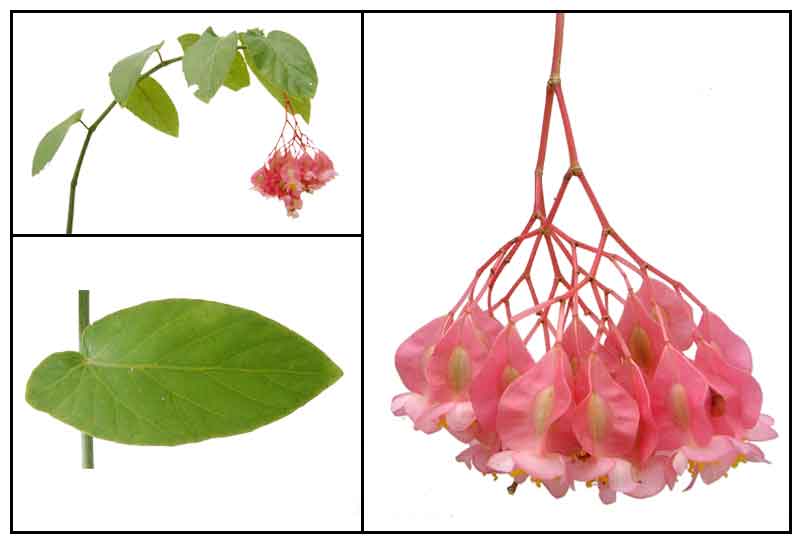
Begonia coccinea with fibrous rooted herbaceous perennial with
erect, branched stems growing to 1.3 meters tall. Leaves are leathery, obliquely-oblong
to ovate, 10 to 15 centimeters long and 5 to 8 centimeters wide, with slightly toothed, undulate edges. Flowers are in axillary,
pendulous racemes with red peduncles. Female flowers are three-winged
with a red ovary. Fruit is a triangular capsule, up to 8 centimeters long and three-winged.
Distribution
- Widely cultivated in the
Philippines for ornamental use.
- Native to Brazil.
Parts utilized
Flowers, leaves, roots.
Properties
Anodyne, ophthalmic, antiphlogistic,
antispasmodic.
Uses
Folkloric
- Not known for folkloric
medicinal use in the Philippines.
- In other countries, it has been written up for the medicinal uses of
its flowers.
- Flower infusions used to promote blood circulation and elimination of
toxins from the body.
- Poultice of flowers used for burns and toxic sores.
Begonia picta
- Juice of the plants is drunk to use relieve headaches.
- Poultice of crushed leaves for sore and irritated nipples.
- Roots of the juice used for conjunctivitis.
- Also used for peptic ulcer.
Begonia grandis
evansiana (Andrews.)Irmsch.
- The tuberous roots and fruits are anodyne, antiphlogistic and antispasmodic.
- Decoction used in the treatment of traumatic pain, haematemesis, gonorrhoea,
postpartum vaginal discharge, amenorrhoea and snakebites.
Studies
• No studies found.
Availability
Cultivated.
|