 Botany Botany
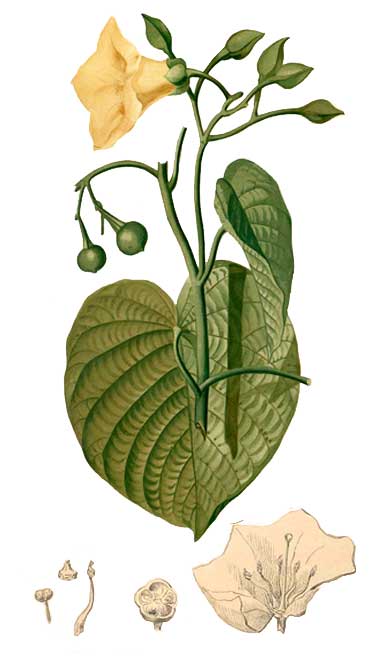
Bulakan is a coarse and widely spreading woody vine. Stems are 5 or more centimeters thick, and porous. Leaves are alternate, smooth, somewhat rounded, about 20 centimeters wide, those toward the ends of the branchlets being much smaller, heart-shaped at the base, pointed at the tip. Peduncle grows solitary from each of the upper leaf axils, erect and longer than the leaves. Flowers are large, golden-yellow, few to many, or clustered. Sepals are smooth, thick, oblong, 2 centimeters long. Corolla has a wide limb.
Distribution
- Common in secondary forests at low and medium altitudes in the Babuyan Islands (Camiguin); Laguna, Quezon, Camarines, Sorsogon Provinces in Luzon; in Mindoro, Palawan, Balabac, Samar, Leyte, Panay, and Mindanao.
- Also occurs in southwestern Asia to tropical Australia and Polynesia.
- In some places considered a troublesome vine, invading forest strands, strangling and smothering vegetation and trees. (11)
- Sometimes utilized to provide rapid ground cover to
reduce erosion and nutrient losses. (11)
Constituents
- Phytochemical screening of leaves yielded terpenoid, steroid, saponin and phenolic compound. (see study below) (9)
Properties
- Laxative, anthelmintic.
- Studies have suggest antibacterial, cytotoxic activities.
Parts used
Stems, leaves, juice.
Uses
Culinary
- In Malaya, tubers reported to be edible, but may have a purgative effect.
Folkloric
- In the Philippines, sap from the stem taken as anthelmintic. Infusion of roots used for chills. Tubers used to treat uterine hemorrhage.
- Juice of the stems taken for coughs and diarrhea; also used for sore eyes.
- Leaves used for washing the hair.
- Leaves applied as poultices for superficial ulcers and wounds.
- Leaves applied as maturative for inflammation of the breasts.
- In Vanuatu, new mothers are encourage to drink a lot of coconut water, to which sap of Merremia peltata may be added. (1)
- In Fiji, leaf decoction used to treat boils, infections, and appendicitis. Decoction of roots used to treat stomach muscle rigidity. Drink made from the juice of leaves used for hernias.
- In Papua, New Guinea, leaf, stem and sap used on wounds, sores and swellings.
- In Manus Island, stem sap used on cuts and young leaves applied to sores. On Buin, used for filariasis, elephantitis of scrotum, cut wounds, fever, rhinitis, boils and centipede bites. In Siwai, used for eye inflammation and bullet wounds. (7)
- In Fiji and India, diluted sap from the young leaves used as eye or ear drops
- Sundanese use the extract for stomachaches.
- In Indonesia, leaves used for washing hair, believed to improve growth and prevent hair loss.
- In Serampas, Jambi Indonesia, used for treating cough. (8)
- To facilitate childbirth, Vanuatu women drink juice squeezed out of ten leaves each of M. odorata and m peltata, and to improve lactation, sap of the leaves added on to coconut milk.
- In Indo-China and India, sap from stem are used as laxative. In Fiji, decoction of leaves used to treat boils, infections and appendicitis. Decoction of roots used to treat stomach muscular rigidity. Juice of leaves use for the treatment of hernia and the heated leaves applied as poultice. In Papua New Guinea, stem or sap used for wounds, sores, and swellings. (4)
- In Papua New Guinea, sap of fresh cut leaves used for boils, sores, ulcers, fresh cuts and wounds. Stems used for fever and malaria. (10)
Others
- In the Philippines, stems sometimes used for tying.
Studies
• Antimicrobial: Leaves yielded alkaloids and showed antimicrobial activity. (4)
• Anti-HIV Activity: A MeOH extract showed anti-HIV activity, inhibiting HIV-1 reverse transcriptase, and gp120-CD4 binding in vitro. (4)(5)
• Cytotoxicity / Leaves: Study evaluated the cytotoxic effects of methanol extract and fractions of leaves of Merremia peltata by Brine Shrimp Lethality Method. The methanolic extract showed cytotoxicity with LC50 19.68 ppm, n-hexane fraction 22.03 ppm, ethyl acetate fraction 130.92 ppm and methanolic fraction 532.11 ppm. (9)
• Antibacterial / Leaves: Phytochemical screening of a leaf extract yielded alkaloid, steroids and flavonoids. Ethanol and and water leaf extract showed inhibitory activity on Gram-posiitive bacteria S. aureus and B. subtilis and Gram-negative bacteria E. coli and P. aeruginosa. (12)
Availability
Wild-crafted.
|