 Botanical factoid Botanical factoid
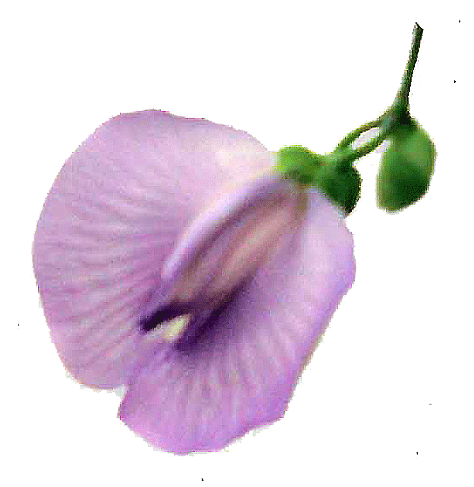
If you stare long enough and let your mind stray, you might appreciate how the common name Pukingan derived from the flower's similarity to the female external genitalia, particularly the clitoris. Another species, Clitorea ternatea, share the same common name, pukingan, from puki, which is Tagalog for vagina.
Taxonomic note
- The tropical forage species, known since the last century as Centrosema pubescens, was renamed Centrosema molle Mart. ex Benth. (18)
Botany
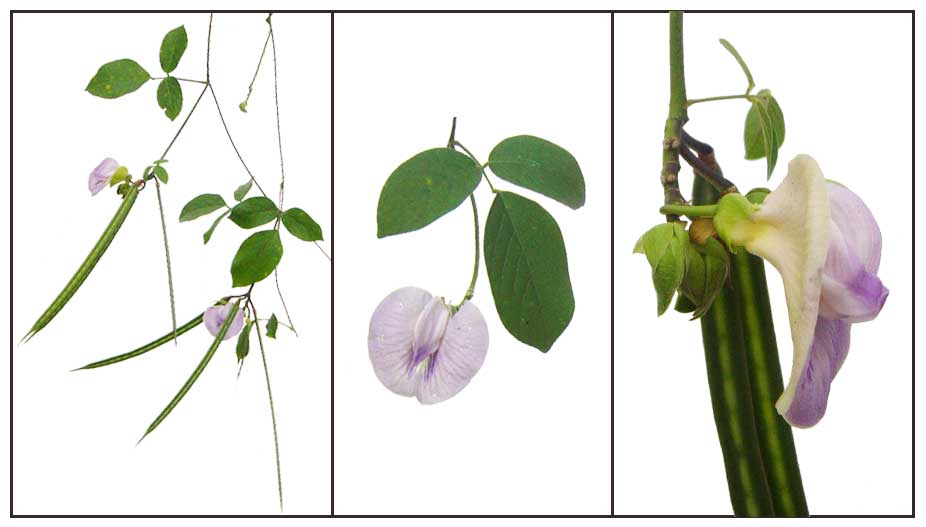
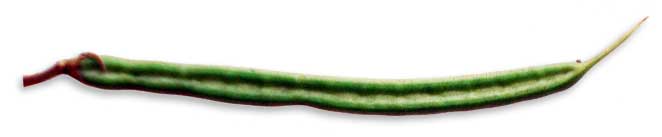
Butterfly pea is a twining herbaceous vine with trifoliate leaves. Leaflets are dark green, elliptic or ovate-elliptic, up to 9 centimeters long and 6 centimeters wide, pubescent on both surfaces and with an obtuse tip. Flowers are showy, bright or pale lilac, with dark violet stripes or blotches. Petal is broadly orbicular and pale lilac with dark blotches. Pods are linear with prominent margins, up to 9 centimeters long and containing up to 20 seeds.
 Distribution Distribution
- Widespread and naturalized in the Philippines.
- A common weed in cultivated fields.
- Occasionally planted as an ornamental.
Constituents
-Phytochemical screening yielded saponins, tannins, terpenes.
- Study of seeds isolated a new isoflavone glycoside, irisolidone 7-O-ß-D-apiofuranosyl-(1-2)B-D-glucopyranoside along with sitosterol, stigmasterol and sitosterol 3-O-ß-D-glucopyranoside. (5)
- Analysis for mineral composition yielded calcium 0.91 - 0.98%, phosphorus 0.34-0.37%, potassium 0.87 - 0.92%. sodium 0.01 - 0.03%. Crude protein was 16.0%. Biomass yield per g/plant was 56.20. Proximate composition (% in DM) of crude protein was 14.77-18.97. (10)
- Proximate composition (%DM) of forage legume 12 weeks after planting in 2001 and 2001 showed 10.99 -11.80 crude fiber, 14.77-18.97 crude protein, 6,01-6.08 ash, 4.98-4.42 ether extract, and 3181.24-3147.21 Kcal/kg, respectively. Mineral composition yielded 0.98-0.91 calcium, 0.34-0.37 phosphorus, 0.87-0.92 potassium, 0.01-0.03 sodium, respectively. (17)
Properties
- Cold tolerant with low soil and rainfall requirements.
-
Studies have shown antibacterial, antifungal, immunopotentiating, larvicidal properties.
Parts used
Seeds
Uses
Folkloric
- No recorded folkloric medicinal use in the Philippines.
- In Laos, seed is crushed on applied to skin for scorpion and snake bites. (16)
- In Nigeria, pods prepared as peppered soup taken by women postpartum for womb cleansing after delivery. (13) Leaves used for skin diseases. (14)
Others
- Fodder: Fodder for livestock. Widely used as forage and protein source for grazing cattle.
Studies
• Immunologically Active Polysaccharides / RES-Potentiating Activity: Study isolated two polysaccharides from the powdered seeds of Centrosema pubescens. The polysaccharides showed reticuloendothelial system-potentiating activity. (1)
• Pubescidin / Seeds: Study isolated a new isoflavone glycoside, irisolidone 7-O-B-D-apiofuranosyl-(1-2)B-D-glucopyranoside from the seeds of CP along with sitosterol, stigmasterol and a sitosterol-glucopyranoside. (5)
• Antimicrobial / Wound Healing: An ethanolic extract of this plant showed significant antibacterial and antimicrobial effect against most pathogenic organisms tested. A crude ointment of the plant showed a certain degree of wound healing evident from wound contraction and increased tensile strength. (6)
• Anti-Proliferative / Apoptosis: Study assessed the anti-proliferative activity of C. pubescens. A dichlormethane extract inhibited the proliferation of HL-60 (promyelocytic acute leukemia) cells. Results showed effective arrest of the cell cycle and apoptosis. The extract exhibited negligible toxicity even at the highest dose tested. (7)
• Larvicidal-Proliferative / Apoptosis / Leaves and Stems: Study evaluated extracts of air-dried stems and leaves of C. pubescens for activity against 4th instar mosquito larvae. Results showed potential larvicidal activity of leaf and stem extracts. All plant extracts showed moderate toxic effect on mosquito larvae, with the leaf extract showing highest mortality. Study suggests potential as an eco-friendly alternative for the control of mosquito larvae. (9)
• Immunologically Active Polysaccharides / Seeds: Fractionation of powdered seeds yielded two polysacchardes that showed reticuloendothelial system-potentiating activity in a carbon clearance test. (11)
• Antibacterial / Antifungal / Leaves: Rhizomes of Zingeber officinale and leaves of C. pubescens were tested for antimicrobial activity. The ethanolic extract of both plants were active against S. aureus, P. aeruginosa, S. typhi, and E. coli. C. pubescens showed significant activity against Candida albicans. (12)
• Antioxidant / Leaves: Study evaluated oven dried and freeze dried ethanol extracts of four common forage legume leaves, viz., Arachis pintoi (Pintoi), C. mucunoides (Calapo), Centrosema pubescens (Centro) and Stylosanthes guanensis (Stylo) for antioxidant activity. All four type of forage legume leaves exhibited strong scavenging effects to DPPH radicals, strong reducing power, and high ß-carotene bleaching inhibitory activities with respect to phenolic content. Arachis pintoi total phenolic content was 7.5 mg GAE/g.
Freeze-dried extracts exhibited excellent antioxidant capacities with higher phenolic content. (15)
Availability
- Wild-crafted.
- Seeds in the cybermarket.
|