 |

Family • Palmae
Tangalo
Actinorhytis calapparia (Blume) H.Wendl. & Drude ex Scheff.
CALAPPA PALM
| Scientific names | Common names |
| Actinorhytis calapparia (Blume) H.Wendl. & Drude | Tañgalo (Bag.) |
| Actinorhytis poamau Blume | Calappa palm (Engl.) |
| Areca calapparia Blume | |
| Areca cocoides Griff. | |
| Pinanga calapparia (Blume) H.Wendl. [Illegitimate] | |
| Ptychosperma calapparia (Blume) Miq. | |
| Seaforthia calapparia (Blume) Mart. | |
| Actinorhytis calapparia (Blume) H.Wendle. & Drude is an accepted name. The Plant List | |
| Other vernacular names |
| INDONESIA: Jambe sinagar, Jawar, Pinang kalapa. |
| MALAYSIA: Pinang penawar, Pinang kelapa. |
| MAROVO: Bakovara. |
Distribution Constituents Properties Parts used Studies Availability |
Updated May 2022 / March 2019 / February 2013

 |
PHOTOS / ILLUSTRATIONS |
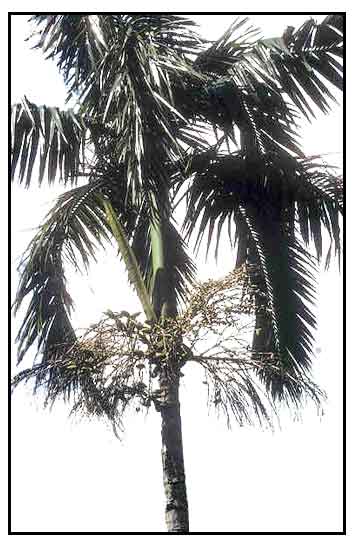
| IMAGE SOURCE: / File:Actinorhytis calapparia.jpg / Scott Zona / 20 November 2008 / This file is licensed under the Wikimedia Commons Attribution 2.0 Generic license / click on image to go to source page / Wikipedia |
| (1) STUDIES ON THE ANTIOXIDANT ACTIVITY OF ACTINORHYTIS CALAPPARIA / H.N. Krishna Kumar, Preethi, S.D. and Jyoti Bala Chauhan / International Journal of Applied Biology and Pharmaceutical Technology, April-June 2012; Vol 3, No 2 (2) Actinorhytis calapparia / Synonyms / The Plant List (3) Actinorhytis / Wikipedia (4) Actinorhytis calapparia / Trees of UM |
• |
DOI: It is not uncommon for links on studies/sources to change. Copying and pasting the information on the search window or using the DOI (if available) will often redirect to the new link page. (Citing and Using a (DOI) Digital Object Identifier) |
| List of Understudied Philippine Medicinal Plants |
• |
 |
• |
|

