 Botany Botany
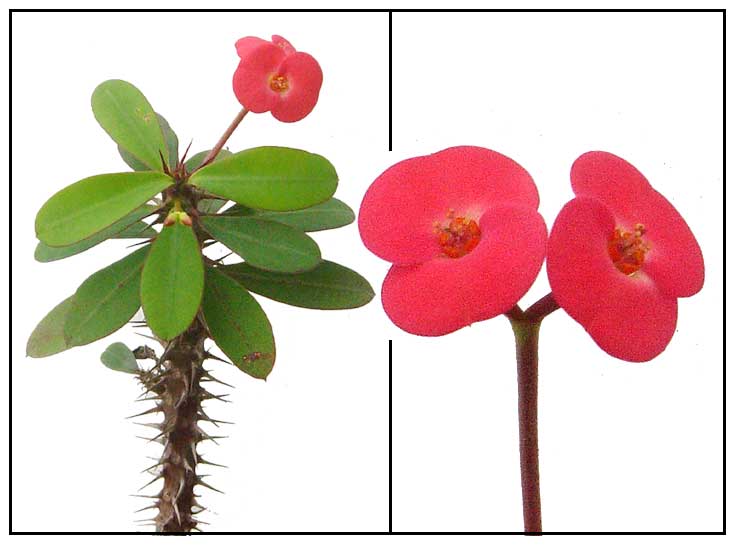
Corona de espina is an erect and branched shrub
growing up to a meter high, with cylindric or obscurely angled branches
lined with stiff, slender, divergent spines. Leaves are few, alternate,
pale green, oblong-obovate, or short acuminate, up to 5 centimeters long. Inflorescences
arise from the upper leaf axils and is peduncled with 2-4 involucres
in each peduncle, each involucre with 2 spreading red kidney-shaped
lobes.
Distribution
- Widely cultivated in settled
areas in the Philippines.
- Native to Madagascar.
Constituents
- Phytochemical screening of various extracts of E. milii red flowers for terpenoids, flavone and phenols yielded two triterpenoids, taraxerol (1), 28-hydroxyfriedelan-1,3-dione-29-oic acid (2), one flavone, quercetin 3-O-(2"-O-galloyl)-a-L-arabinofuranoside (3), and two phenolic compounds, 7 7'- dihydroxy, 8, 6'-bicoumarin (4), 9-acetyl-3'4'-dimethoxy dehydroconiferyl-3-alcohol (5). (10)
- Crude extracts of aerial parts yielded terpenoids, flavonoids, and tannins.
- Phytochemical screening of n-hexane, chloroform, ethyl acetate, petroleum ether and aqueous flower extracts yielded anthraquione, flavonoids, terpenoids, and phenol, with absence of alkaloids, tannins, reducing sugar, saponins, phlobatannins, steroids. (see study below)
(16)
- Bioassay guided fractionation of acetone extract of E. milii yielded 13 new ent-rosane diterpenoids (1-13). (see study below)
(24)
- GC-MS analysis of leaf essential oil yielded hexadecanoic acid, 2-hydroxy-1-(hydroxymethyl) ethyl ester, 6,9,12,15-docosatetraenic acid methyl ester. (see study below)
(27)
Properties
- Studies have suggested antibacterial, molluscicidal, antinociceptive, muscle relaxant, sedative , antiviral, insecticidal, antioxidant, antitumor properties.
Parts used
Flowers, latex.
Uses
Folkloric
• No reported folkloric
medicinal use in the Philippines.
• Popular use in
South Brazil as "dragon's
blood," the red latex from Christ's crown Euphorbia milii (Euphorbiaceae)
as a treatment for warts. (12)
• In Chinese
folk medicine, euphorbia compounds used in cancer treatment.
Studies
• Antibacterial:
In a study of 41 plants tested against E coli, Shigella spp, and Vibrios spp among others, Euphorbia milii was one of 28 that showed antibacterial
activity. (3)
• Aspergillus
Inhibition: Dry flower powder of Euphorbia milii
was found to have 100% total inhibition on aflatoxin-producing fungi
on agar-medium. The effect may be due to the interference of the simple
phenols and phenolic acids, quinones, flavones, flavonoids and flavanols,
possibly at the biosynthetic level. This may find application in the
elimination or control of aflatoxin contamination of foodstuffs, as
well as controlling aspergillosis, a large spectrum of disease caused
by members of genus Aspergillus. (1)
• Mollusicidal / Non-Teratogenic: Study of the embryofeto-toxicity of Crown-of-Thorns
(Euphorbia milii) latex, a natural molluscicide: The study
is a comprehensive safety evaluation of the embryotoxic potential of
E. milii. The crude latex of Euphorbia milii is a potent plant molluscicide
and a promising alternative to synthetic moluscicides used in schistosomiasis
control. The study concludes that the plant molluscicide poses no teratogenic
hazard. (2)
• Absence of Tumor Promoting Activity / Latex: Study showed the crude latex of E. milii does not act as a tumor promoting agent on the mouse back skin assay. (6)
• Antimicrobial / Flowers: Study evaluated various extracts of E. milii flowers for antimicrobial activity against Gram positive (B. subtilis, S. aureus) and Gram-negative (E. coli, P. vulgaris) organisms. Hexane, acetone, and methanol extracts at concentration of 5 µg/ml showed considerable inhibition on S. aureus and B. subtilis compared to EA and water extracts, with amikacin sulfate used as standard. (7)
Hexane extracts pf flowers at concentration of 5 µg/ml showed considerable inhibition zones compared to other extracts against gram positive organisms (B. subtilis, B. megaterium, S. aureus, Enterococci) and gram negative organisms (E. coli, P. vulgaris, P. aeruginosa). (see constituents above) (16)
• Antinociceptive / Aerial Parts: Study evaluated crude methanolic extract of aerial parts of Euphorbia milii for antinociceptive property. Results showed significant dose- and time-dependent attenuation of acetic acid induced writhing. (8)
• Gold Nanoparticles / Antinociceptive / Muscle Relaxant / Sedative / Aerial Parts: Study reports on the synthesis of gold nanoparticles of E. milii. The gold nanoparticles improved the potency of E. milii methanolic extract and exhibited significant antinociceptive effect, significant muscle relaxant and significant sedative effect. (9)
• Antinociceptive / Aerial Parts: Study evaluated various doses of E. milii extract for NKp46 expression in mice infected with MTB (Mycobacterium tuberculosis). NK cells have the dual role in the secretion of IL-22 which activate macrophages infected with M. tuberculosis and NKp46 expression which lyse macrophages infected with MTb. Results showed the ethanol extract of flowers of E. milii can increase the expression of NKp46 in lung tissue of mice infected with MTb. (11)
• Antioxidant / Antitumor / Flowers: Study evaluated the antioxidant and antitumor properties of ethyl acetate extract of E. milii flower against MCF-7 cell line induced breast cancer and CACO-2 cell line induced colon cancer in mice. Results showed the EA extract of E. milii flower was effective as antioxidant and chemopreventive. There was significantly decreased levels of lipid peroxidation and elevated levels of GSH, GPx, and catalase. Cancer specific parameters (Ferritin and CEA) also significantly decreased in the extract treated groups. (13)
• Silver Nanoparticles from Latex: In a study that evaluated eight latex-producing plants, four —J. curcas, J. gossypifolia, P. tithymaloides, and Euphorbia milii—showed high potential to produce physiochemically distinct, small-sized and bactericidal AgNPs. (14)
• Essential Oil / Insecticidial: Study evaluated the genetic toxicity and possible route of insecticidal action of botanical oils from leaves of Euphorbia milii and Cassia occidentalis. A total of 68 and 31 polymorphic bands were observed for chi-15 and E2 primers. Study suggest the insecticidal effect of the plant oils on insect pests may be through mutation in the DNA of test insects causing gene toxicity and eventual death. Results postulate another class of insecticides: "Genetic disruptor insecticides." (15)
• Narrow Spectrum of Biocidal Effects / Latex: Study evaluated the effects of E. milii latex on S mansonii eggs, miracidia and cercariae. Results showed E. milii latex had not effect on S. mansoni eggs and was slightly toxic to miracidia and cercarieae. Study suggests E. milii latex has a narrower spectrum of biocidal actions compared to NCL (niclosamide). (19)
• Not Effective Against Mosquito Larvae: Study of two extract formulations of stem extracts of E. milii did not show significant effect against mosquito larvae, Cx. quinquefasciatus, with 0.50% mortality. (20)
• Antiviral Against Ruminant Virus: The viral disease, Peste des petit s caused by PPRV is a havoc for ruminants in endemic areas. Study evaluated extracts and fractions of E. milii leaves for cytotoxic and antiviral activities against PPRV (Peste des petits ruminants virus) using Vero cell line and MTT assay. The methanol extract and its chloroform fractions showed significant (p<0.05) virucidal potential. The effect could be linked to the presence of quercetin, rutin, myricetin and kaempferol. Further isolation of constituents from fractions may open new horizons for development of new antiviral agents. (21)
• Zinc Oxide Nanoparticles / Antinociceptive, Muscle Relaxant and Sedative: Study reports on the synthesis of ZnO NPs using Euphorbia milii aqueous extract. The NP displayed important muscle relaxant impart in the rota-rod experiment, a sedative impact in open-field experiment, along with antinociceptive impact. (22)
• Natural Indicator in Acid-Base Titration / Flower: Study evaluated a methanolic extract of E. milii flowers in different types of titrations. Results showed E. milii can be an excellent natural replacement for synthetic indicators. They are economical, easily available, non-toxic, easy to extract, economical, accurate in all types of acid-base titrations. (23)
• ent-Rosane Type Diterpenoid / Inhibition of EBV-Lytic Replication: Study evaluated ent-roasane diterpenoids through bioassay guided fractionation and its effect on Epstein-Barr virus (EBV) DNA lytic replication. Compounds 1 (eupominoid A) ,2, 3 and 10 displayed inhibitory capacity with EC50 values ranging from 5.4 to 29.1 µM. Compound 2 showed the most potent inhibitory activity with EC50 of 5.4 compared to positive control rutamarin at 5.4 µM. This is the first report of ent-rosane type diterpenoid exhibiting significant inhibition of EBV lytic replication. (see constituents above) (24)
• Degradation of Trimethylamine: Trimethylamine (TMA) is a volatile organic compound which causes unpleasant odors and health concerns to humans. Average TMA emission from food and fishery industries is 20.60 parts per billion (ppb) and from gas exhausters, up to 370 parts per million (ppm). In a study of 13 plants exposed to 100 ppm, GC-MS study showed E. milii was the most superior plant for TMA removal, absorbing up to 90% of TMA within 12 h. E. milii absorbed TMA via leaf and stem with 55% and 45% uptake efficiency, respectively. Fatty acids, alkanes, and fatty alcohols in the plant leaf wax may also contribute to TMA absorption. Leaf was, stomata, and other leaf constituents contribute 58, 6, and 36%, respectively of total TMA absorption by the leaf. Study of plant metabolites confirmed TMA was degraded and mineralized by E. milii. (25)
• Comparative Toxicity of E. milii Latex and Synthetic Molluscicides: Study compared the developmental toxicity of plant molluscicide (E. milii latex, LAT) with that of three synthetic molluscicidal compounds to Biomphalaria glabrata embryos. Although exhibiting a weak ovicidal effect, E. milii latex markedly impaired the development of snail embryos and produced anomalies. The marked embyotoxicity of E. milii possibly contributes to its effectiveness as a molluscicide. (26)
• Insecticidal / Leaf Essential Oil: Study evaluated the insecticidal efficacy of oils from leaves of Euphorbia milii and C. occidentalis on selected insect pests. Results showed contact insecticidal activity of E. milii oil at LD50 and LD90 (mg/kg) of 0.583 and 1.108 for Periplaneta americana, 0.681 and 1.215 for Tettigonia viridissima, 0.488 and 0.893 for Anopheles gambiae. Results showed the oils possess bioactive metabolites with commendable degree of insecticidal activity. (see constituents above) (27)
Availability
Cultivated.
|