Botany
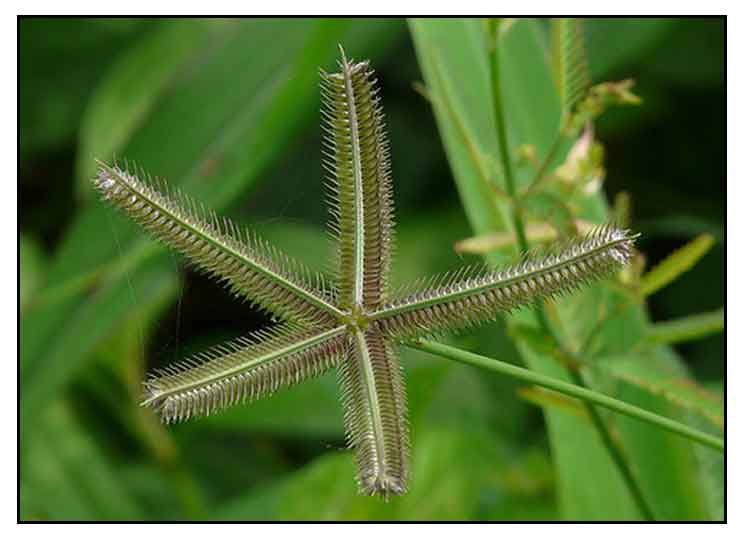
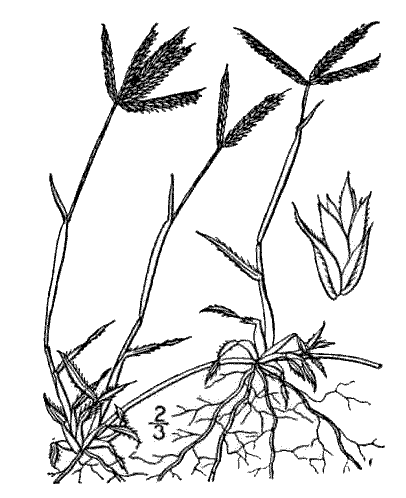
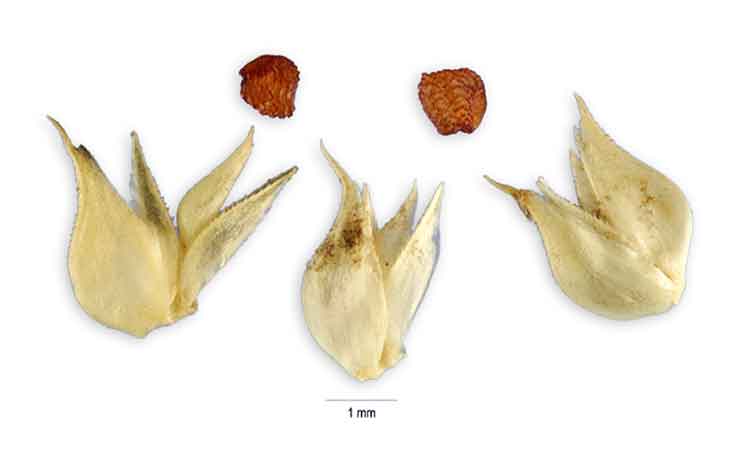
Damung-balang is a rather coarse grass, variable in habit, 15 to 60 centimeters high, the basal parts decumbent, usually more or less creeping and rooting, the flowering stems erect or ascending. Leaves are narrowly linear, 5 to 18 centimeters long, 2 to 6 millimeters wide, with the sheaths loose, and imbricate. Spikes number 3 or 4, rarely only 2, digitately radiating from the top of the peduncle, 1 to 5 centimeters long, 5 to 7 millimeters thick. Spikelets are numerous, and densely crowded, spreading, and about 3 millimeters long, 3- to 4-flowered, the first glume ovate and acute, the second, obliquely awned. Flowering glumes are cuspidate-
awned, the cusps recurved.
 Distribution Distribution
- A common weed throughout the Philippines in settled areas at low and medium altitudes.
- Pantropic in distribution.
Constituents
- Ash (6.9%) is rich in lime (20.67%) with SiO (24.17%) and chlorine (6.76%).
- Reported to contain cyanogenetic glycosides.
- Phytochemical screening yielded saponins, terpenoids, phenolics, alkaloids.
- Ethanolic extract yielded alkaloids, saponins, tannins, steroids, flavonoids, anthraquinones, cardiac glycosides, and reducing sugars. (see study below) (16)
- Nutrient analysis yielded a high crude protein, and low moisture and ash content.
- Study of aerial parts isolated three new compounds, namely: 5-hydroxypyrimidine-2,4 (3H,5H)-dione [6], 6'Glyceryl asysgangoside [8], and 2 amino, 2 methyl,(5,6 di hydroxymethyl ), 1,4 dioxane [11], along with nine known compounds, P. hydroxy benzaldhyde [1], tricin [2], P. hydroxy benzoic acid [3], vanillic acid [4], β-sitosterol-3-O-β-D-glucoside [5], asysgangoside [7] adenine [9], uridine [10] and sucrose [12]. (se study below) (20)
Properties
• Astringent, anthelmintic, tonic.
• Studies have shown apoptotic, antimicrobial, anti-ulcer, antiviral, anti-fertility properties.
Parts used
Whole plant, seeds.
Uses
Edibility
- A famine food in Africa. Not very palatable and not cultivated for that purpose.
- Seeds used for making chapaties or haluwa and eaten as a cooling agent.
- Seeds ground into a flour and cooked.
Folkloric
- Decoction of plant, in fresh or in dry state, used internally for dysentery and acute hemoptysis.
- In Africa, decoction of seeds used to relieve pains in the region of the kidney; stems and leaves applied externally for treatment of ulcers.
- In traditional Thai medicine, use for diuretic, anti-inflammatory and anti-pyretic effects.
- In India, juice of fresh plant used for fevers. Used externally for wounds and ulcers.
- In Indian medicine, grass is used for imparting medicinal properties of Takra (buttermilk) in intestinal, biliary, and urinary diseases. (5)
- In Manipur , juice of fresh plants prescribed in fevers. (2) Decoction of plant given in small pox. (6)
- In
Saudi folk medicine, whole plant used in treating wounds. (7)
- In India, decoction of grain used to alleviate pains in the region of the kidney; herbaceous parts applied externally to treat ulcers. (9)
- In Kenya, crushed leaves used for treatment of heartburn. Whole plant considered a healing vegetable and used in convalescing patients. (11)
- In Central Punjab, Pakistan, dried grain eaten by women suffering from bellyache after childbirth. Seeds used for treatment of typhoid fever. (12)
-Infusion of leaves used to accelerate childbirth.
(22)
Others
- Fodder: Fodder for all classes of ruminants.
- Rituals: Punghai considered by the Meitei tribe as a sacred plant; used in rituals.
 Studies Studies
• Anticancer / Human Lung and Cervical Cancer / Apoptotic Induction: Study of grass extracts of D. aegyptium and Eleusine indica showed selective inhibitory growth inhibition effect on human lung cancer and cervical cancer (HeLa) cells. The activity was probably mediated through induction of apoptosis. (1)
• Antimicrobial: Study evaluated methanolic extracts of nine medicinal plants from Saudi folk medicine for phytochemical compounds and antimicrobial potential against seven standard bacteria, viz., E coli, B. cereus, S. typhi, K. pneumonia, P. aeruginosa, S. aureus and fungus Candida albicans. Most of the plants, including D. aegyptium, showed some degree of antimicrobial activity. (7)
• Gastrointestinal Effects: Crude extract and fractions of D. aegyptium in spontaneous contracting rabbit jejunum preparation showed concentration dependent spasmogenic effect (0.01-0.1 mg/ml) followed by spasmolytic effect at higher doses (0.3-3.0 mg/mgL). Results suggest cholinergic as well as Ca++ channel blocking activity in the ethanolic extract. (14)
• Antibacterial: Study of extracts of
D. aegyptium for antibacterial activity showed maximum zone of inhibition for Pseudomonas aeruginosa and minimum zone of inhibition against Proteus vulgaris, E. coli and K. pneumonia. (15)
• Anti-Ulcer: Study evaluated an ethanolic extract of D. aegyptium for anti-ulcer activity against aspirin plus pylorus ligated induced gastric ulcer in rats, HCl-ethanol induced ulcer in mice and water immersion stress induced ulcer in rats. A significant (p<0.01, P<0.001) anti-ulcer activity was observed in all models. (16)
• Anti-Fertility: Study evaluated an ethanol extract of DA for anti-fertility effects on male albino rats. Results showed dose dependent antifertility effects as evidenced by decreased levels of sperm count, weight of reproductive organs, serum hormonal levels and number of implantations in female rats. (17)
• Antifungal: Study of an ethanol extract of D. aegyptium showed antifungal activity against Aspergillus niger compared to Griseofulvin. (18)
• Effect of Fermentation Time on Minerals of Bread from Seeds Flour: Study evaluated the invitro bioavailability of iron, zinc and calcium of koreeb seeds kisra. Phytic acid and oxilic acid contents were reduced due to effect of fermentation time. Fermentation enhanced the bioavailability of minerals. The bread can be source of easily available minerals for individuals with digestive disorders and also be used as a functional food in general. (19)
• Antiviral, Antimicrobial, Cytotoxic / Aerial Parts: Study of air-dried powdered aerial parts yielded 3 new compounds, namely: 5-hydroxypyrimidine-2,4 (3H,5H)-dione [6], 6'Glyceryl asysgangoside [8], and 2 amino, 2 methyl,(5,6 di hydroxymethyl ), 1,4 dioxane [11], along with nine known compounds. The n-hexane, ethyl acetate, and n-butanol fractions showed significant antiviral, antimicrobial, and cytotoxic activities. (see constituents above) (20)
• Toxicity by Brine Shrimp Lethality Assay: Study evaluated the toxicity of Crowfoot grains through Brine Shrimp Lethality Assay. Results showed the grains were extremely toxic to brine shrimp nauplii with an LC50 of 47.68%. Toxicity was attributed to the presence of cyanogenic glycosides. (21)
Availability
Wild-crafted.
|