Gen info
- Loranthus is a genus of parasitic plants that can grow on the branches of woody trees. It belongs to the Loranthaceae family, the showy mistletoe family.
- In the continuing taxon uncertainty, the number of species recognized in the genus Loranthus has varied widely. At one time it included almost all mistletoes.
,later splitting into many genera.
 Botany Botany
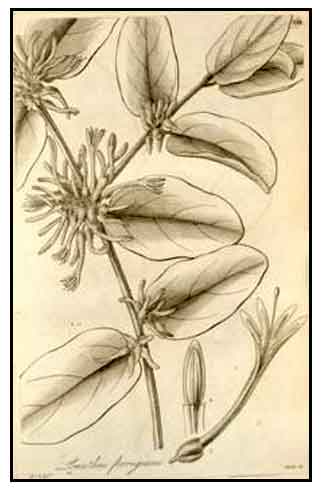
Dapong-kahoi is a bushy hemi-parasitic shrub. Branchlets and leaves beneath are densely covered with a tomentum of long- and short-branched hairs. Leaves are opposite, and shortly petioled, usually roundish-elliptical, 5 to 10 centimeters long, 2 to 5 centimeters wide, and smooth above when old. Inflorescence is usually 2- to 5-flowered. Flowers are 1.2 to 2.5 centimeters long, in axillary, stalkless or short-peduncled fascicles. Calyx tube is obovate or pear-shaped, 2.5 to 3.5 millimeters long, with the limb entire. Corolla is slender, 7 to 17 millimeters long, with the tube split, and with 4 lobes. Fruit is clavate, 8 to 10 millimeters long, 3 to 4 millimeters thick, and hairy.
Distribution
- A parasitic on miscellaneous trees in many islands, in open forests only a low altitudes in Palawan.
- Also occurs in the China, Cambodia, Indonesia, Laos, Malaysia, Burma, Thailand and Vietnam.
Constituents
- Phytochemical studies have shown indicated presence of flavonoids and high concentrations of condensed tannins. Three natural flavonol compounds were isolated from an ethyl acetate fraction i.e., quercetin and quercetrin, and an unusual flavonol glycoside 4'-O-acetylquercetrin. (11)
Properties
- Studies have suggested vascular relaxant, antihypertensive, cholinomimetic, antiviral, cytotoxic, anti-inflammatory, anticancer, apoptotic properties.
Parts used
Leaves.
Uses
Folkloric
- Plant decoction used for malaria.
- Plant decoction used for treatment of hypertension and gastrointestinal complaints. (11)
- Poultice of leaves used for wounds and snake bites.
- Decoction of leaves used as protective medicine after childbirth.
- In Malaysia, used as postpartum protective remedy; also to treat malaria, wounds and snakebites.
- Plant decoction used as home remedy for health maintenance
, enhancement of memory and well-being in the elderly. Leaves, fruits, and flowers are commonly used for hypertension, while roots are used for ulcer and cancer treatment. (11)
- Used for treatment of inflammation, rheumatism, and stroke.
Studies
• Vascular Relaxation / Anti-Hypertensive: Study of n-butanol fraction of methanol extract of Loranthus ferrugineus showed it induced vascular relaxation by stimulating muscarinic receptors, activating the endothelium-derived nitric oxide-cGMP-relaxant pathway, promoting prostacyclin release. Results support its traditional use as anti-hypertensive agent. (1)
• Cholinomimetic Effect: Study of a methanol extract of L. ferrugineus in isolated guinea pig ileum showed a spasmogenic effect probably mediated through a direct action on intestinal muscarinic receptors. (2)
• Antihypertensive / Vasoconstriction Modulation: Study investigated the mode by which LF methanol extract antagonizes or modulates norepinephrine-induced vasoconstriction in rat aortic rings. Results showed LF ME exerted its vascular effect by reversible noncompetitive antagonism of norepinephrine-induced vasoconstriction, providing a mechanism for its antihypertensive effect. (3)
• Antiviral / Cytotoxic: Extracts of Scurrula ferruginea have been found to have antiviral activity against herpes simplex virus and poliovirus. Extracts were also cytotoxic against murine Lewis lung carcinoma, mouse lymphocytic leukemia (LI210), human erythromyeloblastoid leukemia (K562), human glioblastoma (U251), human prostatic carcinoma (DU145) and human breast adenocarcinoma (MCF-7) cells. (5)
• Flavonols / Cytotoxicity: Ethyl acetate fraction of Scurrula ferruginea yielded an unusual flavonol glycoside 4"-O-acetyl- quercitrin, together with quercetin and quercitrin. On cytotoxic evaluation on four human cancer lines, quercetin was the most active with an IC50 of 35 µm on U251 (human glioblastoma cells). (6)
• Vasorelaxant / Blood Pressure Lowering Activity: Study evaluated various extracts of aerial parts for blood pressure lowering activity in in vitro and in vivo animal models. Results showed the methanol extract to be most active in blood pressure lowering activity in anesthetized normotensive Sprague Dawley rats. The hypotensive effect was dose dependent which could be due to vasodilation mechanism and attributable to the high polyphenolic content of the plant. (7)
• Cardiovascular Effects: Study evaluated active fractions of L. ferrugineus and mechanisms of cardiovascular effects. Results suggest L. ferrugineus induced cardiovascular effects by stimulating muscarinic receptors, activating endothelium-derived nitric oxide-cGMP-relaxant pathway, promoting prostacyclin release and/or possibly through lengthening of NO half life. (8)
• Cardiovascular Effect / Vascular Relaxant and Hypotensive Effect: Study showed an n-butanol fraction of a methanol extract of L. ferrugineus was the most potent fraction in producing a concentration-dependent relaxation in vascular smooth muscle in vitro and a dose dependent blood pressure lowering effect in vivo. The effects are most likely attributable to its terpenoid content. (10)
• Hypotensive / Spasmogenic: Study evaluated a methanol extract for blood pressure lowering effect in in anesthetized Sprague Dawley rats and spasmogenic effect in isolated guinea pig ileum. The LFME dose dependently decreased mean arterial pressure. The LFME also produced dose-dependent contractile effect in guinea pig ileum. Results suggest a marked hypotensive effect that can be attributed to to stimulation of muscarinic receptors and/or stimulation of of nitric oxide (NO) release. The considerable spasmogenic effect was attributed to its cholinergic properties. (12)
• Antioxidant / Antimicrobial / Leaves, Stems and Flowers: Study evaluated extracts of flowers, leaves, and stems of S. ferruginea for total phenolic content, antioxidant and antibacterial activities. Results showed the stem extract with the highest total phenolic content (309.069). All extracts exhibited antioxidant activity in a dose dependent manner using DOH radical scavenging assay. The stem extract also found to chelate Fe2+ better than others. By disc diffusion assay, all extracts exhibited moderate inhibition against selected bacteria, with the stem extract showing the most significant MIC and MBC values. (15)
• Anti-Inflammatory / Parasitizing on Tecoma stans: Study evaluated the anti-inflammatory activity and mechanism of freeze-dried stems\ aqueous extract of S. ferruginea parasitizing on Tecoma stans. Activity was assessed via inhibition of inflammatory cytokines interleukin-1ß, IL-6, IL-10 and tumor necrosis factor-alpha (TNF-α) production in lipopolysacharide (LPS) and interferon-y (IFN-y) stimulated RAW 264.7 macrophages. Results showed anti-inflammatory capability attributed to inhibition of iNOS and IL-1ß mRNA expression, NO creation, IL-1ß, IL-6, IL-10 and TNF-α protein production. Study suggests a plant-derived candidate for treatment of inflammation. (16)
• Effect of Drying Methods on Antioxidant Activity / Leaves: Study evaluated the the effect of different drying methods and extraction solvents on total phenolic content and antioxidant activity of leaves. Oven drying (60°C) using 80% acetone gave the optimum extract yield, phenolic content (TPC an TFC) and antioxidant activity by DPPH and FRAP. There was a significant positive correlation among TPC/TFC (p<0.05), DPPH (p<0.01), FRAP (p<0.01) and extract yield (p<0.01) under the influence of drying methods and extraction solvents. (17)
• Apoptotic / Breast Cancer / Antioxidant / Leaves: Study evaluated the antioxidant and cytotoxic activities of S. ferruginea extracts. Extracts showed potent antioxidant activities, and high phenolic and flavonoid contents. A methanol extract showed highest phenolic content (273 mg gallic acid/g extract) and flavonoid content (163 catechin/g extract_ and strong DPPH radical scavenging (IC50-27.81 µg/mL) and metal chelating activity (IC50= 80.20 µg/mL). A stem methanol and aqueous extracts showed dose-dependent cytotoxic activity against MDA-MB-231 cells with IC50s of 19.27 and 50.35 µg/mL, respectively. The extracts inhibited migration and colony formation of the MDA-MB-231 cells in a concentration dependent manner. Morphological observations suggested apoptosis in the treated cells. The methanol extract induced increase in ROS generation and mitochondrial depolarization, suggesting potential apoptotic activity. Results suggest a potential anticancer agent. (18)
Availability
Wild-crafted. |