 Botany Botany
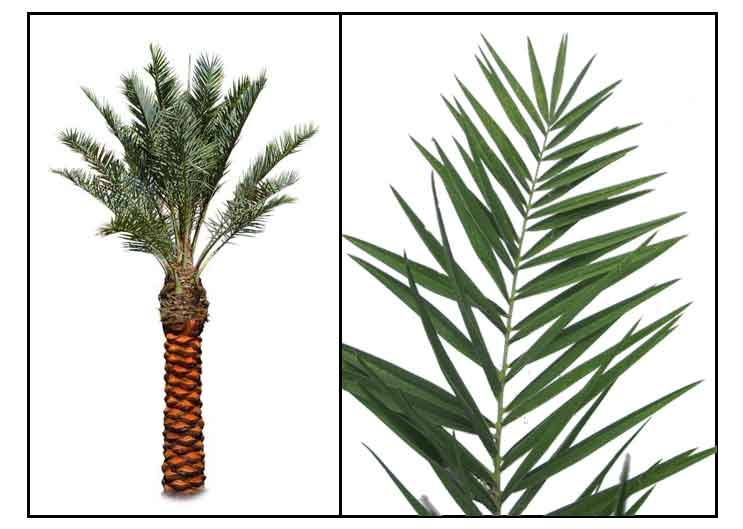
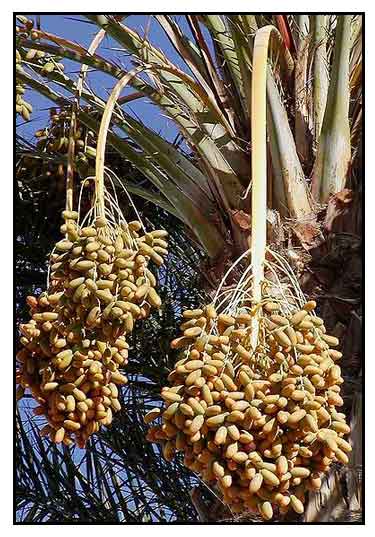
Date palm is a tree growing up to 30 meters high. Trunk is slender, with distinct petiolar scars. Leaves are erect-ascending at the upper part of the crown, down-descending at the lower part of the crown, and long-petioled. Leaflets are narrow-lanceolate, stiff and grayish-glaucous. Inflorescence is produced among the leaves, with a single bract at the base. Flowers are small, yellowish and borne singly. Fruit is cylindrical or oblong-ellipsoid, with edible flesh.
 Distribution Distribution
- Planted as an ornamental in the Philippines.
- Native to West Asia and North Africa.
Constituents
- High caloric content with more essential minerals and vitamins than most other fruits.
- Date palm fruits yield a high percentage of carbohydrates (total sugars, 44-88%), fat, 0.2-0.5%; protein, 2.3-5.6%; 15 kinds of salts and minerals, vitamins, and a high percentage of dietary fiber, 6.4-11.5%.
- Flesh of fruit yields 0.2-0.5% oil; seeds yield 7.7-9.7% oil.
- Yields various minerals: boron, calcium, cobalt, copper, fluorine, iron, magnesium, manganese, potassium, phosphorus, sodium, and zinc. Also contains elemental fluorine and selenium.
- Contains at least six vitamins, including C, B1 (thiamine), B2 (riboflavin), nicotinic acid (niacin), and vitamin A.
- Yield phenolic compounds, mainly cinnamic acids, and flavonoids (flavones, flavonols, and flavanones).
- Phytochemical screening yielded flavonoids, carbohydrates, and/or glycosides, sterols and/or triterpenes. In addition, other active constituents such as tannins, saponins, sterols and/or triterpenes, alkaloids and coumarins were present in date palm tissues (shoot tip, pollen grain, leaves, fruits, callus).
Properties
- Considered tonic, aphrodisiac, antioxidant, purgative.
Parts used
Fruits, pits, flowers, pollen.
Uses
Edibility / Nutritional
- Fruits are edible.
-
High caloric content with more essential minerals and vitamins than most other fruits.
- High magnesium content; a natural source of folic acid.
Folkloric
- No reported folkloric medicinal use in the Philippines.
- In other medicinal practices, used as a tonic.
- Used for fever, colds, cystitis, edema, sore throat, liver cancer, low sperm count. Seeds used as paste to relieve ague Gum used to treat diarrhea. Roots used for toothaches.
(9)
- Flowers used as a purgative.
- Used as aphrodisiac.
- Egyptians have been reported to have used pollen grains to improve fertility in women.
- Middle Easterners consume the date in the morning on an empty stomach to reverse toxicity exposures.
- In Tunisia, used for constipation.
Others
- Animal Feeds: Date pits have been included in animal feed to enhance growth, an action attributed to an increase in plasma levels of estrogen or testosterone.
 Studies Studies
• Hepatoprotective / CCl4-Toxicity: Study of aqueous extracts of the flesh and pits of dates (Phoenix dactylifera) showed significant reduction of CCl4-induced elevation in plasma enzyme and bilirubin concentration and ameliorated morphological and histological liver damage in rats. (1)
• Storage Effect on Antioxidants: Study evaluated the antioxidant activities of the edible parts of the date palm fruits from Iran. Dry date variety had the highest antioxidant activity (AA), total phenolic content (TPC), and total flavonoid content (TFC). Antioxidant compounds (phenolics and flavonoids) of dates increased following storage. (3)
• Male Fertility: Study of Phoenix dactylifera date palm pollen (DPP) on Sprague-Dawley rats showed consumption of a pollen suspension improved the sperm count, motility, and morphology, and DNA quality with increase in weights of the testis and epididymis. Results suggest DPP seems to cure male infertility by improving the quality of sperm parameters. (4)
• Neurobehavioral Effects: Study of neurobehavioral effects of methanolic extract of fruits in mice showed considerable reduction in exploration time, increased discrimination index, potentiation of haloperidol-induced catalepsy, and reduced onset of death in sodium nitrite-induced respiratory arrest. Results suggest a wide range of CNS activities. (5)
• Hepatoprotective / Thioacetamide-Induced Toxicity: Study showed the thioacetamide-induced liver damage in rats can be ameliorated by administration of extract of date flesh and ascorbic acid. (6)
• Antioxidant Effects / Fruits: Study showed a hydromethanolic extract of PD fruit showed good antioxidant activity, reducing power, free radical scavenging activity and hepatic protection. The antioxidant potential was attributed to phytoconstituents (flavonoids, saponins, tannins, steroids) and vitamin C. (7)
• Neuro-Activity Effects: Study of a methanolic extract of fruits and pits showed effectiveness with inhibition of selective serotonin reuptake, prevention of the immune system hyperactivity, oxidative stress profile, with lipid effects, and improved the sucrose consumption, which play a role in improving the etiology of depression. (8)
• Neuroprotective: Study evaluated neuroprotective effect in a cerebral ischemia induced model in brain of rats occlusion/reperfusion of cerebral/carotid arteries. In rats treated with date palm fruit extract, a neuroprotective effect was suggested by significant reduction of neuronal damage with increase in levels of endogenous antioxidants. (10)
• Haemopoietic Activity: Study investigated the haemopoietic activity of crude methanolic and crude aqueous extract of fruit on peripheral blood parameters in Wistar rats. Results showed dosage dependent increase in absolute values, RBC, Hb, Hct, reticulocytes and platelet counts. (11)
• Aphrodisiac Activity: Study evaluated the effect of an aqueous extract of Phoenix dactylifera pollen on sexual behavior of male rats. All test doses stimulated male sexual behavior, with significant increase in mount, ejaculation, intromission frequencies and ejaculation latency. Activity was attributed to alkaloids, saponins, and/or flavonoids which has engorging and androgen enhancing effects. (12)
• Antidiarrheal / Fruit: Study evaluated the antidiarrheal activity of an aqueous fruit extract of Phoenix datylifera on castor oi-induced diarrhea, enteropooling and gastrointestinal motility activity in Wistar rats. Results showed significant decrease in frequency of defecation and decreased gastrointestinal motility. It showed greater anti-enteropooling effect than standard drug loperamide. (13)
• Effect of Seed Extract on Paraoxonase and Arylesterase: Paraoxonase 1 (PON1) is a HDL-associated enzyme, displaying esterase and lactonase activity. Study evaluated the effects of methanolic date seed extract on paraoxonase and arylesterase activities in hypercholesterolemic rats. The DSE significantly increased serum paraoxonase and arylesterase activity. Results suggest the DSE may be useful in decreasing the symptoms of diseases resulting from low activity of paraoxonase. (14)
• Antimicrobial Synergism / Phoenix dactylifera and Annona squammosa: Combination of extracts of P. dactylifera and A. squamosa showed a strong synergistic effect against most of the testpathogens viz. Klebsiella pneumonia, Staph aureus, E. coli, Salmonella typhi, Enterococcus faecalis. (15)
• Anti-Obesity: Study evaluated an aqueous extract for anti-hyperlipidemic effect in high fat diet (HFD)-induced obese albino rats. Administration of the extract reversed the altered parameters caused by the HFD to normal levels indicating an anti-hyperlipidemic effect. Results suggest P. dactylifera may be a valuable diet option against obesity. (16)
• Repellent / Yellow Fever Mosquito/ Spathe Essential Oil: Study evaluated P. dactylifera spathe essential oil and its repellent activity. The oil showed promising activity against yellow fever mosquito—Aedes aegypti. Sixteen components were characterized, constituting 99% of the oil. Of the five major compounds, 3,4-Dimethoxytoluene and 2,4-dimethoxytoluene showed the best repellent activity. (18)
• Immunostimulatory: Study evaluated in in vivo immunostimulatory properties of P. dactylifera "AZARZA" variety by the carbon clearance rate test. There was significantly increased phagocytic and antioxidant activity in animals injected with the extract. Results showed an immune-stimulatory effect on the reticuloendothelial system and antioxidant activity. (19)
• Antioxidant / Antimutagenic: Study evaluated the antioxidant and antimutagenic in vitro properties of aqueous extract date palm. Results showed dose-dependent inhibition of superoxide and hydroxyl radicals. Date fruit extract also produced a dose-dependent inhibition of benzo(a)pyrene-induced mutagenecity on Salmonella tester strains. Results indicated potent antioxidant and antimutagenic activity in date fruit and suggests the presence of compounds with potent free-radical scavenging activity. (20)
• Effect on Progesterone and Estrogen: Study evaluated the effects of date pollen on serum density of estrogen, progesterone, and gonadotropin in female rats. Results showed Phoenix dactylifera increases estrogen and progesterone, but has no effect on gonadotropins. (22)
• Gastrointestinal Stimulatory Activity: Study evaluated the effects of dates pulp extract and palm sap on gastrointestinal activity in healthy adult rats. The date pulp extract significantly and dose dependently increased GIT activity while the palm sap slightly increased it. (23)
• Effect on Sperm Parameters and Reproductive System: Study evaluated the effects of orally administered date palm pollen on the reproductive system of adult male rats. Results showed improved sperm count, motility, morphology and DNA quality with an increase in weights of the testis and epididymis.(24)
• Anti-Inflammatory / Antiproliferative / Pollen: Study evaluated the effect of DPP suspension and extract on APH (atypical prostatic hyperplasia)-induced rats. Results showed a potential protective effect in APH-induced Wistar rats through modulation of cytokine expression and/or upregulation of their autrocrine/paracrine receptors. (25)
Availability
Wild-crafted.
|