 Botany Botany
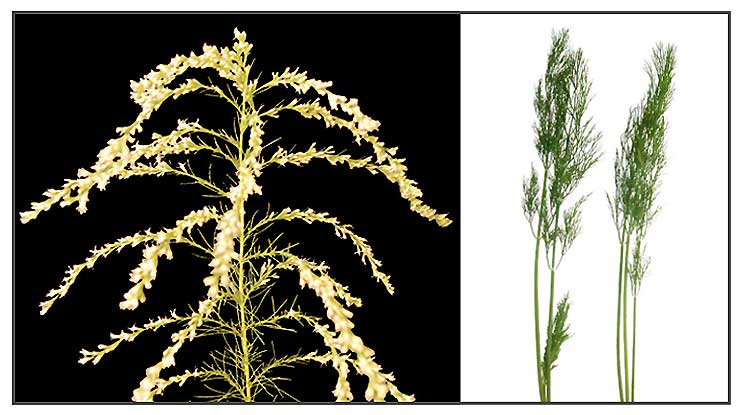
Dill an annual plant growing up to 90 centimeters in height. Stems are slender. Leaves are filiform, dividing into three or four pinnate sections, similar and slighter broader than fennel leaves.
Flowers are yellow umbels producing oval dill seeds. Seeds are small, flat, with a pleasant aromatic odor. Fruits are oval, compressed, winged, about 2 centimeters wide, with three longitudinal ridges on the back and three dark lines on the flat surface.
 Distribution Distribution
- Cultivated for culinary spice use.
Properties
- Has the medicinal value
of caraway and aniseed.
- Antihalitosis, antispasmodic, diuretic, carminative, galactagogue, and
stomachic.
- Studies have suggest antibacterial, antioxidant, hepatoprotective, hypolipidemic, antibacterial, antifungal, antispasmodic, antiulcer, antisecretory, repellent, antimycobacterial, hypoglycemic, anti-inflammatory, hematopoietic, anticonvulsant properties.
C onstituents onstituents
- Phytochemical analysis of seeds, leaves, and roots yielded tannins (SLR), terpenoids (SLR), saponins (S), steroid (LR), flavonoid (SLR), cardiac glycosides (SLR), and anthraquinone (S). (14) (15)
-
Fruits contain essential oils (carvone, limonene, phellandrene including pinene, diterpene, cineole, myrcene, myristin, apiol among others.
- Yields essential oils, fatty oil, proteins, carbohydrates, fiber, and mineral elements (calcium, potassium, magnesium, phosphorus, sodium, vitamin A and niacin).
- Seeds yield essential oil, coumarins, flavonoids, phenolic acids, and steroids.
- Seeds yield various volatile compounds. Carvone is the predominant odorant of dill seed, together with α-phellandrene, limonene, dill ether and myristicin.
- Study of hydrodistilled volatile oil from the aerial parts yielded 28 components representing 99.76% of the total chemical composition of the oil, The unsaponifiable matter and fatty acids methyl esters of the aerial parts yielded sitosterol (3.92%) as the major sterol, followed by campesterol (2.50%) and stigmasterol (2.01%) and n-dotriacontane(58.40%). Linoleic acid (20.51%) was the major fatty acid present followed by nonadecanoic acid (9.95%). (19)
- Essential oil of freeze-dried dill herb isolated by hydrodistillation solvent extraction and CO2-extraction, and analyzed by GLC-MS and head space gas chromatography (HSGC) yielded 50 compounds. Best results was achieved by HSGC, with 3,6-dimethyl-2,3,3a,4,5,7a-hexahydrobenzofuran as the most important aroma compound. (28)
- Genetic variability of major essential oil constituents in a germplasm collection of dill was characterized. Oil content ranged from 0.10% to 0.30% (v/fw) and in dill seed 1.75% to 4.0% (v/dw).
Three major constituents of dill herb oil were α-phellandrene,, ß-phellandrene, and 3,9-oxy-p-methyl-1-ene (dill ether) comprising 90% to 97% of total oil constituents. The major constituent in dill seed oil were carvone and dihydrocarvone comprising 68 to 83% of total oil constituents. Limonene ranged from 14.18% to 21.43%. (30)
- GC-MS analysis for volatile components yielded main constituents of 7-α-hydroxy manool (24.43%), l-carvone (14.28%), limonene (13.9%), epi-α-bisabolol (6.81%), α-terpinene (5.44%), and α-phellandrene (4.63%) and minor constituents of p-Cymene (2.13%), sabinene (1.98), and α-pinene (1.43%): (see study below) (35)
- GC-MS analysis of dill seed by
supercritical CO2 yielded 6.7% essential oil. Out of 37 compounds, main constituents were D-carvone (40.36 %), D-limonene (19.31 %), apiol (17.50 %), α-pinene (6.43 %), 9-octadecenoic acid (9.00 %) as well as 9,12-octadecadienoic acid (2.44 %). (43)
 Parts
used Parts
used
Seeds, leaves.
Uses
Culinary
- A preferred kitchen spice.
- Dill oil, extracted from seeds, leaves, and stems, yield an essential oil used as flavoring in the food industry. (14)
Folkloric
- Infusion of the seed used
for insomnia.
- Infusion also used for stomach acidity, flatulence, dyspepsia, colic.
- The seed boiled in olive oil and applied warm over furuncles hastens
suppuration and provides pain relief.
- Nursing mothers use the dill to increase milk flow.
- Chewing of the seeds helpful in halitosis.
- Decoction of the herb used for colic in babies. Seed decoctions are
more potent and should be adjusted accordingly.
Others
• Repellent: Some compounds, d-carvone for example, is added to insecticides
to increase effectivity.
• Oil / Perfume: Seed contains up to 4% essential oils used in perfuming soaps, medicines
and food flavoring.
• Ancient Use: In the Middle Ages, used to protect against witchcraft. Greeks covered their heads with dill leaves to help induce sleep. (14)
• New Use: Used for menstrual cramps. (see study below)
 Studies Studies
•
Hypolipidemic: Often touted as antihyperlipidemic, a study showed Anethum graveolens
had no significant effect on lipid profile. (1) In contrast to the above
study, an Iranian study concluded that Anethum graveolens has significant
lipid lowering effects and is a promising cardioprotective agent. (4)
• Antibacterial / Phytochemical: Phytochemical screening showed alkaloids, flavonoids, tannins, saponins and cardiac glycosides. Hot water and acetone seed extracts showed good antibacterial activity against all bacteria except K pneumoniae and one strain of P aeruginosa.
• Antispasmodic: Study showed
that dill fruit extract is a potent relaxant of contractions induced
by various spasmogens. The spasmolytic effect may be through calcium
channels. Study supports its traditional use for gastrointestinal disorders. (2)
• Antifertility / Menstrual Regulation:
The study suggests dill can be used as a regulatory agent of
the menstrual cycle or as an antifertility agent. (3)
• Gastric Mucosal Protective / Antisecretory:
Study suggests that A. graveolens seed extracts have significant
mucosal protective and antisecretory effects of the gastric mucosa in
mice. (6)
• Genotoxicity: Essential oils
from dill herb and seeds induced dose-dependent CA (chromosomal aberration
and sister chromatid exchange tests (SCE). All essential oils studied
were cytotoxic to human lymphocytes. In the SMART test, the essential oil from dill seeds was almost inactive. (7)
• Repellant: Seed or
fruit extract of A. graveolens exhibited varying degrees of biologic
effect on the adults of S oryzae and T confusum. (8)
• Antimycobacterial: Study
isolated a new furanocoumarin and three known compounds, oxypeucedanin,
oxypeucedanin hydrate and falcarindiol, from the whole herb of A. graveolens.
The three known compounds exhibited antibacterial activity against a
panel of mycobacteria. (9)
• Antibacterial / Antiulcer / Anti-H pylori: Study showed A graveolens with moderately potent anti-H pylori activity and suggests a potential as a curative anti-ulcer agent. (11)
• PM52 / Cognitive Benefits / Alzheimer's Disease: Study evaluated the protective effect of a combined extract of Cissampelos pareira and Anethum graveolens, against age-related cognitive impairment in animal model of age-related cognitive impairment. All doses of PM52 could attenuate memory impairment and neurodegeneration in the hippocampus, possibly through suppression of AChE and decreased oxidative stress in the hipoccampus. Results suggest a potential as food supplement to protect against age-related cognitive impairment like MCI and Alzheimer's. (12)
• Anti-Inflammatory / Oil-Based Dill: Study evaluated the effects of aerial organs' extract and seed on inflammation caused by plantar injection of formalin in rats. Results showed significant decrease in paw volume (p<0.001). (17)
• Hypoglycemic / Hematopoetic Potential / Seeds: Study evaluated the hypoglycemic and hematopoetic potential of seed extracts of A. graveolens in alloxan-induced diabetic mice. Aqueous and ethanol extracts caused a significant decrease in blood glucose. Both extracts and carvone (a monoterpene constituent of dill oil) showed beneficial effects on hematological parameters. (18)
• Antibacterial / Essential Oil / Aerial Parts: Study of essential oil from aerial parts exhibited significant antibacterial activity against gram positive and gram negative bacterial, as well as moderate antifungal effect. (see constituents above) (19)
• Improved Insulin Sensitivity and Lipid Profile: Study investigated the effects of Anethum graveolens supplementation on insulin sensitivity, fasting blood glucose and lipid profile of type diabetic patients. Results showed significant reduction in insulin level and significant decreases in total cholesterol and LDL-C. (20)
• Bioadsorption of Lead from Contaminated Wastewater: Study reported the feasibility of Anethum graveolens as biosorbent to remove Pb(II) from aqueous solution. Results showed a high adsorption capacity that ranks A. graveolens as one of the best adsorbents for the removal of Pb(II) from aqueous affluents. (21)
• Infertility Effect / Seed: Previous studies have shown A. graveolens caused some changes in female reproductive system that induced infertility. In this study, results showed a dill seed aqueous extract can induce infertility without any effect on oocyte structure. (22)
• Oral Safety Evaluation: Study evaluated the safety profile of a total hydroalcoholic extract in acute, subacute, and subchronic treatment periods in mice. In acute study, doses up to 2000 mg/kg did not cause any mortality; in subacute study, doses up to 1000 mg/kg did not cause toxic effect. In a 45-day regimen with doses of 1000 mg/k/d, there was significant reduction in FBS in the high dose female animal group. Doses less than 50 mg/kg can be considered safe in both mice genders. (23)
• Anticonvulsant Effect / Leaves: Study evaluated an aqueous extract of A. graveolens leaves in the treatment of convulsions and epilepsy in a PTZ (pentylenetetrazole) model in mice. Results showed a noticeable anticonvulsant effect. (24)
• Antifungal Against Candida albicans / Essential Oil from Seeds: Study evaluated the antifungal mechanism of dill seed essential oil against Candida albicans. Results indicate the cytoplasmic membrane and mitochondria are the main anti-Candidal targets of dill seed essential oil. (25)
• Effect on Markers of Metabolic Syndrome / Clinical Trial: A randomized double-blind controlled trial evaluated the effect of 12 weeks of Anethum graveolens on metabolic markers in 24 patients with metabolic syndrome. Present study showed the dill extract resulted in significant reduction in triglyceride levels from baseline to 12 weeks. However serum TG was not significantly different in dill group compared to placebo. However, dill treatment was not associated with significant improvement in metabolic syndrome related markers compared to control. (26)
• Effect on Markers of Metabolic Syndrome / Clinical Trial: Anethum graveolens has been reported to have hypolipidemic and hypoglycemic effect, and to reduce the incidence of diabetic complications. Study summarizes and highlights the pharmacological and therapeutic effects of AG in the management of diabetes. Although all components of AG have antioxidant, hypoglycemic, and hypolipidemic effects, these components are at low levels in dill, and possibly have synergistic effects. Studies also suggest that activation of LDL-R, PPAR-alpha, and other FA oxidation-related genes and also inhibition of HMG-CoA reductase contribute to the hypolipidemic effects of AG. (27)
• Effect on Clinical and Metabolic Status of T2 Diabetic Patients / Dill Powder / Clinical Trial: Study evaluated the effects of AG dill powder supplementation on glycemic control, lipid profile, some antioxidants and inflammatory markers, and gastroitestinal symptoms in 42 patients with Type 2 diabetes. Results: Dill powder supplementation significantly decreased the mean serum levels of insulin, homeostatic model assessment of insulin resistance, LDL-cholesterol, total cholesterol, and malon-dialdehyde in the intervention group (p<0.05). Mean serum levels of HDL and total antioxidant capacity were significantly increased (p<0.05). Colonic motility disorder symptom was significantly reduced by supplementation (p<0.01). (29)
• Effect on A. graveolens and Oxytocin on Induction of Labor / Clinical Trial: Oxytocin is the most common medicine used for induction of labor, which however is sometimes ineffective, and has maternal and fetal side effects. This randomized clinical trial evaluated the effects of dill seeds on induction of labor and compare it with oxytocin in term pregnancy. Dill seeds, 0.018 g/kg, with a spoonful of sugar in 250 mL of boiling water, brewed for 10 minutes. Results showed the boiled Anethum graveolens seeds was effective on labor induction. (31)
• Antioxidant / Antimicrobial / Essential Oils and Oleoresins / Seeds and Leaves: Study evaluated the antioxidant and antimicrobial potentials of essential oils and oleoresins from dill seeds and leaves. Essential oil yielded yielded carvone (47.2%) as main component of seed essential oil, and dillapiole (90.2%) was the main component of leaf essential oil. Oleoresins yielded carvone, dillapiole and oleic acid. Essential oils showed significant antibacterial activity against S aureus and B. subtilis, with minimal inhibitory effects against E. coli and P. aeruginosa. Seed essential oil showed excellent antifungal activity against Aspergillus flavus and Fusarium graminearum in food poisoned method. (33)
• Antifungal Against Aspergillus flavus / Essential Oil: Study evaluated the effect of essential oil of seeds on plasma membrane and mitochondria of Aspergillus flavus. Results showed antifungal activity of dill oil attributed to its ability to disrupt the permeability barrier of the plasma membrane and from the mitochondrial dysfunction-induced ROS accumulation in A. flavus. (34)
• Hepatoprotetive / Paracetamol Induced Hepatotoxicity / Antioxidant / Volatile Compounds: Study evaluated the chemical composition of volatile compounds in dell and their hepatoprotetive and nephroprotective activity against free radicals generated by paracetamol. A mega dose of paracetamol induced production of free radicals, which caused damage to hepatocytes and nephrocytes in rats. The aqueous extract of dill yielded high antioxidant properties and acted as an extracellular neutralizer of free radicals. Supplementation with dill in paracetamol intoxicated rats attenuated the damage to the liver. (see constituents above) (35)
• No Male Antifertlity Effect / Seed: Study evaluated the infertility effect of A. graveolens seed extracts in a model of 30 adult male Wistar rats. Results showed no antifertility effect. There was no effect on body and organ weight, serum testosterone, sperm count and motility and nuclear maturity. (36)
• Aroma Compounds / Variation During Stages of Growth: GC-MS study isolated 22 volatile compounds, including a-phellandrene (1), limonene (2), ß-phellandrene (3), p-cymene (4), and 3,6-dimethyl-2,3,3a4,5,7a-hexahydrobenzofuran (5) as major components. These five comprised65-80% of all identified compounds. Study showed the total amount of aroma compounds varied widely during growth. During growth of dill, 2, 5, and carvone increased, while 1, 3, myristicin and apiol decreased. Total amounts of aroma compounds varied widely during growth. (37)
• Anthelmintic / Haemonchus contortus / Essential Oil: Study evaluated the anthelmintic activity of A. graveolens essential oil on different stages of Haemonchus contortus life cycle and its toxicity on MDBK cells. Main oil components in 95.93% of total oil were dihydrocarvone (39.1%), carvone (22.24%), D-limonene (16.84%), apiol (10.49%) and transdihydrocarvone (7.26%). Minimum EO concentrations required to inhibit 50% (IC50) of egg hatching, larval development, and larval migration were 0.006 mg/mL, 2.536 mg/mL, and 3.963 mg/mL, respectively. Results suggest a promising alternative in sheep gastrointestinal nematode control. (38)
• Hepatoprotective / Carbon Tetrachloride Induced Toxicity: Study evaluated the protective effect of dill tablets (used as hypolipidemic agent) against hepatic damage induced by carbon tetrachloride in male Wistar rats. Results showed significant decrease in liver enzymes, LDH, AP, AST, ALT, GGTP, total bilirubin, direct bilirubin, as well as TG, TC (p<0.05). Results suggest dill has potential as hepatoprotective agent against CCl4-induced liver damage. (39)
• Insecticidal / Essential Oil of Seeds: Study evaluated the insecticidal activity of essential oil of A. graveolens. The EO of seeds was obtained by hydrodistillation. GC-MS analysis yielded main components of R-(-)-carvone(38.899%), apiol (30.812%), limonene(15.938%) and trans-(+)-dihydrocarvone (10.999%). The EO was found to be toxic to Periplaneta americana L, Musca domestica L, and Tribolium castaneum, with mean mortality ranges from 25 to 100% for the different insects. Results suggest potential as a natural insecticide against various insects. (40)
• Antioxidant / Antimicrobial / Cytotoxicity: Study evaluated
the antioxidant, antimicrobial, and toxicity properties of hydromethanolic crude extract and fractions for aerial parts of A. graveolens. An ethyl acetate fraction showed highest scavenging of free radicals by DPPH and reducing power assays. On antimicrobial testing against gram negative and gram positive bacteria, MIC of carious fractions ranged from 0.19 to 12.5 mg/ml. Cytotoxicity test against brine shrimp lethality assay showed the crude extract was toxic with LC50 of 51.29 µg/mL. Results suggest considerable antioxidant and antibacterial activities and suggest to explore its potential as biopreservatives. (41)
• A. graveolens and Hyperlipidemia / Randomized Clinical Trial: Randomized clinical trial evaluated
the effects of A. graveolens on the lipid profile of 91 hypercholesterolemic patients. Gemfibrozil increased HDL-cholesterol by 3.91% (p<0.05) and reduced triglyceride and total cholesterol by 32.7% and 9.41% (p<0.05), respectively. Dill tablets for 2 months reduced total cholesterol and triglycerides by 18% and 7.38% (p<0.05), respectively, without any effect on HDL. Dill tables did not produce any side effects. (42)
• Modulator of Testicular Steroidogenesis: Study evaluated the possible in vitro effects of Anethum graveolens extract on steroidogenesis in testicular tissue and its in vitro effects on the production of cholesterol, DHEA, androstenedione and testosterone by rat testicular fragments. Results suggest that bioactive molecules in A. graveolens could have a dose-dependent effect on the secretion of selected male reproductive hormones, playing a role in the regulation of testicular steroidogenesis. (44)
• Effect on Aspirin Induced Gastric Ulcer: Study evaluated the effect of ethanolic extract of Anethum graveolens on aspirin-induced gastric ulcers in guinea pigs. Results showed significant decrease (p<0.05) in gastric ulcer index, gastric volume, total gastric are, serum and tissue MDA, and significant increase (p<0.05) in gastric pH. Higher dosage of extract (300 mg/jg) was superior to cimetidine in its gastroprotective effect. (45)
• Acute and Sub-Chronic Toxicological Evaluation / Seed: Study evaluated the toxicity profile of seed extract of A. graveolens in acute and subchronic doses in Swiss albino mice. Acute toxicity doses were 1000, 2000, 3000 and 5000 mg/kbw. Chronic dose study was 1000, 2000, and 3000 mg/kbw. There were no adverse effects of mortality, and no alterations in organ weight, hematological profile and biochemical parameters. Results suggest nontoxicity and safety.(46)
• Effect on Severity of Primary Dysmenorrhea / Clinical Study: A randomized, double blind trial evaluated the effect of dill compared to mefanamic acid on primary dysmenorrhea in 75 singe female students between 18 and 28 years old. Dill was given as 1000 mg of powder every 12 hours for 5 days from 2 days before the beginning of menstruation for two cycles; mefanamic acid was 200 mg.. Results showed dill was as effective as mefanamic acid in reducing pain severity in primary dysmenorrhea. (47)
Availability
- Cultivated.
- Herbal products and dill seed oils in the cybermarket. |





.jpg)