Botany
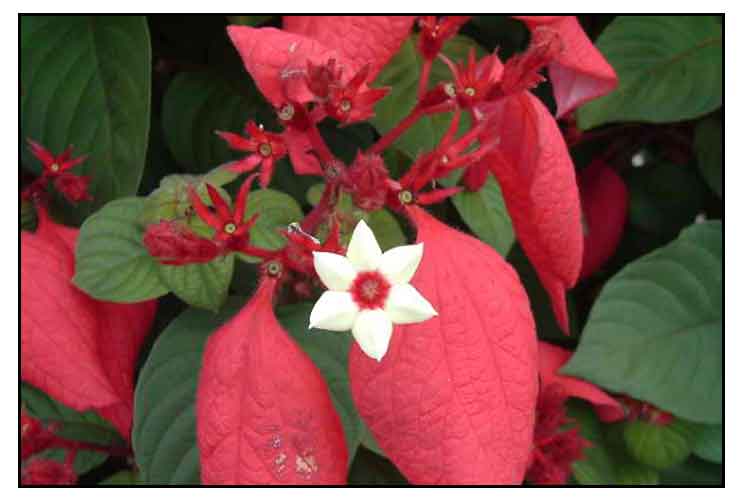
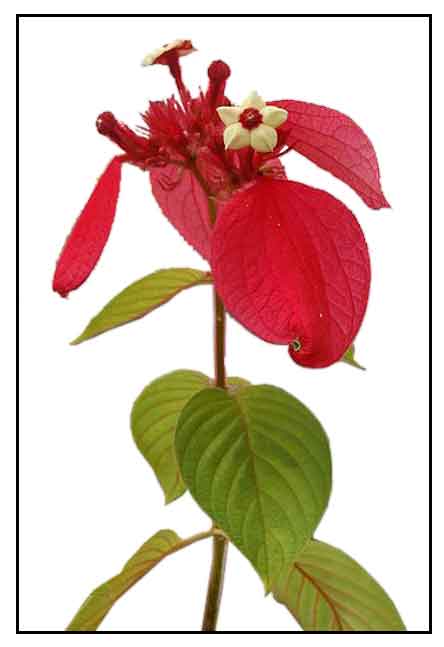
Mussaenda erythrophylla is a perennial, evergreen shrub with a branched tap root system. Flowers are big, creamy-white or yellow, orange, with reddish rings at the center. Leafy sepals are ovate, up to 9 centimeters long, rich vermillon-scarlet, with lighter colored veins.
 Distribution Distribution
- Introduced to the Philippines, probably after the Second World War.
- Cultivated in gardens in the Philippines.
- Cultivated as ornamental plant in India.
- Native to western tropical Africa.
Constituents
- Study of stems yielded β-sitosterol, 5 hydroxy-7, 4'-dimethoxy flavones, 3- iso cumaryloxy – cyclopropane-1-oic acid and 4 -hydroxy-3-methoxy cinnamic acid. (3)
-
Phytochemical screening yielded phytosterols, triterpenes, and flavonoids.
- Studies have previously isolated triterpenoids and glycosides, mussaendosides A-C, M and N with cyclolanostene type aglycone and aureusidin, iridoid glycosides.
- Leaves yielded the presence of flavonoids, terpenoids, carbohydrates, tannins, and glycosides. (7)
- Phytochemical screening of roots yielded carbohydrates, alkaloids, cardiac glycosides.
flavonoids with absence of saponins, steroids, and anthraquinone glycosides. (12)
Uses
Folkloric
- No reported folkloric medicinal use in the Philippines.
- Elsewhere, reported use for cough, jaundice, and when chewed, as appetizer.
- Study of aerial parts of M. erythrophylla isolated 18 known compounds (1-16) distributed in coumarins, flavonoid, glucosides, quinic acid derivatives, triterpenoids, monoglyceride, steroids, tetraterpenoid, and polyol. (see study below) (15)
Studies
• Anthelmintic / Roots: Extracts from A. leptopus roots and rhizomes and Mussaenda erythrophylla roots were tested for in vitro anthelmintic activity against earthworm Pheretima posthuma. Both plants showed potent activity. The ethyl acetate extract of M. erythrophylla was more potent than the methanol extract. (1)
• Hepatoprotective / Carbon Tetrachloride Toxicity / Stems: Study of ethyl acetate and methanol extracts of stems of ME against CCl4-induced liver damage in Wistar albino rats showed hepatoprotective effects with significant reduction of hepatic enzymes and reduction in pathologic changes (centrilobular necrosis and vacuolization). (2)
• Diuretic / Roots: Study evaluated the diuretic effect of chloroform and ethanolic extracts of M. erythrophylla roots in normal rats. Results showed significant increase in urine volume, with increased excretion of sodium and potassium. The diuretic effect was comparable to reference drug furosemide. (5)
• Anthelmintic / Roots: In in-vitro anthelmintic evaluation against earthworms Pheretima posthuma, ethyl acetate and methanol extracts of Mussaenda erythrophylla roots caused significant paralysis in doses of 10, 20, 40 and 80 mg/ml and caused death of worms at higher concentration of 80mg/ml as compared to standard piperazine hydrate. The ethyl acetate extract was more potent than the methanol extract. (6)
• Antiurolithiatic / Antioxidant: Study evaluated the potential of M. erythrophylla in the treatment of renal calculi on ethylene glycol-induced urolithiasis in rats. The extracts were safe and exhibited no gross behavioral changes in the rats. While the hypercalciuric animals exhibited grossly increased excretion of oxalate, calcium, and phosphate, the increased deposition of stone forming constituents in the kidneys of calculogenic rats were significantly lowered by extract treatment. The chloroform extract also exhibited significant in vitro antioxidant effect. (8)
• Antioxidant / Free Radical Scavenging Activity: Study evaluated the in vitro antioxidant activities on superoxide radical, hydroxyl radical, lipid peroxidation and DPPH radical assays. An ethyl acetate extract had a lower IC50 value suggesting higher free radical scavenging activity. The ethyl acetate extract also showed better activity than methanolic extract. (9)
• Glucoside U / Anti-Acetylcholine : An invention discloses an application of M. erythrophylla glucoside U as an anti-acetylcholine medicine. The research evaluates the influences of ME glucoside U to contractility of ileum smooth muscles of in-vitro guinea pig. The ME glucoside U and a medicine excipient are used for preparing an anti-acetylcholine preparation which can be used to treat patients with organophosphorus nerve agent poisoning, acute microcirculation disturbance, stomach and intestinal cramps, and biliary tract or urethral canal spasmodic pain. (10)
• Cytotoxicity / Leaves: Study evaluated the cytotoxicity potential of leaves of Mussaenda erythrophylla against Vero, MCF-10, MCF-7, HT-29, A-549 and HEPG2 cell lines. Results showed cytotoxicity against all cell lines tested. The extract showed more potency and effect against A-549 (Human Lung cancer cell lines) with IC50 of 30.68 µg/ml. (11)
• Silver Nanoparticles / Leaves: Study reports on the green synthesis of silver nanoparticles using leaf extracts of M. erythrophylla. The AgNPs were used as catalyst to degrade the azo dye, methyl orange, (13)
• Natural Dye / Red Sepals: In this study, cotton, silk, and polyester yarns were dyed with aqueous extracts of natural dyes from the pink leaves of Cordyline fruticosa and red sepals of Mussaenda erythrophylla. Various shades of ash-green and pink colors were obtained from aqueous extracts of C. fruticosa leaves and M. erythrophylla sepals. Fastness was graded good to very good. The dyes were polygenetic in nature. (14)
• Antileishmanial / Antiplasmodial / Aerial Parts: Study of aerial parts of M. erythrophylla isolated 18 known compounds. The crude extract showed moderate antileishmanial activity (IC50 61.6 µg/mL) while the hexane extract soluble fraction showed good antileishmanial activity (IC50=31.06 µg/mL) compared to reference drug amphotericin B (IC50=0.11 µg/mL) Compounds 11 and 9 exhibited potent antileishmanial activity (IC50s 53.7-52.0 µM). The crude extract and ethyl acetate soluble fraction exhibited good antiplasmodial activity (IC50s of 7.43 and 14.49 µg/mL, respectively) compared to reference artemisinin (IC50=0.014 µM). (see constituents above) (15)
Availability
Wild-crafted.
|