 |

Family •
Apocynaceae
Dugtong-ahas
Tagulauai
Parameria
laevigata (A. Juss.) Moldenke
CEBU BALSAM
Jie jia teng
|
Family •
Apocynaceae
Dugtong-ahas
Tagulauai
Parameria
laevigata (A. Juss.) Moldenke
CEBU BALSAM
Jie jia teng
| Scientific names | Common names |
| Aegiphila laevigata Juss. | Bulau-bulau (P. Bis.) |
| Chonemorpha densiflora (Blume) G.Don | Dugtong-ahas (Tag.) |
| Ecdysanthera barbata (Blume) Miq. | Gamot-sambali (Tag.) |
| Ecdysanthera densiflora (Blume) Miq. | Ikdig-ñga-purau (Ilk.) |
| Ecdysanthera glandulifera (Wall. ex G.Don) A.DC. | Inggiu-na-puti (Tag.) |
| Ecdysanthera griffithii Wight | Itiban (Tag.) |
| Echites barbatus (Blume) D.Dietr. | Karkarsang (Ig.) |
| Echites densiflorus Blume | Kuni-na-puti (Tag.) |
| Echites glanduliferus Wall. ex G.Don | Lumpiit (Ilk.) |
| Parameria angustior (Miq.) Boerl. | Lupiit (Ilk.) |
| Parameria barbata (Blume) K.Schum. | Ogoi (Ig.) |
| Parameria glandulifera (Wall. ex G.Don) Benth ex Kurz. | Parugtong-ahas (Tag.) |
| Parameria glandulifera var. philippinensis (Radlk.) Stapf. | Pataan (Ilk.) |
| Parameria laevigata (Juss.) Moldenke | Patian (Ilk.) |
| Parameria philippinensis Radlk. | Pulang-pulang (Ilk.) |
| Parameria vulneraria Radlk. | Sada (Ig.) |
| Parsonsia barbata Blume | Sadak (Ilk.) |
| Sagid (Bis.) | |
| Sagit (Tag.) | |
| Tagolauai (Tag.) | |
| Taguk-taguk (Bis.) | |
| Tagulauai (P. Bis.) | |
| Yakdig (Ilk.) | |
| Cebu balsam (Engl.) | |
| Parameria laevigata (Juss.) Moldenke is an accepted name. The Plant List | |
| Other vernacular names |
| CAMBODIA: Var ang kot. |
| CHINESE: Jie jia teng, Chang jie zhu. |
| INDONESIA: Gembor, Ragen, Akar gerip putih, Pegat sih, Kayu rapet. |
| MALAYSIA: Akar serapat puteh, Akar garip puteh, Akar serau, Kayu rapat. |
| SPANISH: Balsamo de Cebu. |
| THAILAND: Khruea khao muak, Khruea suut, Som lom. |
| VIETNAM: D[oox] tr[oj]ng nam. |
|
Distribution
Properties Parts
utilized Studies |
Updated February 2019 / September 2016

 |
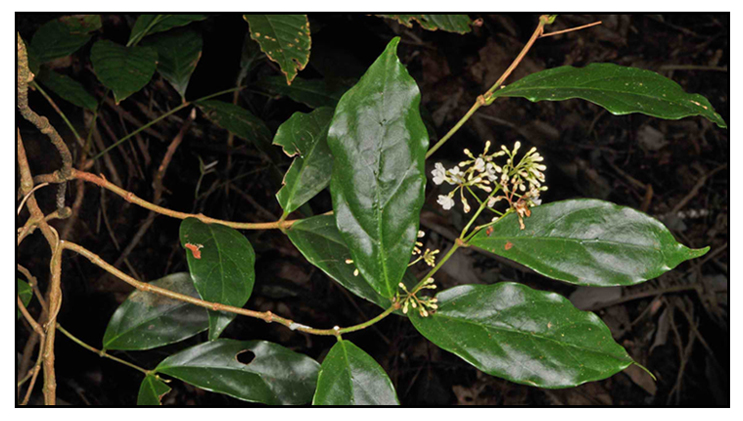
| IMAGE SOURCE: / Photo /Apocynaceae : Parameria laevigata / Flowering vine / Copyright © 2013 by P.B. Pelser & J.F. Barcelona (contact: pieter.pelser@canterbury.ac.nz) [ref. DOL62255] / Non-Commercial Use / click on photo to see source image / Phytoimages.siu.edu |
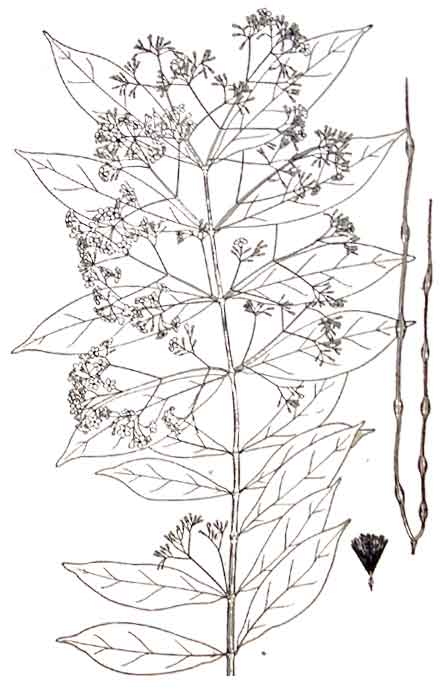
| OTHER IMAGE SOURCE: Minor Products of Philippine Forests / Vol 2 / William H Brown / Figure 32/ Parameria barbata (Dugtung ahas) / 1920 |
Additional
Sources and Suggested Readings |
| It is not uncommon for links on studies/sources to change. Copying and pasting the information on the search window or using the DOI (if available) will often redirect to the new link page. |
• |
 |
|
 Constituents
