Botany
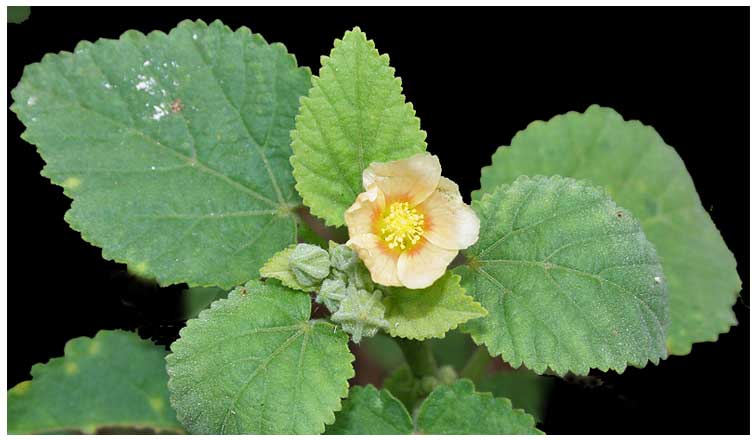
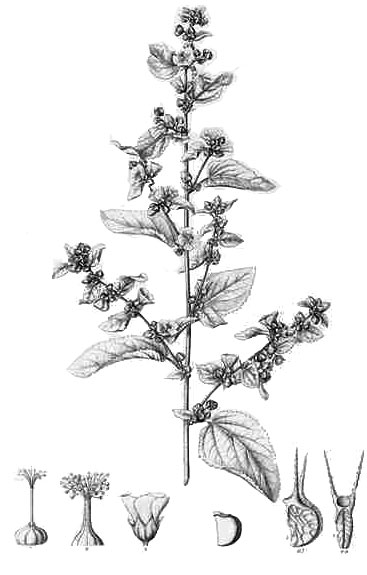
Gulipas is an erect, half-woody shrub, 0.4 to 1 meter in height, covered with soft, velvety hairs mixed with long spreading hairs. Leaves are hairy, ovate, 1.5 to 4.5 centimeters long, with blunt tip, heart-shaped base, and toothed margins. Flowers are yellow, borne in axils of the leaves, often crowded on the younger branches, forming leafy racemes. Carpels are prominently rough, the projections as long as the carpels.
 Distribution Distribution
- Found from northern Luzon to Mindanao as a weed in open dry places, in and about towns.
- Pantropic.
- Probably a native of the Old World.
Constituents
- Studies have yielded asparagin, alkaloids (ephedrine, hypaphorine, vasicinone, vasicine, and vasicinol), phytosterols, mucin, gelatin, potassium nitrate and rutin. Ephedrine content of the whole plant is 0.085%. (34)
- Study reported 0.112% of ephedrine from the whole plant (Khatoon et al, 2005). Seeds contain more alkaloids than found in stems, roots, or leaves. (34)
-
Whole plant yields alkaloids, four times more in the seeds than stems, roots and leaves.
- Contains ephedrine and pseudo-ephedrine that is responsible for its cardiovascular and CNS stimulant effect.
- The alkaloid ephedrine is present at 0.8 to 1.2%.
- Ethanolic and aqueous extracts of the plant yielded alkaloids, resins, flavonoids, steroids, amino acids (EE), proteins, carbohydrates. (See study below)
(14)
- Yields ephedrine, pseudoephedrine, sterculic, malvalic and coronaric acid, fatty acids, saponin, betaphenethylamine, hypaphorine, ecdysterone, indole alkaloids, palmitic, stearic and ß-sitosterol.
(20)
-
Phytochemical screening of ethanol extract of roots yielded reducing sugar, alkaloids, steroids, and saponins. (see study below) (22)
- Study yielded major phytochemical compounds viz., vasicinol, ephedrine, vasicinone, hypaphorine. (see study below)
(24)
- Study of methanol extract of aerial parts yielded four new alkaloids, viz.,
1,2,3,9-tetrahydro-pyrrolo [2,1-b] quinazolin-3-ylamine, 5′-hydroxymethyl-1′-(1,2,3,9-tetrahydro- pyrrolo [2,1-b] quinazolin-1-yl)-heptan-1-one, 2-(1′-amino-butyl) indol-3-one and 2′-(3H-indol-3-ylmethyl)-butan-1′-ol. (34)
Properties
- Leaves considered emollient, analgesic, demulcent, diuretic, nervine, stimulant and tonic.
- Roots considered cooling, astringent, stomachic and tonic.
- Stems considered demulcent, emollient, febrifuge and diuretic.
Parts used
Roots, leaves, seeds and stems.
Uses
Folkloric
- Decoction of leaves used as emollient and a diuretic.
- Pounded in water, juice used for spermatorrhea and gonorrhea.
- Infusion of roots, used for nervous and urinary disease; also for disorders of the blood and bile.
- In China, plant used as diuretic.
- Root juice used for healing wounds.
- Juice of whole plant used for rheumatism and spermatorrhea.
- Decoction of root and ginger used for intermittent fevers with shivering fits.
- Root bark powder in milk and sugar used for frequent micturition and leukorrhea.
- Root, alone or with asafoetida and rock salt used for neurologic disorders (headaches, paralysis).
Infusion of root used for delirium.
- Roots also used internally for asthma and as a cardiac tonic.
- Infusion of leaves used as cooling medicine for fevers and to check bloody fluxes.
- Bruised fresh leaves used for boils to promote suppuration.
- Leaves cooked and eaten for bleeding piles.
- Leaves are mucilaginous and used as a demulcent.
- In Konkan, leaves for ophthalmia.
- Seeds considered aphrodisiac; used for gonorrhea, cystitis, colds and tenesmus.
- Gujarat folk tribes in India use the herb for coronary manifestations.
- In Ayurveda, leaves, seeds, or whole plant used in diseases of rakta pitta origin. Mainly used as general tonic, anti-inflammatory, blood coagulant, for sexual dysfunction and Parkinson's disease, among others. (25)
- In upper Assam, India, juice extracted from roots mixed with old preserved sugar cane juice and candy sugar used for treatment of peptic ulcer. Powder from bark or root bark of S. cordifolia and bark of Areca catechu taken to control diarrhea and dysentery. (32)
Others
• Fiber: Produces a fiber, as valued as jute.
• Dye: Source of natural dye. (see study below: 31)
Studies
• Weight Loss Supplement / Ephedrine / Hepatotoxicity: Because of the small amounts of ephedrine and pseudo-ephedrine it contains, it has become a component in many weight loss products. However, at present, no evidence supports the use of S. cordifolia as a weight loss product in humans. In many countries, the use of ephedrine in weight loss products has been banned because of reported hepatotoxicity. (1)
• Liver Regenerative / Leaves: Study showed the aqueous extract of Sida cordifolia leaves stimulates liver regeneration after 67% partial hepatectomy in rats. Findings suggest that Sida cordifolia stimulates insulin release by the pancreatic ß-cells. Insulin acting as important co-mitogen raised the hypothesis that the augmented release of the hormone, stimulated by S. cordifolia, may increase the hepatocellular synthesis of DNA and the liver regeneration process. (2)
• Immunomodulatory: In cyclophosphamide-treated birds with marked immunosuppression, administration of A. racemosa and S. cordifolia in combination with Levamisole showed immunomodulatory effects. (4)
• Antioxidant: Study showed S. cordifolia to be a potential source of antioxidants. The ethanol extracts were found to be a good scavenger of DPPH radicals, the roots betters than stems, leaves and whole plant. (5)
• Analgesic / Anti-Inflammatory: Study of extracts exhibited sufficient inhibition of paw edema, comparable to standard drug, phenylbutazone. (2) Study isolated a bioactive alkaloid that exhibited significant analgesic activity and significant inhibition of paw edema induced by carrageenan. (6)
• Antimicrobial / Roots and Leaves: Methanol extracts of several medicinal plants were studied for antimicrobial activity. S. cordifolia showed significant activity against B subtilis, E coli, P fluorescens, S aureus and X axonopodis. The root and leaf extract showed significant activity against all test bacteria. The methanol extract also exhibited significant antifungal activity against F. verticillioides. (7)
• Antistress / Adaptogenic / Roots: Study evaluated ethanol extract of roots for antistress, adaptogenic activity using cold restraint stress and swim endurance in mice. Mice pretreated with ethanol extract of roots of Sida cordifolia showed significant improvement in the swim duration and reduced the elevated WBC, blood glucose and plasma cortisone. (8)
• Bioactive Alkaloid / Analgesic / Anti-Inflammatory: Study isolated a new alkaloid (5′-Hydroxymethyl-1′- (1,2,3,9-tetrahydro-pyrrolo [2,1-b] quinazolin-1-yl)-heptan-1-one) (compound 1) from S. cordifoli. The compound was evaluated in animal models using acetic acid induced writhing and radiant heat tail flick method in mice for analgesic activity and carrageenan induced rat paw edema for anti-inflammatory activity. Compound 1 exhibited significant (p<0.01) analgesic activity in both models and significant (p<0.01) inhibition of rat paw edema induced by carrageenan. (9)
• Cardiovascular Effects: Study of the aqueous fraction of the hydroalcoholic extract of Sida cordifolia leaves produced hypotension and bradycardia, mainly due to direct stimulation of the endothelial vascular muscarinic receptor and indirect cardiac muscarinic activation, respectively. (10)
• Cardiovascular Effects / Antioxidant: Study of biochemical and antioxidant profile during myocardial injury showed significantly increased endogenous antioxidants in heart tissue homogenate. Biochemical findings were supported by histopathological observations. Results confirm, in part, its folk use in the treatment of MI. (11)
• Anti-Neurotoxicity: Study showed that on coadministration of Ksheerabala with quinolinic acid, the levels of all biochemical parameters were restored to near-normal levels, indicating a protective effect.
• Antibacterial / Antifungal / Phytochemicals: Study of chloroform and ethanol extracts yielded carbohydrates, alkaloids, phytosterols, saponins and fixed oils. Antimicrobial screening with S aureus, B subtilis, E Coli, P aeruginosa, C albicans and A niger. There was appreciable antibacterial activity against all the selected bacteria, with maximum activity against S aureus and E coli.
• Antioxidant / Anthelmintic: Study evaluated ethanolic and aqueous extracts from the whole plant of Sida cordifolia for antioxidant activity and anthelmintic activity against earthworm Pheretima posthuma. Both extracts showed anthelmintic activity. For antioxidant activity, the ethanolic extract was more significant. (14)
• Antiperoxidative / Anti-Inflammatory / Quinolinic Acid-Induced Neurotoxicity: Study evaluated an ethanolic extract of S. cordifolia root on quinolinic acid-induced neurotoxicity in rat brain. Extract treatment decreased lipid peroxidation products and increased activity of scavenging enzymes. Results showed the ethanolic extract possess potent antioxidant and anti-inflammatory activity comparable to standard drug deprenyl. (15)
• Anti-Candidal / Free Radical Scavenging / Synergism: Study showed a synergistic effect between alkaloidal compounds and antifungal references such as Nystatin and Clotrimazole. Antioxidant capacity was best with reduction capacity of DPPH radicals. Results showed potentially exploitable antifungal activity. (16)
• Nephroprotective: Study evaluated the nephroprotective activity of an aqueous root extract of S. cordifolia against gentamicin and cisplatin-induced experimental animal models. Results showed nephroprotective activity with prevention of renal damage and normalization of increased levels of renal markers. (17)
• Antitumor Activity / Cytotoxicity: A methanolic extract of the plant showed antitumor activity on cytotoxicity assay. GCMS analysis of the bioactive compounds yielded vasicine and ephedrine. (18)
• Cardiotonic / Roots: Study evaluated the cardiotonic activity of infusion of roots of S. cordifolia using perfused frog heart assembly. Results showed better cardiotonic activity than digoxin. There was a significant increase in force of contraction (positive ionotropic effect) and decrease heart rate (negative chronotropic effect). (19)
• Analgesic / Antioxidant / Roots: Study of ethanolic extract of roots showed antioxidant activity in DPPH scavenging assay with an IC50 value of 50 µg/mL. The crude extract produced statistically significant analgesic activity (p.0.001) with 44.30% inhibition of acetic acid-induced writhing. It did not show antimicrobial activity against five types of microorganisms. (19)
• Phytopharmacological Study / Roots: Study evaluated an 80% concentrated ethanol extract of roots for phytopharmacologic properties. In DPPH scavenging assay, IC50 was 50 µg/ml. Crude extract exhibited statistically significant (p<0.001) 44.30% inhibition of writhing at dose of 500 mg/kbw. The extract showed no in vitro antibacterial activity five test microorganisms. (see constituents above) (22)
• Anti-Hyperglycemic / Anti-Hyperlipidemic / Antioxidant / Aerial Parts: Study of alcoholic extract of aerial parts of S. cordifolia in STZ-induced diabetic wistar rats at a dose of 400 mg/kg showed potency to act as anti-diabetic, hypoglycemic, and antioxidant. It protects from LPO that damages the cell membrane. The therapeutic potential may be due to the presence of bioactive compounds such as glucosides, resins, alkaloids, sterols, saponins, flavanoids, etc. (23)
• Cytotoxicity / HeLa Cell Line / Antimicrobial / Leaves: Study showed S. cordifolia leaf possesses cytotoxic activity against HeLa cells. On antibacterial testing, a methanol extract showed higher inhibition activity against E. coli, E. aerogenes, Mycobacterium sp., and Micrococcus variance, P. aeruginosa and B. subtilis. (24)
• Wound Healing: Study evaluated the wound healing potential of ethanolic extract of S. cordifolia in excision, incision, and burn wound models in rats. The ointment formulation of the ethanolic extract showed significant (p<0.01) healing in all wound models as evidenced by significant changes (p<0.01) in the measured parameters viz., wound contraction, epithelization period, hydroxyproline content, tensile strength, and histopathological studies. (26)
• Analgesic Activity / Toxicity Study: Study evaluated the toxicological effects and analgesic effects of aqueous acetone extracts of Sida acuta and Sida cordifolia in Wistar albino rats treated by gavage for 28 days. Analgesic effect was evaluated in mice by acetic acid writhing and by formalin test. For acute toxicity test, S. cordifolia showed an LD50 of 3.4 g/kg. The extracts showed significant analgesic effects (p<0.05) by acetic acid writhing and hot plate method in a dose-dependent manner. (27)
• Nootropic Activity: Study evaluated the nootropic effect of aqueous and hydroethanolic extracts of Sida cordifolia in mice using transfer latency (TL) and step-down latency (SDL) tests. The hydralcoholic extract dose dependently increased the SDL and decreased the TL in mice as compared to the control group. Results suggest potential for use in treatment of diseases associated with memory dysfunctions such as Alzheimer's disease. (28)
• Anticancer / Leaves: GC-MS analysis of ethanolic extract of S. cordifolia leaves yielded 20 major compounds. In-silico approach evaluated the compounds for anticancer activity. Of all compounds studied 3-[(3E,7E)-3,7- dimethyl-9-(phenylsulfanyl)nona-3,7-dien-1-yl]-2,2- dimethyloxirane was found be a potential inhibitor of Bcl2. (29)
• Acceleration of Wound Healing in T2 Diabetic Rats: Study evaluated the wound healing potential of hydrogel of methanolic extract applied topically to excision wound and incision wounds of fructose-fed STZ-induced diabetic rats. Results showed that in both models, the hydrogel exhibited significant wound healing activity in terms of wound contraction (p<0.01), period of epithelization (p<0.01), and hydroxyproline content (p<0.01) in the excision model, and tensile strength (p<0.01) in the incision model. Activity was attributed to the presence of phenolic compounds and gallic acid in the extracts. (30)
• Natural Dye / Eco-Friendly Dyeing of Woolen Fabric: Study observed that extract of S. cordifolia natural dye yields various shades in green-yellow region on woolen fabric with the assistance of various chemical and natusral mordants. The dyeing process can be achieved using renewable eco-friendly natural materials. (31)
• Antifertility Potential: Study evaluated the effect of S. cordifolia on fertility of female Swiss albino rats. Treatment caused decrease in the weight of the ovaries and uterus. Histopathological evaluation showed abnormalilty effects on the ovaries and fallopian tubes which as responsible for implantation. Results suggest abortifacient and antiimplantation activity. (33)
Concerns / Caution
• Ephedrine: Ephedrine, a 2-aminophenylpropane alkaloid was first isolated from Ephedra sinica Stapf. (Ma-Huang). Ephedra gerandiana Wall. ex Stapf. is widely used in Ayurvedic medicine. Another alkaloid reported from Ephedra sp. is a pseudoephedrine which is present in lower concentrations in Sida cordifolia. Today, companies continue to promote S. cordifolia for anti-obesity effects. (3)
•
Ephedra / Ephedrine / Banned: Sida cordifolia contains ephedrine, an amphetamine-like stimulant that can cause harmful side effects. Since 2004, the US FDA has banned ephedra, Sida cordifolia and other products that contain ephedrine. (21)
• Interactions: Sida cordifolia can increase the speed of the heartbeat. It can interact with many cardiac medications, methylxanthines, stimulant drugs. Moderate interaction may also be seen with dexamethasone, ergot derivatives, MAOs, and antidiabetic drugs. (22)
Availability
- Wild-crafted.
- Capsules, powder, extracts and syrups in the cybermarket.
|


_in_Hyderabad,_AP_W2_IMG_9420.jpg)