 |

Family • Moraceae
Hagimit
Ficus minahassae (Teijsm. & Vriese) Miq.
CLUSTER FIG TREE
| Scientific names | Common names |
| Bosscheria minahassae de Vriese & Teijsm. | Agimet (Ilk.) |
| Ficus glomerata Blanco [llegitimate] | Alomit (Ig.) |
| Ficus minahassae (Teijsm. & Vriese) Miq. | Arimit (Abra) |
| Arinit (Ting.) | |
| Ayimit (Tag.) | |
| Aymit (Ayta) | |
| Ayumit (Tag.) | |
| Businag (Ilk.) | |
| Gimit (Sub.) | |
| Hagamit (Tag.) | |
| Haganit (Tag.) | |
| Hagimit (Tag., Bis.) | |
| Hagumit (Tag.) | |
| Hasimit (C. Bis.) | |
| Lagumit (Buk.) | |
| Logemit (Higaonon) | |
| Malatungbog (Mbo.) | |
| Matanug (Sul.) | |
| Sabfog (Tag.) | |
| Sangai (Bag.) | |
| Taisan (Yak.) | |
| Tambis-tambis (C. Bis.) | |
| Tambuyogan (S. L. Bis.) | |
| Cluster fig tree (Engl.) | |
| Ficus minahassae (Teijsm. & Vriese) Miq. is an accepted name. The Plant List | |
| Other vernacular names |
| INDONESIAN: Langusei. |

Distribution Constituents Properties Studies Availability |

Updated May 2020 / October 2016

 |
| PHOTOS / ILLUSTRATIONS |
| IMAGE SOURCE: / Illustration / Ficus minahassae (Teijsm. & Vriese) Miq. / Annals of the Royal Botanic Garden, Calcutta, vol. 1: t. 141 (1888) [G.C. Das] / Illustration contributed by the Library of the Missouri Botanical Garden, U.S.A. / Plant Illustration / CLICK ON IMAGE TO GO TO SOURCE PAGE |
| OTHER IMAGE SOURCE:/ Photograph / Moraceae : Ficus minahassae det. John Rey Callado 26-Nov-11 / Infructescence Copyright © 2012 by P.B. Pelser & J.F. Barcelona (contact: pieter.pelser@canterbury.ac.nz) [ref. DOL46340] / PhytoImages.siu.edu |
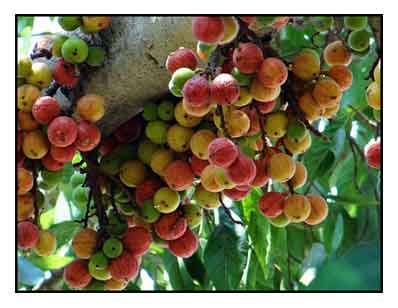
| OTHER IMAGE SOURCE:/ Photograph / Fruit clusters : Ficus minahassae / Cluster fig tree / .click on image to go to source page / Copyright / © earth.com |
| Additional
Sources and Suggested Readings (1) Medicinal Plants Used by the Higaonon Tribe of Rogongon, Iligan City, Mindanao, Philippines / Lilybeth F. Olowa, Mark Anthony J. Torres, Eduardo C. Aranico and Cesar G. Demayo / Advances in Environmental Biology, 2012; 6(4): 1442-1449 (2) Chemical Constituents of Ficus minahassae (Teijsm. & de Vriese) Miq. / Phelan Apostol, Mariquit de los Reyes, Emelina Mandia, Chien-Chang Shen, Consolacion Ragasa / Der Pharma Chemica, Dec 2016; 8(20) (3) Ficus minahassae / Synonyms / The Plant List (4) Endophytic Bacteria isolated from the leaf of Langusei (Ficus minahassae Tesym. & De Vr.) and their antibacterial activities / T E Tallei, Y T Linelejan, S D Umboh, A A Adam, Muslem, and R Idroes / IOP Conf. Series: Materials Science and Engineering 796, 2020; 012047 / doi:10.1088/1757-899X/796/1/012047 (5) Free Radical Scavenging Activity of Mature Red Tomato (Lycopersicon esculentum Mill.) Fruit Coated with Hagimit (Ficus minahassae Miq.) Extract / Jesriel Mancao Boko, Felix Managbanag Salas / Journal of Food and Nutrition Sciences. Special Issue: Food Processing and Food Quality., 2015; Vol 3, No 1-2: pp. 100-105. / doi: 10.11648/j.jfns.s.2015030102.29 (6) Useful Plants of Selected Ayta Communities from Porac, Pampanga, Twenty Years after the Eruption of Mt. Pinatubo / Elena M Ragragio, Cynthia Neri Zayas, and Jasper John A Obico / Philippine Journal of Science, Special Issue; 142: pp 169-181 (7) Phytochemical Screening and Antioxidant Activity of Edible Wild Fruits in Benguet, Cordillera Administrative Region, Philippines / Racquel Barcelo / Electronic Journal of Biology, 2015; 11(3): pp 80-89 |
DOI |
• |
| List of Understudied Philippine Medicinal Plants |
 |
|
