Botany
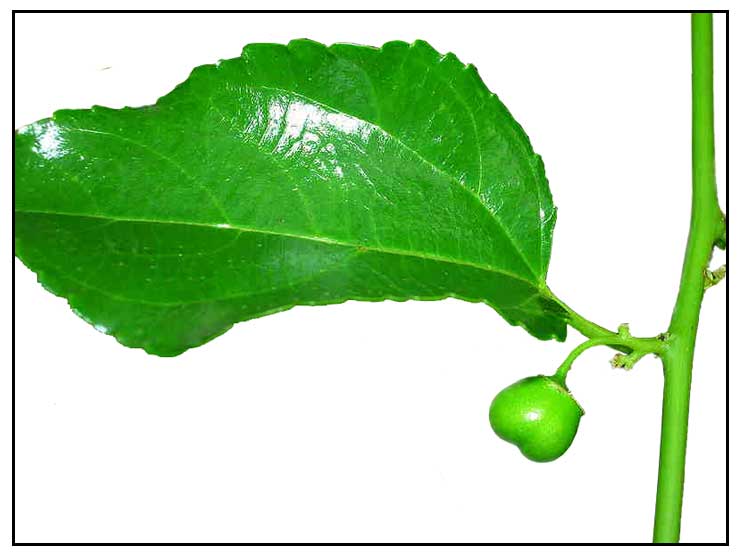
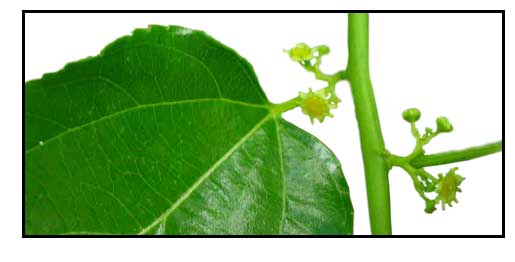
Kabatiti is a climbing, smooth shrub, reaching a height of 6 meters. Leaves are shining, ovate, 5 to 9 centimeters long, 2 to 6 centimeters wide; with pointed tips, rounded bases and toothed margins. Three nerves arise from the base of the leaf. Flowers are yellowish green, about 4 millimeters in diameter, borne on axillary, short inflorescences which are about 1 centimeter long. Fruit is somewhat rounded, 7 to 9 millimeters in diameter, and surrounded at the base by the calyx, green and fleshy, becoming dark brown with age, and contains three seeds.
 Distribution Distribution
- Native to the Philippines.
-
Along the seashore and borders of tidal streams throughout the Philippines.
- Also occurs in India to Africa, and through Malaya to Australia and Polynesia.
- Highly invasive shrub species especially appearing in coastal habitats. Species has a wide dispersal range: seeds widely dispersed by ocean currents and birds.
(12)
Constituents
- Bark yields saponin.
- Plant extracts yield alkaloid, flavonoid, unsaturated sterol and triterpene, steroid glycoside, anthraquinone, saponin, tannin, phenols.
- Study yielded three new jujubogenin glycosides from the leaves of Colubrina asiatica, together with known colubrin, rutin, and kaempferol 3-O-rutinoside. (1)
- Leaves yielded two saponins: jujubogenin-3-O-[2-O-acetyl-3-O-(3-O-beta-D-xylopyranosyl-4-O-acetyl-beta-D-glucopyranosyl)-alpha-L-arabinoside] (colubrinoside) and jujubogenin-3-O- [2-O-acetyl -3-O- (2-O- beta -D- xylopyranosyl-beta-D-glucopyranosyl)-alpha-L-arabinoside] (colubrin). (4)
- Study of C. asiatica isolated 16 compounds: six triterpene acids (1-6), five steroids (7-11), one benzoic acid derivative (12), two peptides (13 and 15), one sesquiterpenoid (15), and one jujubogenin (16).
(see study below) (11)
- Study of roots isolated two new ceanothane triterpenes: 3.7-O.O-dibenzoyl ceanothic acid methylester (1) and 3-O-acetyl-6-O-benzoyl ceanothic acid methylester (2), along with nine compounds (3-11).
(see study below) (15)
Properties
- Considered cooling and alterative.
- Studies have suggest antibacterial, antioxidant, antimalarial, antimycobacterial, anticancer properties.
Parts used
Leaves and fruits.
Uses
Folkloric
- Decoction of leaves use to alleviate skin irritation and treat a variety of skin diseases.
- Decoction of fruit used as abortifacient.
- In Polynesia, employed as tonic and cicatrizant for wounds.
- In India, juice used as tonic.
Others
- Fish poison: Fruit used as fish poison.
- Soap: Leaves used as soap, lathering in water. In Samoa and Fiji, leaves are used for washing.
Studies
• Jujubogenin Glycosides / Leaves: Study yielded three new jujubogenin glycosides from the leaves of Colubrina asiatica, together with known colubrin, rutin, and kaempferol 3-O-rutinoside. (1)
• Antibacterial / Essential Oil: Essential oils from six medicinal plants were studied for in vitro bacterial property against 15 pathogenic and non-pathogenic bacterial. The combination of essential oils of Litsea chinensis, Piper cubeba and Colubrina asiatica displayed maximum inhibitory response white the rest failed to show any synergistic or potentiating effect. (3) GC-MS study of essential oil from fresh leaves yielded 10 compounds with dodecamethylcyclohexasiloxane highest at 17%, α-cubebene 14%, and dehydro-N-[4.5-methylenedioxy2-nitrobenzylidene]-tyramine lowest at 1.9%. On invitro testing, the EO showed significant activity against Gram+ Staphylococcus aureus. (14)
• Saponins / CNS Effects: Leaves yielded two saponins. Both inhibited spontaneous motility of mice and showed an antagonistic effect on amphetamine and a synergistic activity on chlordiazepoxide. (see constituents above) (4)
• Antioxidant: Study evaluated the relationship between antioxidant activity and total phenolic contents in selected common traditional vegetables. C. asiatica exhibited the highest antioxidant activity. The study found no relationship between antioxidant activity and total phenolic contents. (7)
• Antioxidant / Leaves and Stems: Study evaluated the antioxidant potential of crude aqueous extracts of leaves and stems.
Phytochemical screening yielded flavonoids, saponins, and total polyphenols. Total phenolic content of aqueous leaf extract was 12.499 mg gallic acid equivalent/g of extract powder in leaves and 0.867 in stem. Total flavonoid contents were 0.8 ± - and 2.8 ± 0.1 mg GAE/g extract in leaves and stems, respectively. Total antioxidant activity by FRAP assay in leaves was 137 ± 4.8 and 170 ± 38 µM Fe2+ in stem. (9)
• Antioxidant / Essential Oil: Study evaluated the antimicrobial efficacy of essential oil and in vitro antioxidant activities of aqueous extract of C. asiatica. On various assays, the water extract showed powerful antioxidant activity, with effective reducing power, free radical scavenging, superoxide anion radical scavenging, hydrogen peroxide scavenging and metal chelating activities at same concentrations, compared to standard antioxidants such as ascorbic acid, BHT, BHA, gallic acid, and quercetin. Essential oil yielded 10 compounds with dodecamethylcyclohexasiloxane highest at 17% and cubebene at 14%. (10)
• Antimalarial / Antimycobacterial / Cytotoxicity: Study of C. asiatica isolated 16 compounds: six triterpene acids (1-6), five steroids (7-11), one benzoic acid derivative (12), two peptides (13 and 15), one sesquiterpenoid (15), and one jujubogenin (16). Compounds 3 and 10 showed antimalarial activity against Plasmodium falcifarum. Compound 5 showed antimycobacterial activity. Compounds 3,5,6,10 and 14 exhibited weak cytotoxicity against cancer cell lines. (11)
• Pharmacological Activity of Essential Oil: The essential oil does not possess any marked CNS activity. It caused significant reduction in rectal temperature without causing sedation. In anesthetized dogs, the EO produced a marked hypotensive effect and on frog heart it showed a depressant effect, both effects blocked by atropine. The oil antagonized the spasmodic effect of acetylcholine, histamine, and barium on smooth muscle, and blocked the contractile effect of acetylcholine on skeletal muscle. (13)
• Bioactive Triterpenoids / Antimalarial / Antimycobacterial / Anticancer / Roots: Study of roots isolated two new ceanothane triterpenes: 3.7-O.O-dibenzoyl ceanothic acid methylester (1) and 3-O-acetyl-6-O-benzoyl ceanothic acid methylester (2), along with nine compounds (3-11). Compounds 1 and 2 showed antimalarial activity against Plasmodium falcifarum with IC50s of 4.67 and 3.07 µg/ml, respectively. Compound 2 showed antimycobacterial activity against Mycobacterium tuberculosis with MIC 6.25 µg/mL. Compounds 1, 2, 10 and 11 showed cytotoxicity against three cancer cell lines (KB, NCI-H187, and MCF-7) with IC50s ranging from 8.32 to 46.72 µg/mL. (15)
Availability
Wild-crafted. |