|
  Gen info Gen info
- Sterculia is a genus of flowering plants in the mallow family, Malvaceae: subfamily Sterculioideae (previously placed in the now obsolete Sterculiaceae). Most in the genus are colloquially known as tropical chestnuts. Plants of the World Online lists 182 accepted species. (3)
- The species was described in 1753 by Carl Linnaeus.
- Etymology: Both genus and species names refer to its bad smell. The genus name Sterculia derives from Sterculius of Roman mythology, the god of manure, which refers to the unpleasant aroma of the flowers of the genus. The species epithet foetida is Latin, meaning "stinking. (33)
Botany
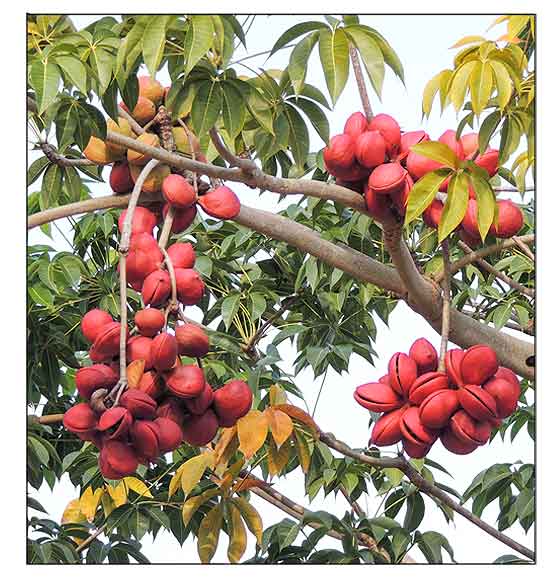
• Kalumpang is a spreading tree
reaching a height of 20 meters or more. Leaves are crowded at the ends
of the branches, and digitately compound, with 7 to 9 leaflets. Leaves are smooth, leathery, entire, elliptic-lanceolate,
12 to 18 centimeters long, with pointed tip. Flowers are malodorous,
dull, yellowish to purplish, 2 to 2.5 centimeters in diameter, and borne on panicles at the axils of the leaves, appearing with new leaves. Fruit is
large, smooth, ovoid, red, nearly smooth, obovoid, about 10 centimeters long, containing 10 to 15 seeds, which are black and about 2 centimeters long.
 • A soft wooded tree that can grow up to 25 m tall. Branches of Sterculia foetida are arranged in whorls; they spread horizontally. Tree's bark is smooth and gray. Leaves are placed at the end of branchlets; petioles ranging from 12.5 and 23 centimeters (4.9 and 9.1 inches) in length; blades are palmately compound, containing 7–9 leaflets. Leaflets are elliptical, 100–170 mm long, and shortly petioled. Petioles are the source of the foul smell of the plant. Flowers are arranged in panicles, 10–15 cm (4–6 in) long. Green or purple flowers are large and unisexual as the tree is dioecious (male and female flowers are found on different trees). Pollens are oval in shape, approximately 40 microns in length. Calyx is dull orange and is divided into five sepals, each one 10–13 millimeters (3⁄8–1⁄2 in) long. Fruit consists of four to five follicles, each follicle generally containing 10–15 seeds. Follicles are scarlet when ripe. (33) • A soft wooded tree that can grow up to 25 m tall. Branches of Sterculia foetida are arranged in whorls; they spread horizontally. Tree's bark is smooth and gray. Leaves are placed at the end of branchlets; petioles ranging from 12.5 and 23 centimeters (4.9 and 9.1 inches) in length; blades are palmately compound, containing 7–9 leaflets. Leaflets are elliptical, 100–170 mm long, and shortly petioled. Petioles are the source of the foul smell of the plant. Flowers are arranged in panicles, 10–15 cm (4–6 in) long. Green or purple flowers are large and unisexual as the tree is dioecious (male and female flowers are found on different trees). Pollens are oval in shape, approximately 40 microns in length. Calyx is dull orange and is divided into five sepals, each one 10–13 millimeters (3⁄8–1⁄2 in) long. Fruit consists of four to five follicles, each follicle generally containing 10–15 seeds. Follicles are scarlet when ripe. (33)
Distribution
- Native to the Philippines.
-
From northern Luzon to Palawan and Mindanao, in most islands and provinces along the seashore and in semi-open forests at low and medium altitudes.
- Also native to Assam, Bangladesh, Cambodia, India, Laos, Lesser Sunda Is., Malaya, Myanmar, Sri Lanka, Sumatera, Thailand, Vietnam.
 Constituents Constituents
- Kernels: Fixed oil, 51.78%;
protein, 21.61 %; starch 12.1 %; sugar, 5%; cellulose, 5.51%; ash 3%.
- From the leaves, study yielded two new flavonoid glycosides and a new phenylpropanoid glucose ester.
- Ethanol extract yielded flavonoids, saponins and alkaloids.
-
Study of leaf extracts yielded 46 compounds, including 36 flavonoids, 4 coumarins, 6 organic acids, and 3 steroids compounds.
- Study of leaves yielded 8 compounds: 5,7,8-tetrahydroxy-4'-methoxyflavone-8-O-beta-D-glucoside, 5,7,8-tetrahydroxy-4'-methoxyflavone-7-O-beta-D-glucoside, quercetin-3-O-beta-D-glucoside, apigenin-6, 8-di-C-beta-D-glucoside, puerarin, 5,7,8,3'-tetrahydroxy-4'-methoxyflavone, 5,7,8-tetrahydroxy-3',4'-dimethoxyflavone, 5,7,8-tetrahydroxy-4'-methoxyflavone. (11)
- Sterculia foetida oil contains cyclopropene fatty acids, namely: 8,9-methylene-heptadec-8-enoic acid (malvalic) and 9,10-methylene-octadec-9-enoic acid (sterculic) to an extent of 50–55%. (see study below)
(19)
- Analysis of fatty acid composition in fixed oil yielded methyl esters of tetradecanoic acid (Myristic acid) (1.65%), hexadecanoic acid (Palmitic acid) (11.87%), 9-Octadecenoic acid (Oleic acid) (20.50%), 7, 10-Octadecadienoic acid (Linoleic acid) (20.50%), 8-(2-Octacyclopropen-1-yl)octanoic acid (Sterculic acid) (6.76%). (23)
- Phytochemical screening of ethyl acetate and ethanol extracts of flowers yielded flavonoids, saponins and carbohydrates. (see study below) (29)
- Phytochemical screening of various solvent extracts of dried powdered bark yielded
alkaloids, flavonoids, phenols, triterpenoids, tannins and steroids. (31)
- GC-MS analysis of methanolic extract of seeds identified 29 compounds, consisting primarily of phenols, terpenoids, esters, and other organic compounds. (see study below) (37)
Properties
- Considered aperient, diuretic, and insect repellent.
- Bark and leaves considered aperient, diaphoretic, and diuretic.
- Kernels are flavored like cacao, but are not bitter, and used to adulterate cacao.
- Oil is bland, sweet, and yellow, with a high melting point.
- Oil is reported to resemble olive oil in its physiological properties, non-toxic, non-irritating, and administered to dogs acts like a mild laxative.
- Stuidies have suggested CNS depressant, mitogenic, antimicrobial, cytotoxic, anti-inflammatory, antioxidant, anti-obesity, antifeedant, anticonvulsant, antidiabetic, antihyperlipidemic,
analgesic, thrombolytic, antipyretic, oil-nutritive, excipient potential properties.
- Toxicity concerns: While the seeds are edible, there is a caution they may be "slightly poisonous" when eaten fresh. Also, the oil is reported to contain cyclopropene fatty acids, which could be carcinogenic or co-carcinogenic. (34)(35)
 Parts used Parts used
Leaves, fruit, seed, bark.
Uses
Edibility
- Fruit contains peanut-like oily kernels which are edible and more or less laxative when eaten raw.
- Seeds have a pleasant cacao-like flavor and sometimes used to adulterate cacao. (Caution: Seeds eaten as nuts, but may be "slightly poisonous" when fresh. )
- The oil resembles olive oil and may be useful for
culinary purposes.
- Rootstock of young plants is a rich source of starch, with a flavor similar to jicama, and can be eaten raw. (25)
Folkloric
- Decoction of bark used in the Philippines for dropsy and rheumatism; as aperient, diaphoretic, and diuretic.
-
Decoction
of leaves as wash for skin eruptions.
- Decoction of leaves used for difficult labor.
- Fruit contains oily kernels which are edible and laxative when raw.
- Decoction of fruit is mucilaginous and astringent.
- Paste of oil applied to pruritic conditions.
- Oil from seeds given internally for itching and skin diseases; also applied externally as a paste.
- In Java, decoction of fruit used for blennorrhagia
- In Ghana, seeds used as purgative. (16)
- In Sri Lanka, leaves used for the treatment of wounds and ulcers. (30)
Others
- Wood: Wood is soft to very soft, light to very light, with poor durability. Used for house construction (sides, ceilings, partitions) and for small
project constructions: i.e, boxes. Wood considered stronger and more durable than most other Sterculia wood. (31)
- Fiber: Cord is made from bark fiber. (16)
- Gum / Resin: Gum from trunk and branches, resembling "gum tragacanth," used for bookbinding. (16)
- Oil: Oil from kernels is used as an illuminant.
- Dye: Rind of fruit was once used for dyeing baths for batik.
- Paint: Oil mixed with white earth is used as paint.
- Repellent: Leaves used as insect repellent.
Studies
• CNS Depressant / Anti-Inflammatory / Leaves: Extract of leaves on various
animal models showed CNS depressant activity and anti-inflammatory activity observed as decreased exploratory activity in mice and potentiation of pentobarbitone sleeping time in normal and chronic pentobarbitone-treated mice. The extract also showed significant anti-inflammatory activity in acute carrageenan-induced rat paw edema. (1)
• Mitogenic Activity: Mitogenic Activity of Sterculic Acid,
a Cyclopropenoid Fatty Acid: Sterculic acid isolated from Sterculia
foetida oil was identified as one of the mitogenic principles. (2)
• Gum / Controlled Release Excipient:
Sterculia foetida gum was studied as a hydrophilic matrix polymer for controlled release preparations. Results concluded it can be used as a controlled release matrix polymer. (3)
 • Gum / Ophthalmic Drug Delivery System: .Study of SF gum showed it could be good polymer candidate for the formulation of different ocular dosage forms like solution or viscous solution (drops), nanoparticles, nanosuspensions or suspension, micro or nano emulsion, lotion, gels, hydro gels, in-situ forming gels, ointment, inserts, films, minitablets, etc. (7) • Gum / Ophthalmic Drug Delivery System: .Study of SF gum showed it could be good polymer candidate for the formulation of different ocular dosage forms like solution or viscous solution (drops), nanoparticles, nanosuspensions or suspension, micro or nano emulsion, lotion, gels, hydro gels, in-situ forming gels, ointment, inserts, films, minitablets, etc. (7)
• Phytochemicals: Study yielded two new flavonoid glycosides and a new phenylpropanoid glucose ester from the leaves of Sterculia foetida.
• Fatty Acids: Study of the seed oil showed palmitic acid to be the dominant fatty acid, 52%, with 10% sterculic acid.
• Antimicrobial / Cytotoxicity / Phytochemical Screening: Study yielded tannins, 2-deoxysugars, leucoanthocyanin and benzopyrone nucleus. Results showed extracts with antibacterial activity, inhibiting S aureus and E coli. Antiprotozoal assay also showed inhibition of growth of Entamoeba histolytica. In an in situ cell death detection kit, it showed apoptotic-like changes. (6)
• Toxic and Antifeedant Activities: Study of the seed crude extract showed S. foetida acted as insecticide to Asian armyworm, S. litura and as antifeedant to the semilooper, Achaea janata, indicating a dual mode of action against the different pest larvae treated. (8)
• Sterculic Oil / Anti-Obesity: Oil extracted from the seeds of the Sterculia foetida tree may reduce belly fat and help protect against obesity-related issues. The fatty acid content of sterculic oil may inhibit the action of an enzyme associated with insulin resistance, which may indirectly reduce belly fat. The data from rodent studies suggest a potential for developing a natural nutritional supplement. (9)
• Antioxidant / Seed: Study evaluated the phenolic content and antioxidant activity of methanol extract of seeds of S. foetida. The extract yielded 9.5% crude material with a total polyphenol content of 14.32%. Antioxidant activity was assessed by DPPH, ferric reducing power and ABTS. (13)
• Biodiesel / Seed Oil: Paper suggests Sterculia foetida oil is one of the non-edible feedstocks with a potential for biodiesel production. (14) Study reports the production of biodiesel from S. foetida seed oil. Results showed as the percentage of biodiesel increases, the engine runs smoother while efficiency decreases. The blend fuel with 5% biodiesel is better with 2.8% less brake thermal efficiency than diesel. (18) Study reports on the preparation of biodiesel from S. foetida oil. Physio-chemical properties were compared with sunflower, soybean and rapeseed oil-based biodiesel and were found comparable except for the pour point. (19)
• Nasal In-situ Gel Using Sterculia foetida Gum as Natural Mucoadhesive Polymer: The nasal mucosa is considered a potential administration route for faster and higher drug absorption. Study shows the S. foetida gum can be successfully used as a mucoadhesive natural polymer in developed thermoreversible mucoadhesive nasal gel of zolmitriptan for use in migraine therapy. (15)
• Anti-Convulsant: Study evaluated the anticonvulsant property of aqueous extract of Sterculia foetida in pentylenetetrazole (PTZ) and MES induced convulsions in experimental rat models. Results showed significant decrease in duration of tonic clonic seizures and recovery time in the MES model. There was delayed onset of seizures and reduced duration of convulsions in the PTZ model. (17)
• Nanoparticles / Antimicrobial / Leaves: Study reports on the extracellular silver nanoparticles synthesis using young leaves extracts as reducing agent. The bio-functionalized silver nanoparticles showed admirable antimicrobial effect. Results suggest a eco-friendly synthetic procedure with a potential for many pharmaceutical applications. (20)
• Anti-Diabetic / Antihyperlipidemic / Leaves: Study of a methanolic extract of leaves in alloxan induced diabetic albino rats showed significant antidiabetic and antihyperlipidemic effects with restoration of metabolic changes. The percentage reduction was higher in the glibenclamide group. (21)
• Delay of Sexual Maturity / Oil: Study evaluated 21-day old female albino rats of Sprague-Dawley strains on diets partially substituted with S. foetida oil. Results showed 3% oil in the diet, which supplied about 105 mg of sterculic acid per day definitely delayed the sexual maturity of female rat by criteria of age at the time of vaginal opening and regularity and length of consecutive cycles. (22)
• Antibacterial / Hemolytic / Lectin from Seeds: Study evaluated the antibacterial and hemolytic activity of a lectin isolated from the seeds of Sterculia foetida. Results showed SF lectin inhibited the bacterial growth of all tested strains and caused little hemolysis in human erythrocytes when compared to positive control Triton X-100. (26)
• Gum as Controlled Release Excipient: Study showed S. foetida gum has potential as a hydrophilic matrix polymer for controlled release preparation. (27)
• Anticonvulsant: Study evaluated the anticonvulsant property of aqueous extract of S. foetida in Pentylenetetrazole (PTZ) and MES induced convulsions in experimental rat models. In the MES model, there was significant (p<0.001) decrease in duration of tonic clonic seizures and recovery time. In the PTZ model, there was delay (p<0.002) in the onset of seizures with reduced (p<0.001) duration of convulsions. (28)
• Analgesic / Flowers: Study evaluated the analgesic activity of ethanol extract of S. foetida flowers using hot plate method. Results showed significant analgesic activity at 500 mg/kg. (see constituents above) (29)
• Antifungal: In a study of crude extracts of 61 folkloric medicinal plants, S. foetida was one of 18 that exhibited significant antidermatophytic activity against Trichophyton rubrum. (32)
• Silver Nanoparticles / Antioxidant / Anti-Inflammatory / Cytotoxic / Seeds: Study reports on the biosynthesis of silver nanoparticles using silver nitrate and a water-based extract obtained from S. foetida seeds. The AgNPs exhibited higher antioxidant capacity than the seed aqueous extract, and higher antimicrobial activity against E. coli and S. aureus. In in-viitro anti-inflammatory studies, the AgNPs could control protein denaturation and inhibit proteinase implicated in the inflammatory process. In MTT assay to evaluate cytotoxic activity against SK-MEL-5 cancer cell line, the AgNPs showed dose-dependent decrease in cell viability. Results suggest the AgNPs synthesized using S. foetida seed possess antioxidant antibacterial, anti-inflammatory and cytotoxic properties. (36)
• Cytotoxic / Thrombolytic / Antiarthritic / Analgesic / Antipyretic / Seeds: Study evaluated the metabolites and pharmacologic activities of methanolic extract of S. foetida (MESF) seeds using in-vitro, in-vivo and in silico experiments. MESF showed moderated cytotoxic activity against brine shrimp and significant thrombolytic activity on clot lysis testing and significant anti-arthritic activity using albumin denaturation assay. The extract also showed dose-dependent and significant analgesic and antipyretic activities using acetic acid-induced writhing test and formalin-induced paw-licking test. Docking studies showed 1-azuleneethanol acetate returned the best scores for the tested enzymes. Results suggest a potent soource of thrombolytic, anti-arthritic, analgesic, antipyretic agents with moderate cytotoxic effects. (37)
• Potential for Nutritious Edible Oil / Seeds: The vegetable oil market is increasing upward with a CAGR of 3.25% during forecast period (2019-2024) all around the world. Study evaluated the seed oil from S. foetida as an alternative source of vegetable oil. The seeds of Sf yielded considerable amount of oil (58.7 g/100g) compared to other vegetable oils (sunflower, ground nut, mustard, soybean). Of the five tested oils, Sterculia seed oil showed higher total fatty acid as well as unsaturated fatty acid percentage. Proximate and mineral composition showed it to be a good source of protein, lipids, macro and micro-nutrients. Lowest TOTOX value (2.67) and higher iodine value (132-144) indicated higher oxidative stability and greater number of unsaturated bands in fatty acid moieties, which is of benefit for human health. Sterulia oil showed lower IC50s in DPPH and NO radical scavenging assays. The oil did not exhibit any cytotoxic effect on both normal and cancerous cell lines at concentrations of 40 µg/ml. . Study suggests S. foetida may be a cost effective and viable source of safe nutritious edible oils. (38)
• Antidiabetic / Effect on Insulin Resistance / Seeds: Study evaluated the effect of Sterculia foetida seeds on insulin resistance in type 2 diabetic Wistar rats induced by HFD and STZ. Results showed the extract has antihyperglycemic, hypolipidemic and anti-insulin resistance effect. the antidiabetic effect of the EASF may be mediated via increase in insulin secretion, inhibition of gluconeogenesis and glycogenolysis and/or protection of pancreatic ß-cells from streptozotocin and glucose-induced oxidative stress. (39)
Availability
- Wild-crafted.
- Cultivated.
- Seeds in the cybermarket.
|




_fruits_W_IMG_8878.jpg)

