 |

Family • Connaraceae
Kamagsa
Rourea minor (Gaertn.) Merr.
BIG LEAVED ROUREA
Hong ye teng
| Scientific names | Common names |
| Aegiceras minus Gaertn. | Gikos-gikos (Tag.) |
| Cnestis acuminata Wall. | Guraikan (Tag.) |
| Cnestis erecta Blanco | Hanmababau (Bis., Tag.) |
| Cnestis florida Jack | Kamagsa (Tag.) |
| Cnestis glabra Blanco | Kamagsa-tagilis (Tag.) |
| Cnestis monadelpha DC | Kamumin (Tag.) |
| Connarus javanicus Blume | Magtabig (Bis., Pamp.) |
| Connarus monocarpus Wight & Arn. | Paragauuk (Ibn.) |
| Connarus obliquus (C.Presl) C.Presl | Big-leaved rourea (Engl.) |
| Connarus roxburghii Hook. & Arn. | Cow vine (Engl.) |
| Connarus santaloides Vahl | |
| Omphalobium pictum Blanco | |
| Pterotum procumbens Lour. | |
| Rhizophora aegiceras C.F.Gaertn. | |
| Rourea acropetala Pierre | |
| Rourea acuminata Hook.f. | |
| Rourea afzelii R.Br. ex Planch. | |
| Rourea anomala King | |
| Rourea bamangensis De Wild. & T.Durand | |
| Rourea chiliantha Gilg | |
| Rourea commutata Planch | |
| Rourea erecta (Blannco) Merr. | |
| Rourea florida Miq. | |
| Rourea gudjuana Gilg | |
| Rourea heterophylla Planch | |
| Rourea humulis Blume | |
| Rourea imbricata Elmer | |
| Rourea javanica Blume | |
| Rourea luzoniensis Merr/ | |
| Rourea microcarpa Elmer | |
| Rourea millettii Planch. | |
| Rourea minor (Gaertn.) Alston | |
| Rourea multiflora Planch. | |
| Rourea platysepala Baker | |
| Rourea pulchella Planch. | |
| Rourea rubella Pierre | |
| Rourea samoensis Lauterb. | |
| Rourea santaloides (Vahl) Wight & Arn. | |
| Rourea simplicifolia Blume | |
| Rourea sookurthoontee Voigt | |
| Rourea splendida Gilg | |
| Rourea striate De Wild. | |
| Rourea subvolubilis Elmer | |
| Rourea unifoliolata Merr. | |
| Rourea volubilis Merr. | |
| Santalodes acuminatum (Hook.f.) Kuntze | |
| Santalodes floridum (Miq.) Kuntze | |
| Santalodes hermannianum Kuntze | |
| Santalodes heterophyllum (Planch.) Kuntze | |
| Santalodes humile (Blume) Kuntze | |
| Santalodes monadelphum (DC.) Kuntze | |
| Santalodes multiflorum (Planch.) Kuntze | |
| Santalodes pulchellum (Planch.) Kuntze | |
| Santalodes roxburghii (Hook. & Arn.) Kuntze | |
| Santalodes simplicifolium (Blume) Kuntze | |
| Santaloides acropetala (Pierre) G.Schellenb. | |
| Santaloides afzelii (R.Br. ex Planch.) G.Schellenb. | |
| Santaloides anomala (King) G.Schellenb. | |
| Santaloides bamangensis (De Wild. & T.Durand) G.Schellenb. | |
| Santaloides beccarii G.Schellenb. | |
| Santaloides celebica G.Schellenb. | |
| Santaloides cordata G.Schellenb. | |
| Santaloides desmos Guillaumin | |
| Santaloides discolor G.Schellenb. | |
| Santaloides elmeri G.Schellenb. | |
| Santaloides erecta (Blanco) G.Schellenb. | |
| Santaloides florida (Jack) Kuntze | |
| Santaloides gossweileri Exell & Mendonca | |
| Santaloides gudjuana (Gilg) G.Schellenb. | |
| Santaloides luzoniensis (Merr) G.Schellenb. | |
| Santaloides microphyla var. grandifolioolata G.Schellenb. | |
| Santaloides minor (Gaertn.) G.Schellenb. | |
| Santaloides minor subsp. monadelpha (DC.) Y.M.Shui | |
| Santaloides papuana G.Schellenb. | |
| Santaloides pierrana G.Schellenb. | |
| Santaloides platysepala (Baker) G.Schellenb. | |
| Santaloides rubella (Pierre) G.Schellenb. | |
| Santaloides samoensis (Lauterb) G.Schellenb. | |
| Santaloides siamensis G.Schellenb. | |
| Santaloides splendida (Gilg) G.Schellenb. | |
| Santaloides sumatrensis G.Schellenb. | |
| Santaloides urophylla G.Schellenb. | |
| Santaloides vieillardii G.Schellenb. | |
| Santaloides vitiensis G.Schellenb. | |
| Connaropsis varians Craib | |
| Sarcotheca paniculata Ridl. | |
| Sarcotheca varians (Craib) R.Knuth | |
| Tali minor (Gaertn.) M.R.Almeida | |
| Gikos-gikos is a local common names shared by (1) Rourea erecta and (2) Rourea volubilis, and (3) Saga, Arbus precatorius | |
| Kamagsa is a local common names shared by both (1) Rourea erecta and (2) Rourea volubilis. | |
| Rourea minor (Gaertn.) Merr. is an accepted species. KEW: Plants of the World Online | |
| Other vernacular names |
| BANGLADESH: Kurochick shak. |
| CHINESE: Hong ye teng, Ha ji me wo. |
| HINDI: Kalavidhara. |
| MALAYALAM: Cheriyamarikunni, Kuriel. |
| MALAYSIA: Akar nyamuk, Akar sembelit. |
| SPANISH: Palo santo. |
| SRI LANKAN: Kirindi wel, Goda kirindi. |
| VIETNAMESE: D[ooj]c ch[os], Doc cho, Tr[os]c claar ju, Troc cau. |
Botany
Constituents
Availability |
© Godofredo U. Stuart Jr., M.D. / StuartXchange |
Updated March 2023 / October 2018 / July 2016

 |
PHOTOS / ILLUSTRATIONS |
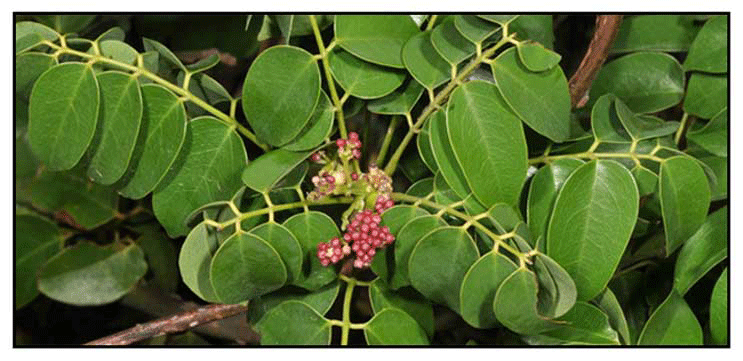
| IMAGE SOURCE: / Photo / Rourea minor. Vine with young inflorescence / Copyright © 2015 by P.B. Pelser & J.F. Barcelona (contact: pieter.pelser@canterbury.ac.nz) [ref. DOL101652]/ Non-Commercial Use / image modified by G. Stuart / click on image to go to source page / Phytoimages.siu.edu |
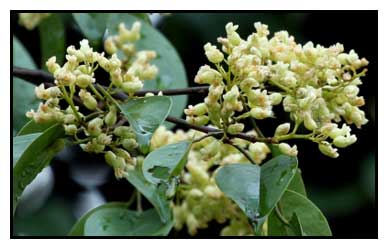
| OTHER IMAGE SOURCE: / Photo / Rourea minor / Flowering stem / loupok / Creative Commons / Attribution-NonCommercial-NoDerivs 2.0 Generic / click on image to go to source page / image modified by G. Stuart / click on image to go to source page / Useful Tropical Plants |
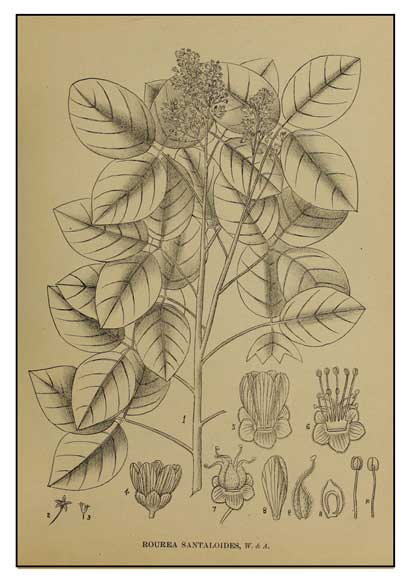
| OTHER IMAGE SOURCE: Drawing of flowering stem / Rourea minor / Photograph by: Kirtikar, K.R., Basu, B.D., Indian medicinal plants, Plates, vol. 2: t. 285 (1918) / Creative Commons / Attribution-NonCommercial-NoDerivs 2.0 Generic / click on image to go to source page / / click on image to go to source page / Useful Tropical Plants |
Additional
Sources and Suggested Readings |
α•(5) |
DOI: It is not uncommon for links on studies/sources to change. Copying and pasting the information on the search window or using the DOI (if available) will often redirect to the new link page. (Citing and Using a (DOI) Digital Object Identifier) |
| List of Understudied Philippine Medicinal Plants |
α•(5) |
 |
|
