| Botany
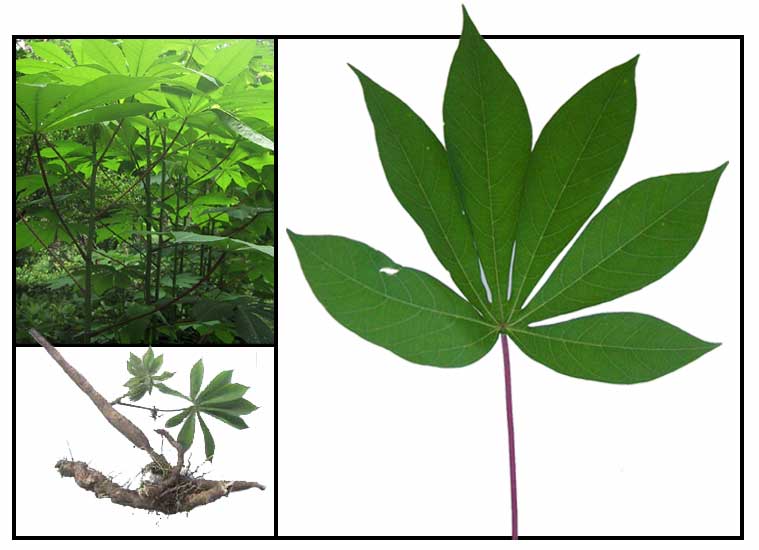
Kamoteng-kahoi is an erect, smooth, half-woody
or shrubby plant, 1.5 to 3 meters in height, growing from stout and
fleshy roots. Leaves are alternate and smooth (except for some of the upper leaves, which are entire) and dividing to the base into three to seven narrow segments, 10 to 20 centimeters long.
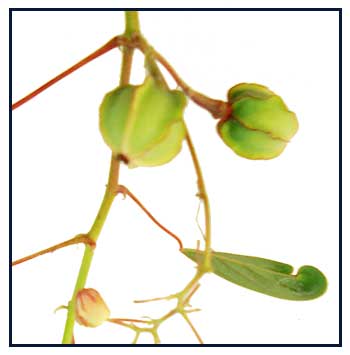
Flowers are about 1 centimeter long. Fruit is a capsule, ovoid,1.5 centimeter long, with six,
narrow longitudinal wings.
 Distribution Distribution
- Planted or semicultivated in settled areas
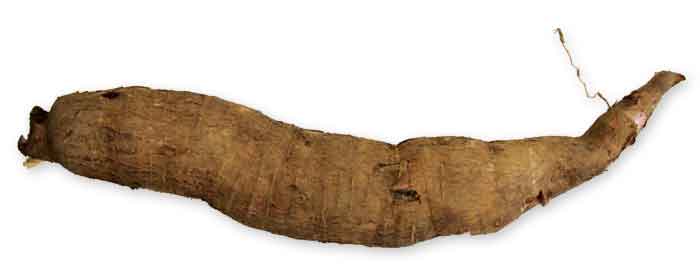
throughout the Philippines for its fleshy and starchy roots.
- Introduced from Mexico in the early colonial period.
-
Now pantropic.
Constituents
• Mandiocin, a glucoside, has been isolated from the leaves.
• Study reports poison of the manioc plant is hydrocyanic or prussic acid, in the tissues, free or combined with a glucoside. The glucoside, phaseolunatin, is also found in various beans, rendering them poisonous.
• In nature, the hydrocyanic acid bound with the glucoside is held in check; but after the root is dug and as wilting occurs, the hydrocyanic acid is freed from the glucoside, and once harmless root, now stale, becomes poisonous.
• Most of the poisonous hydrocyanic acid from the cortical layers
of the roots is removed by thorough peeling of the tubers.
• Tuber contains 26 to 40% starch and 1.5 to 2 percent proteids.
• Cassava leaves yield flavonoids, saponins and vitamin C.
• Study on the chemical composition of stalks: ashes 4.97%, cold water extraction 12.04%, hot water extraction 12.57%, 1% sodium hydroxide solution extraction 34.16%, benzene-alcohol solution extraction 4.20%, nitric acid-alcohol cellulose 35.86%, holo-cellulose 72.62%, pentosan 19.20%, acid-soluble lignin 2.51%, acid-insoluble lignin 26.10%, organic solvent-soluble lignin 1.07%, pectin content is 0.02%. (13)
Properties
• Two well-known varieties: bitter and sweet.
• The bitter, more robust and planted for its starch, the source of tapioca. The roots
containing hydrocyanic acid, considered poisonous but easily dissipated
by heat.
• The root, harmless when fresh, becomes poisonous when stale.
Thorough peeling of the tubers before cooking removes the chance of
poisoning. The sweet variety is grown for use as a vegetable.
• Sweet cassava is not as good a starch producer as the bitter
kind, but is non-poisonous, tasty and grown for use as vegetable.
• Tubers considered antiseptic
• Roots considered
appetizer, aperient, vulnerary, tonic.
• Bark of trunk considered anti-rheumatic.
• Leaves reported to have anti-inflammatory and antimicrobial activity.
Parts used
Tuber, leaves, bark, latex.
Uses
Edibility / Nutrition
- Source of tapioca.
- Sweet cassava is not as good a starch producer as the bitter
kind, but is non-poisonous, tasty and grown for use as vegetable.
- In the Philippines, tender leaves used as wrapping and as ingredient in vegetable stews.
- Tender leaves used as food among the Indians of Brazil; also of widespread use in Malaysia.
- One of the staple food crops in many regions of Africa, Asia, and Latin America.
- In Indonesia, cassava roots used as alternative staple food and tapioca flour as wheat flour substitute in making bread and cookies.
Folkloric
- Leaves used for measles,
small pox, chicken pox, and/or skin rashes.
- Used as flour for starch bath.
- Remove peelings and grate the tuber. Extract the juice, add enough water
for a baby tub bath and boil.
- Poultice of fresh rhizome used for ulcers.
- Leaf sap latex used for eye conditions.
- Decoction of trunk bark used for rheumatism.
- Poultice of fresh rhizome applied to ulcers.
- In West Tropical Africa, compress of powdered
leaves used for fevers and headaches.
- In Cambodia, pounded tubers used for ulcerated
wounds.
- In Brazil, ointment useful for ulcers of
the cornea; also used to preserve meat.
- In Malaysia, used for headaches, colds, fever and to treat constipation.
- In Guiana boiled down to a syrup and used as aperient.
- In Nigeria used in the treatment of ringworm, tumor, conjunctivitis, sores and abscesses.
Others
- Fish Poison: Fruit used as fish poison in Brazil and California.
- Ruminant Energy Source: Cassava chip can be used as alternative energy
source for ruminant feeding. (see study below) (20)
Studies
• Antimicrobial Activity of Cassava Seed
Oil on Skin Pathogenic Microorganisms: Study
showed Cassava seed oil had inhibitory effect on the growth of all test
isolates (Staph aureus, Propionibacterium acne, E coli, Pityrospoium
ovale and C albicans). (1)
• Antibacterial / Low Toxicity: The in vitro Antibacterial
Activity and Brine Shrimp Toxicity of Manihot esculenta Extracts:
Chloroform extracts exhibited antibacterial activity against L. moncytogenes,
V cholera, Shigella flexneri, S typhi white ethanol extracts was effective
against P aeruginosa, C diphtheria and V cholera. (2)
• Antiamoebicidal Activity : In a study on the in-vitro effects of extracts on E. histolytica,
Manihot esculenta was one of 10 extracts that showed ≥ 50% antiamoebic
activity at 96 hours. (3)
• Antitumor Activity: A study has suggested antitumor activity attributed to its triterpenes.
• Decreased Alcohol Toxicity / Increased
Cassava Toxicity: Contrary
to expectations that consumption of alcohol with a cassava rich diet
would potentiate the toxicity of alcohol, co-administration reduced
the toxicity of alcohol and potentiated the toxicity of cassava. The
protection by cassava on alcohol-induced toxicity may be due to micronutrients
like vitamins B and C. However, the toxicity of cassava was potentiated
by consumption of alcohol as shown by the degeneration of hepatocytes
and cell death. (4)
• Lipid Content of Young Leaves: Study showed young cassava leaves to have low content of lipids
(3.02%). Analysis of the fatty acid composition of each of the leaf
lipids showed that, with the exception of of steryl esters, all leaf
lipids have a high content of polyunsaturated fatty acids. (5)
• Anthelmintic / Leaves: A study on fresh cassava leaves incorporated into the diets of
West African goats in Cameroon showed decrease in helmintic and coccidia
infections. (7)
• Analgesic: Ethanol extract of cassava leaves in mice showed an analgesic effect of similar potency as paracetamol.
(8)
• Novel Binder for Paracetamol Tablets: Study showed paracetamol tablets manufactured by using Manihot esculenta starch is better in friability and hardness than those made of industrial starch (Maize). Results showed increased disintegration time and binding capacity. It presents a potential as a cheaper alternative to the tablet manufacturing industry.
(9)
• α-Cellulose from Waste Stems: Study showed the waste stems of Manihot esculenta to have a high cellulose content. Study evaluated the use of the α-cellulose for paper. As raw material it yielded fiber 65.38%, leather waste 29.01%, waste cambium levels of 5.61%, and α-cellulose 56.82%. Stages of investigation included prehidrolisis, delignification and bleaching stages and analysis of α-cellulose. (14)
• Biodegradable Plastic Using Cassava Starch: Study investigated the production of biodegradable plastic using cassava starch as its main component. Cassava starch was mixed with water, epoxydized soya bean oil, glycerol, and polyvinyl alcohol. Material produced yielded desirable mechanical properties and proven to be biodegradable.
(16)
• Anthelmintic / Leaf Extract / Trichostrongyloid Larvae: Study evaluated the anthelmintic activity of Cassava leaves extract against larvae of Trichostrongyloid nematodes using larval paralysis time. Results showed the extract can be used to control the infective stage of trichostrongyloid parasites in small ruminants. (17)
• Antioxidant / Effect on Lipoperoxidation: Study on inhibition of lipid hydroperoxides in assay with DMPD showed an IC59 of 55.08 ± 9.83 µg/mL. Total flavonoid by aluminum hydroxide was 1.53 g/100 g of dry powder.
(19)
• Energy Source for Ruminant Feeding: Cassava roots can be processed as dried chip or pellet. It is rich in soluble carbohydrates (75 to 85%) but low in crude protein (2 to 3%), with an energy value comparable to corn meal but has a relatively higher rate of rumen degradation. Cassava chip can be processed with other ingredients such as tallow, raw banana meal, soybean meal, rice bran, etc.
(20)
• Nutritive and Anti-Nutritive Composition: Aqueous and ethanolic extracts of raw tubers yield alkaloids, flavonoids, tannins, anthraquinone, phlobatannins, saponins, reducing sugars and anthrocyanosides. Raw cassava leaves contain more crude fiber and protein compared to raw or boiled tubers. Raw and boiled tubers and raw leaves yielded vitamins A, C, and E, and minerals calcium, magnesium, phosphorus, iron, sodium, and chloride ions; the levels were significantly reduced by boiling.
(21)
• Antidiarrheal / Leaves: Study evaluated the antidiarrheal activity of a leaf extract of M. esculenta in Wistar rats using castor oil-induced intestinal fluid accumulation and charcoal passage test. Results showed significant antidiarrheal activity by decreasing intestinal fluid accumulation and gastrointestinal motility.
(22)
• Pesticidal / Grain Pest / Leaves: Study showed M. esculenta can be used as potential grain protectant against Sitophilus oryzae. An ethyl acetate solvent extract of leaves was highly toxic against adults of S. oryzae, with 100% mortality at higher doses and exposure time.
(23)
• Jedi-Jedi Pill / Anti-Inflammatory / Analgesic / Leaves: Study evaluated the anti-inflammatory, anti-pyretic and anti-diarrheal activities of a Nigerian tri-herbal (Croton penduiflorus, Cassia podocarpa, and Manihot esculenta) decoction branded "Jedi-Jedi Pill" widely used for treating hemorrhoids and associated diseases. Results
showed anti-inflammatory (carrageenan-induced paw edema) and anti-diarrheal (castor oil method) capabilities but lacking anti-pyretic action. (24)
• Trace Elements in Cassava Flour: Study evaluated the concentrations of trace elements in 10 commercially available cassava flours. Based on recommended daily intake for adults, 10 g/day of cassava flour provides 5.3% of daily intake of Cu, Fe 0.5-1.2%, Ca 0.5%. Mg 0.9-1.2%, Mn 0.6-0.8%, P 0.6%, K 0.2%, and Zn 0.2-0.3. (26)
• Angiosuppressive Potential / Leaves: Angiogenesis is the process through which new blood vessels proliferate from pre-existing vessels. Study evaluated the antiangiogenic potential of M. esculenta leaves ethanolic extract on Chorioallantoic Membrane (CAM) of duck embryos. The ethanolic extract of leaves showed angiosuppressive activity comparable to retinoic acid, a known angiogenic inhibitor. The activity may be attributed to the antioxidants, lignans, and linamarin found in the leaves. (27)
• Thrombolytic Activity / Leaves and Tubers: Study evaluated the in vitro thrombolytic activities of leaves and tuber extracts of cassava Manihot esculenta. Streptokinase was used as positive control. Results showed good thrombolytic activity which increased with increasing concentrations. In vivo clot dissolving properties and active components for clot lysis are yet to be determined. (28)
• Allergic Reactions / Latex-Fruit Syndrome: Study evaluated 9 patients presenting with allergic symptoms after ingestion of boiled manioc. All patients presented with clinical relevant latex allergy. A relevant IgE-binding glutamic acid-rich protein from manioc with 41.8% sequence homology to Hev b 5, an important latex allergen, considered to be a strong candidate for involvement in a latex-manioc syndrome. It is important clinicians are aware that manioc is a source of allergens involved in the latex-fruit syndrome. (29)
Toxicity
concerns
• Cyanogenic Glucosides / Linamarin: (1) Cassava is a dietary staple in many tropical
countries. In times of famine, it may be the only food available. Tissues
of all cassava cultivars have been found to have varying amounts of cyanogenic
glucosides. (2) Presence of cyanoglycosides, linamarin (93%) and lotaustralin
(methyl linamarin, 3%) pose potential toxic effects. Linamarin is hydrolyzed
by intestinal luminal bacterial ß-glucosidases to release hydrogen
cyanide which can cause acute poisoning. Although traditional methods
of cooking (boiling and decanting) and processing remove cyanoglycosides,
some residual amounts and toxicity remains.
• In Asia, cassava is processed to make cassava chips and tapioca.
In rural Philippines, it is a common and accessible snack fare consumed
after simple boiling or frying.
• In traditional use, processing of vegetables with known toxicity through chopping, immersion in water, roasting, crushing, and cooking in boiling water for 30 to 45 minutes before consumption eliminates known toxic compounds or decrease them under non toxic level. (19)
• A Kwashiorkor Etiology Hypothesis / Cassava
and Linamarin: A study hypothesizes that intact linamarin from cassava
diets cause Na-K-ATPase inhibition with consequent electrolyte imbalances
and potassium depletion, which may results in renal tubular nephrosis,
subsequent proteinuria and hypoalbuminemia, hepatocellular damage, pancreatic
dysfunction, muscle wasting–all features of kwashiorkor. (6)
• Toxicity Study in Rats After Traditional Processing: In Sudan and other countries, cassava roots are consumed mainly as flour. It was suspected that traditional processing was not enough to eliminate all the toxic cyanogenic glycosides. Study in Wistar rats evaluating aqueous and methanolic extracts of tubercular roots after traditional processing reported toxic causing alterations on various serobiochemical and hematological parameters with correlating dysfunction of vital organs. Toxicity was attributed to the presence of cyanogenic glycoside - linamarin and lotaustralin. (10)
• Linamarin / Neurotoxic Effect: If cassava is not adequately processed or the consumer has nutritional deficiencies, the cyanogenetic glycosides (linamarin and lotaustralin) makes it potentially neurotoxic. Study evaluated the neurotoxic effects of different concentrations of linamarin (0.75 to 0.30 mg/kg) contained in cassava juice in locomotor alterations in open field and swim tests in adult male Wistar rats. Results showed behavioral changes which may be due to neuronal damage caused by linamarin consumption in cassava juice. (25)
Availability
- Wild-crafted.
- Common backyard planting and market produce. |