 Gen info Gen info
- Terminalia is a genus of large trees of the flowering plant family Combretaceae, comprising nearly 300 species distributed in tropical regions of the world.
- The Genus name Terminalia derives from Latin terminus, referring to the leaves that appear at the very tip of the shoots. (2) The specific epithet citrina derives from 'citrus lemon', referring to the lemon-yellow flowers.
Botany
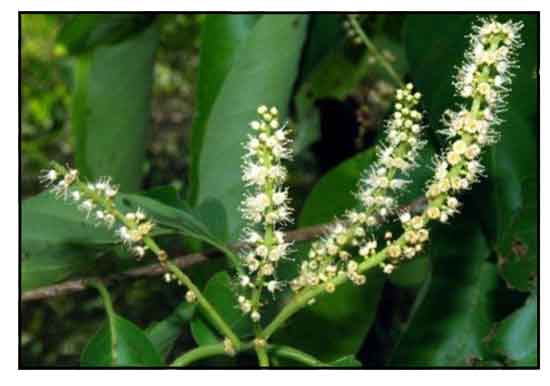
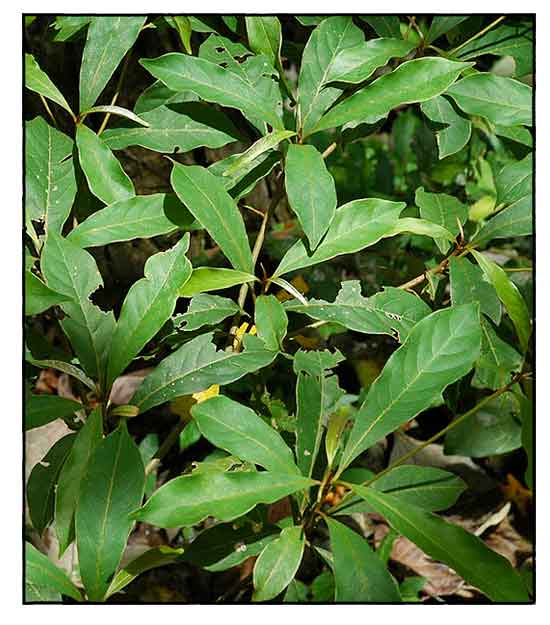
• A large deciduous tree with alternate opposite leaves reaching about 10m in height. Flowers are yellowish white with offensive smell arranged in axillary spikes. Drupaceous fruit is ovoid in shape with more or less five ridges. (8)
• Yellow Myrobalan is a medium sized to large deciduous tree, often with buttressed stem attaining 80 ft. in height. Bark is gray or brown, slightly vertically fissured outside, light yellow, turning brown and fibrous inside, about 8 mm thick. Young shoots are shining, rusty or brown velvet-hairy, soon hairless. Leaves are nearly opposite, 7-19 x 3-10 cm, lance-shaped or blonde-lanceshaped to elliptic, pointed or shortly tapering; velvet-hairy when young, hairless and shining when mature; lateral nerves 8-12 on either half, curving upwards; base wedge-shaped or rounded; leaf-stalk 1.0-2.5 cm long, bi-glandular, glands prominent, round. Flowers are borne in spikes deciduously rusty finely velvet-hairy, panicled at the ends of shoots with lower branches in leaf-axils or sometimes solitary and in leaf-axils. Flowers are about 5 mm across, stalkless, all hermaphrodite, each with a small linear silky velvet-hairy deciduous bract, those towards the bottom of the spikes spoon-shaped and larger downwards. Sepal-cup is hairless outside, rusty hairy within; limb broad, cup-shaped; teeth 5, erect. Fruit is 5-7.5 cm by 1.8-2.5 cm, oblong-lanceshaped, slightly club-shaped, smooth, hairless, obscurely 5-ridged. (21)
Distribution
- Native to the Philippines.
- Found in Bancalan, Bataan, Batangas, Bulacan, Cagayan, Laguna, NCR, Pampanga, Pangasinan, Quezon, Rizal, Leyte, Masbate, Agusan del Norte, Davao del Sur, Zamboanga, Mindoro, Negros, Polillo, Romblon, Ticao. (3)
- In forests at low and medium elevation; also frequent along e seashore.
(2)
- Also native to
Andaman Is., Assam, Bangladesh, Borneo, East Himalaya, India, Jawa, Laos, Lesser Sunda Is., Malaya, Maluku, Myanmar, Nepal, Nicobar Is., Sulawesi, Sumatera, Thailand, Vietnam, West Himalaya. (1)
 Constituents Constituents
- Phytochemical analysis of aqueous and ethanolic extract of fruits yielded alkaloids, carbohydrates, phenolic compounds, tannins, catechins, and saponins. (see study below) (4)
-Study of fruit CH3OH extract isolated five known tannins: corilagin (1), punicalagin (2), 1,3,6-tri-O-galloyl-β-D-glucopyranose (3), chebulagic acid (4), and 1,2,3,4,6-penta-O-galloyl-β-D-glucopyranose (5). (see study below) (5)
- Fruit nutritional value per 100 gm: Energy 143 kcal; water 58 gm; carbohydrate 9 gm; protein 4 gm; potassium 64 mg, calcium 128 mg; magnesium 67 mg; zinc 0.20 mg. (8)
- Phytochemical screening of methanolic extract of leaves yielded alkaloids, flavonoids, tannins, saponins, quinines, anthocyanins, glycosides, carbohydrates and reducing sugars. (see study below) (10)
- Spectroscopic studies of Terminalia citrina leaves characterized 1 new furofuran lignan glucosides, terminalosides A-K (1-4, 6-12), 2-epiterminaloside D (5), and 6-epiterminaloside K (13). (see study below) (14)
- Methanol and ethanol extracts of fruits yielded carbohydrates, alkaloids, glycosides, tannins and phenolics, flavonoids, and saponin, with absence of of terpenoids and steroids. (see study below) (16)
- Study isolated seven previously undescribed α-keto tetrahydrofuran lignan glucosides (terminalosides Q-W) from EtOAc extract of Terminalia citrina leaves. (see study below) (18)
- Study isolated five new polyalkoxylated furofuranone lignan glucosides, terminalosides L-P (1-5) from EtOAc extract of leaves of Terminalia citrina. (see study below) (19)
-
Study isolated anti-Salmonella T3SS active compounds neochebulagic acid (1), ellagic acid (2) and urolithin M5 (3) from the seed extract of Terminalia citrina. (see study below) (20)
Properties
- Fruit considered astringent.
-
Bark is cardiotonic and diuretic.
-
Studies have suggested genotoxic, mutagenic, antimicrobial, antinociceptive, anti-inflammatory, anxiolytic, anthelmintic, antioxidant, anti-Vibrio cholerae, estrogen-inhibitory, hypoglycemic, antidiarrheal, antiproliferative, thrombolytic properties.
Parts used
Fruit, seed, leaves.
 Uses Uses
Edibility
- Fruits is edible; eaten raw; described as sour, astringent, bitter, savory, and hot. (7)
Folkloric
- In the Philippines, decoction of fruit used for treating thrush and obstinate diarrhea.
-
In Indonesia, decoction used for abdominal illness.
- Fruit eaten raw stimulates bowel movement and can cause diarrhea; eaten boiled, it can cause constipation. Juice drunk to promote longevity and considered good for the voice; used to treating sore eyes. A mixture of fruit powder and honey is licked to cure gas. Pounded fruit is smoked in a pipe as a remedy for asthma. In a blanc mange-like confection, use to relieve intermittent fever and diarrhea. Mixture of ground fruit, water, honey, and sesame oil applied to burns. (7)
-
Powdered fruit used as toothpaste to whiten teeth. Reduction of boiled fruit to a fifth-volume use for disorders of mouth and palate. Fruit decoction used to wash flesh-eroding sores. Crushed fruit applied to head for migraine headaches. Overnight fruit infusion used as eye rinse to cool the eyes and improve vision. Pellets dried in the sun, prepared from fruit powder with juice from mu-yar gyi (Adhatoda vasica, Justicia adhatoda) are rolled in honey and licked to stop vomiting and bleeding. Fruit boiled in cow urine used as cure for anemia and debilitating diseases. (7)
- Used as mouthwash and gargle for sore throat and cough. (8)
- In Bangladesh, fruit is used for long-term fever, loss of appetite, and as sexual stimulant. Seed is used for stomach aches and intestinal diseases. Plant used for asthma, diarrhea, boils, burns, constipation, migraine, bleeding hemorrhoids, cough, urolithiasis and for longevity in Myanmar. (11)
Studies
• Genotoxic / Cytotoxic / Fruits: Study evaluated aqueous and ethanolic fruit extracts of T. citrina for genotoxic potential by Ames reverse mutagenicity assay in Salmonella TA 100 and 102 strains and cytotoxic potential in a baby hamster kidney cell line (BHK021). The ethanolic extract showed higher mutagenicity in TA 100 strain, while the aqueous extract exhibited higher mutagenicity in TA 102 strain. Both extracts showed dose dependent mutagenicity. The genotoxic and cytotoxic effects exacerbated with increase in extract concentration. Results suggest the fruit may not be safe in humans and suggest further studies in rodents to asses pathological and physiological effects with its use. (see constituents above) (4)
• Antimicrobial / Tannins / Fruits: Study of fruit CH3OH extract isolated five known tannins: corilagin (1), punicalagin (2), 1,3,6-tri-O-galloyl-β-D-glucopyranose (3), chebulagic acid (4), and 1,2,3,4,6-penta-O-galloyl-β-D-glucopyranose (5). Each tannin exhibited antimicrobial activity against different microorganisms in varying degrees. Compound 1 was more active against more organisms with equal or less concentration. Some were active against E. coli (1) and C. albicans (1, 2, 4, 5). All were effective against S. aureus. Compounds 1 and 2 inhibited P. aeruginosa. (5)
• Antinociceptive / Anti-Inflammatory / Anxiolytic / Leaves: Study of methanolic extract of leaves showed antinociceptive activity by acetic acid induced writhing method and radiant heat flick method, anti-inflammatory activity by human red blood cell membrane stabilization method, and anxiolytic activity by elevated plus maze model. (6)
• Toxicity Studies / Leaves: Study evaluated the acute and subacute toxicity of methanol extract of T. citrina leaves in Sprague Dawley rats. using limit dose of 3 200 mg/kbw for acute toxicity studies, and 250, 500 and 1000 mg/kg extracts orally daily for 28 days for subacute toxicity testing. Results showed no toxic effect of the extract, hematologically, biochemically, and pathologically. No mortality was recorded in 28 days. Results suggest safety and nontoxicity. (9)
• Anthelmintic / Leaves: Study evaluate the anthelmintic activity of methanolic extract of Terminalia citrina against Pheretima posthuma using doses of 25, 50, and 100 mg/mL of extracts, using measures of time of paralysis and time of death of worms. Results showed significant paralysis and death of worms especially at highest dose of 100 mg/mL, compared to standard Albendazole (10 mg/ml). (see constituents above) (10)
• Antioxidant / Leaves: Study evaluated methanol extract and fractions (petroleum ether, carbon tetrachloride, dichloromethane, and ethyl acetate) of leaves of T. citrina for antioxidant, antimicrobial, and cytotoxic activity. The methanol leaf extract exhibited highest flavonoid content and antioxidant capacity while the ethyl acetate fraction yielded highest phenolic content, reducing power, DPPH, and ABTS radical scavenging activity. On antimicrobial and cytotoxicity testing, the leaves extracts did not show remarkable activity against tested microorganisms and Artemia salina. (11)
• Antipyretic / Antinociceptive / Anti-Inflammatory / Fruits: Study evaluated the anti-inflammatory, anti-nociceptive, and antipyretic potential of ethanolic and aqueous extracts of Terminalia citrina fruits using extract doses of 200, 400, and 600 mg/kg in albino mice. Carrageenan induced paw edema method was used for anti-inflammatory evaluation, acetic acid induced writhing for analgesic testing, and brewer's yeast induced pyrexia model for antipyretic potential. Both extracts showed significant and dose-dependent anti-inflammatory, analgesic, and antipyretic activities. The ethanolic extract was more effective in reducing inflammatory edema, pyrexia and pain sensation than the aqueous extract. (12)
• Antidiabetic / Antinociceptive / Anti-Inflammatory / Fruits: Study evaluated the antidiabetic activity of T. citrina methanolic extract in streptozotocin-induced diabetic male Wistar rats. The methanolic extract exhibited better in-vitro antioxidant and α-amylase inhibitory activity. The ME showed notable (p<0.5) antidiabetic potential evidenced by lowered fasting blood glucose level, restored lipid level, serum amylase, HbA1c, renal and liver function tests, and co-evidenced by histological findings of the liver, pancreas, and kidney. Acute and subacute toxicity tests showed no clinical toxic signs and mortality. GC-MD study revealed10-octadecenoic acid and other compounds that may have contributed to its antidiabetic potential. (13)
• Furofuran Lignan Glucosides / Estrogen-Inhibitory Properties / Leaves: Spectroscopic studies of Terminalia citrina leaves characterized 1 new furofuran lignan glucosides, terminalosides A-K (1-4, 6-12), 2-epiterminaloside D (5), and 6-epiterminaloside K (13). Isolates were tested for their estrogenic/ antiestrogenic activity using MCF-7 and T47D estrogen-responsive human breast cancer cell lines. Terminalosides B (2) and G (8) exhibited inhibitory effects for both cell lines, and 90% suppression of estradiol-enhanced cell proliferation at concentrations lower than 10 µM. Terminaloside E (6) showed inhibitory activity against T47D cell line, while terminalosides C (3), F (7), and I (10) and 6-epiterminaloside K (13) displayed antiestrogenic activity against MCF-7 cells.
(14)
• Antioxidant / Cholinesterase Inhibitory / Fruits: Study evaluated lyophilized water (WTE) and alcohol extracts (ETE) of T. citrina for antioxidant activities, phenolic content, and effects on cholinesterases (ChEs, AChE, acetylcholinesterase, and BChE, butyrylcholinesterae). Both WTE and ETE exhibited strong antioxidant capacity. ETE and WTE showed inhibitory effect against ChEs with IC50s 94.87 and 130.90 m,g/mL for AChE and 262.55 and 279.70 mg/mL for BChE respectively. Results suggest potential for Alzheimers disease, preventing oxidative damage mitochondrial dysfunction. (15)
• Anti-Vibrio cholerae / In-Vitro Cytotoxicity / Fruits: Study evaluated the anti-Vibrio cholera activities of methanolic and ethanolic extracts of Terminalia citrina and Desmodium triflorum. Both plants showed appreciable anti-V. cholerae activities with mild toxicity. Only the ethanolic extract of T. citrina fruits showed 100% mortality at highest concentration of 800 µg/ml. Results suggest potential phytotherapy against cholera disease. (see constituents above) (16)
• Antidiarrheal / Hypoglycemic / Thrombolytic / Leaves: Study evaluated the anti-diarrheal, central nervous system depressant, hypoglycemic, and thrombolytic effects of methanol extracts of T. citrina leaves. On castor oil-induced diarrhea method, the extract showed significant (p<0.01) and dose-dependent 25.48% reduction of diarrhea. The extract exhibited significant (p<0.01) hypoglycemic effect at 400 mg/kbw, and significant (p<0.01) 10.74% clot lysis by in vitro clot lysis test. The extract showed no central nervous system depressant effect. (17)
• Inhibition of Estradiol (E2)-Induced Proliferation in Cancer Cells: Study isolated seven previously undescribed α-keto tetrahydrofuran lignan glucosides (terminalosides Q-W) from EtOAc extract of Terminalia citrina leaves. The isolated compounds were evaluated for estrogenic and anti-estrogenic properties using two types of estrogen-responsive human breast cancer cell lines (MCF-7 and T47D). Terminaloside R inhibited 90% of estradiol-enhancede cell proliferation in T47D and MCF-7 cells at concentrations of 0.01 and 0.1 µM, respectively. Terminaloside T suppressed 90% of cell proliferation selectively n T7D cells at 0.01 µM concentration. (18)
• Antiestrogenic / Furofuranone Lignan Glucosides / Terminalosides / Leaves: Study isolated five new polyalkoxylated furofuranone lignan glucosides, terminalosides L-P (1-5) from EtOAc extract of leaves of Terminalia citrina. t 10 nM, terminaloside L (1) suppressed E2-enhanced T47D cell proliferation by 90%, while terminaloside M (2) showed 90% antiestrogenic activity against MCF-7 cells. (19)
• Regulation of Intestinal Homeostasis / Urolithin B: Study isolated anti-Salmonella T3SS active compounds neochebulagic acid (1), ellagic acid (2) and urolithin M5 (3) from the seed extract of Terminalia citrina. Urolithins are the main and stable intestinal microbiota metabolites of hydrolysable tannins. Metabolite urolith9in B repressed translation and secretion of SipC through the Hha–H-NS–HilD–HilC–RtsA–HilA regulatory pathway. Results suggest Terminalia seeds and ellagitannin-rich berries and nuts regulate intestinal homeostasis and can treat bacterial infection. (20)
Availability
Wild-crafted.
|