|
 Botany Botany
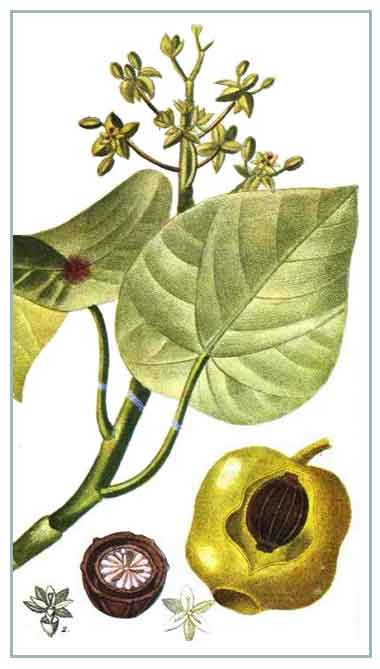
Koron-koron is a small tree, growing to a height of 40 feet. Leaves
are smooth, somewhat leathery, broadly ovate, peltate, 15 to 18 centimeters long, 8 to 10 centimeters wide, pointed at
the tip, broad and rounded at the base, with petioles up to 7 to 12 inches long.
Blade is 5- to 9-nerved. Inflorescence is terminal or at the axils
of the leaves, 10 to 20 centimeters long. Flowers are hairy, whitish and about one centimeter in diameter. Fruit is ellipsoid or somewhat rounded and 1.5 to 3 centimeters long. Involucre is greatly enlarged.
 Distribution Distribution
- Found along the seashore, occasionally
extending inland on slopes at low altitudes from central Luzon (Zambales and Quezon) to Palawan, Mindanao and the Sulu Archipelago.
- Also occurs in Sri Lanka to tropical East Africa and Madagascar, and through Malaya to tropical Australia and Polynesia.
Constituents
- Fruit contains an alkaloid, 0.7 per
cent, resembling berberine.
- Seeds contain an oil, 51%, used in the same way as those of Aleurites in some parts of the Dutch Indies in making candles.
- Oil is red brown; feebly drying, which contains stearin. It is inedible.
- Study of root-bark led to the isolation of eight compounds: desoxypodophyllotoxint , thalicarpine, dehydrothalicarpine, ovigerine, hemanger-ine, hemando-nine and two unknown substances, mp. 219-220" and mp. 269-270°. Desoxypodop-hyllotoxin(I) and thalicarpineflll) exhibited a distinctively cytotoxic activity against nasopharynx carcinoma was reported by S.M. Kupchan et aI. Dehydrothalicarp-ine(IV) is merely a dehydro product of thalicarpine(III) at C-6a and C-7 of aporphinemoiety.
- Study for lignoidic and alkaloidal content of leaves, stem barks and root barks of HG yielded two aryltetrahydronaphthalenes, two dibenzylbutyrolactones, and nine alkaloids. (12)
- Seeds yielded three kinds of lignans, including a new lignan, hemolactone, including six known lignans: desoxypodophyllotoxin (DPT), desoxypicropodophyllin, bursehernin, podorhizol, hernandin and dehydro-DPT. (14)
- Fractionation of ethyl acetate extract of twigs yielded two naturally occurring aryltetralin lignans (7R,8S,7‘R,8‘R)-(+)-7‘-acetyl-5‘-methoxypicropodophyllin (1) and (7R,8S,7‘R,8‘R)-(+)-7‘-acetylpicropodophyllin (2), along with eight known compounds, epiyangambin (3), caruilignan C, diasesartemin, (+)-epimagnolin A, N-methylcorydaldine, (−)-5‘-methoxyyatein, (+)-syringaresinol dimethyl ether, and (−)-yatein.
Properties
Bark and leaves considered cathartic and depilatory.
Parts
utilized
Leaves, oil, roots.
Uses
Folkloric
- In the Philippines, the oil is used as a hair restorer;
also used for dandruff.
- The root is chewed to counter the effects of eating poisonous crabs
or fish.
- Leaves and seeds, when eaten, cause purging and dizziness.
- In the Moluccas, the heartwood
at the base of the trunk used for treating hemorrhages.
- The bark and leaves used as cathartic and depilatory.
- In the Guianas, juice from stem bark used as depilatory and to kill hair lice. Juice of young leaves used as depilatory. Decoction of fruit and flower used for whooping cough. Bark, young leaves and seeds used as mild purgative. (13)
Others
- Oil: In the Dutch Indies, oil used to make candles.
Studies
 • Twigs Constituents:
Fractionation of ethyl acetate extract of HO twigs isolated two new
naturally occurring aryltetralin lignans along with 8 known compounds.
Two (compounds 2 and 3) exhibited significant inhibition of the transformation of murine
epidermal JB6 cells with IC50 of 0.15 and 0.4 µg/mL, respectively. (see constituents above) (1) • Twigs Constituents:
Fractionation of ethyl acetate extract of HO twigs isolated two new
naturally occurring aryltetralin lignans along with 8 known compounds.
Two (compounds 2 and 3) exhibited significant inhibition of the transformation of murine
epidermal JB6 cells with IC50 of 0.15 and 0.4 µg/mL, respectively. (see constituents above) (1)
• Antitumor:
HO reported to possess alkaloid possessing inhibitory activity against
the Walker intramuscular carcinosarcoma 256 test system.
•
Seed Constituents / Lignans:
Study isolated a new lignan, hernolactone from the seeds of HO besides
six previously reported lignans. (3)
• Deoxypodophyllotoxin / Anticancer: The seeds of HO contain 2.4% DPT (deoxypodophyllotoxin). DPT is a form of epipodophyllotoxin, a basic skeleton of the anticancer drug etoposide. HO presents a possible source for the mass production of etoposide. (4)
• Antiplatelet Aggregation / p-Quinonoide Aporphine Alkaloids: Study isolated 3 minor p-quinonoid aporphine alkaloids (sonodione, demethysonodione and norsonodione) and ovigerine, hernangerine, N-methylhernangerine, (+)-malekulatine and isovanillin from the stem bark of Hernandia sonora. Compounds 4-8 showed moderate antiplatelet aggregation activity in vitro. (5)
• Tumor-Inhibitor / Thalicarpine: A tumor-inhibitor thalicarpine, the first dimeric benzylisoquinoline-aporphine alkaloid, had been isolated from the stem-bark of Hernandia ovigera.
• Cytotoxicity / Nasopharyngeal Carcinoma: A 1975 study of root-bark led to the isolation of eight compounds: desoxypodophyllotoxint , thalicarpine, dehydrothalicarpine, ovigerine, hemanger-ine, hemando-nine and two unknown substances. , mp. 219-220" and mp. 269-270°. Desoxypodophyllotoxin and thalicarpine exhibited a distinctively cytotoxic activity against nasopharynx carcinoma. (7)
• Cyclooxygenase-2 Inhibitory Activity: Study isolated a new dibenzylbutyrolactone lignan, (2 R,3 R)-5'-methoxyguayarol, from an ethanol extract of seeds, together with three known fatty acid derivatives and seven known lignans. (S)-coriolic acid and (+/-)-glycerol 1-monolinolate were shown to have selective inhibitory activity with cyclooxygenase 2. (9)
• Conversion of DPT to EPT / Anticancer Etoposide / Seeds: Penicillium F0543 converted deoxypodophyllotoxin (DPT), a major constituent (2.4%) of seeds of H. ovigera, to epipodophyllotoxin (EPT), a basic skeleton of the excellent anticancer agent, etoposide. (15)
• Lignans / Anti-Tumor Promoters: Seeds yielded seven lignans and were tested for inhibitory effects on Epstein-Barr virus early antigen activation induced by 12-O-tetradecanoylphorbol 13-acetate in Raji cells. All showed inhibitory activity with IC50 of 470-590 mol ratio/32 pmol TPA. Results suggest the lignans may be valuable anti-tumor promoters. (16)
Availability
Wild-crafted. |