Botany
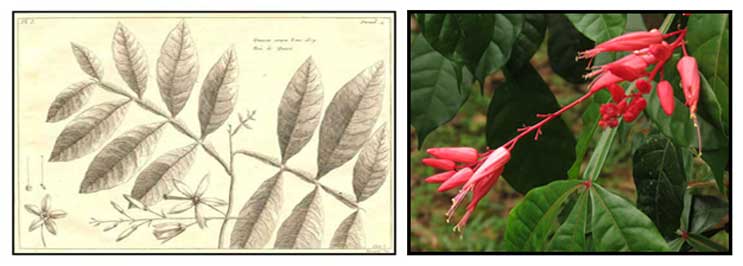
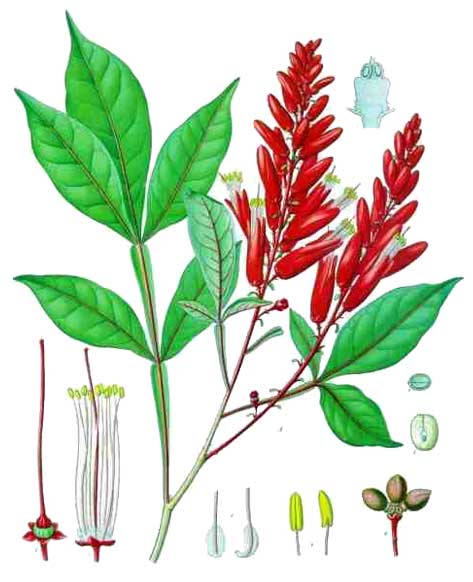
Kuasia is a smooth shrub growing 2 to 3.5 meters high. Leaves are alternate, about 20 centimeters long. Petiole and rachis are broadly winged. Leaflets are five, stalkless, elliptic-oblong, although the terminal one could be oblong-obovate, and 7 to 12 centimeters long. Flowers are borne on racemes, 8 to 20 centimeters long, bright red, with the corolla about 2.5 centimeters long.
 Distribution Distribution
- Ornamental cultivation.
- Certainly introduced; native of tropical America.
Constituents
- Bark contains quassin, the bitter principle, 0.1 percent.
- Contains no tannin.
- Yields (1) quassain, a mixture of α-picrasmin and ß-picrasmin bitter principles, (2) a volatile oil.
- Phytochemicals: Quassinoids (quassimarin, quassol, quassin, neoquassin, isoquassin, 18-hydorxyquassin, quasinol), alkaloids, beta-sitostenone, gallic acid, mallic acid, simalikalactone D.
- Flowers and leaves also contain quassin.
- Study of Quassia amara young leaf tea contains several quassinoids: simalikalactone D (SkD) (1), picrasin B (2), picrasin H (3), neoquassin (4), quassin (5), picrasin I (6) and picrasin J (7). (see study below) (3)
- Flash column chromatography and HPLC separation of commercial crude quassin (extract from Quassia amara) yielded a new quassinoid lactol named quassialactol (1), along with known compounds quassin, neoquassin, paraine, nigakilactone A and
180hydroxyquassin. (28)
- Study of methanol extract of stem wood isolated a new alkaloid, 2-methoxycanthin-6-one (1) along with quassin (6).
(35)
Properties
- Considered anthelmintic, antilithic, carminative, bile stimulant, digestive stimulant, insecticidal, analgesic, antiviral, antiulcer, gastroprotective, antimalarial, sedative, tonic, vermifuge.
- Considered a bitter tonic without astringency.
- Infusion of wood is considered tonic, febrifuge, and stomachic.
- Studies have suggested antibacterial, antifungal, antiparasitic, anthelmintic, antifertility, anti-head lice, antimalarial, anti-anemic, anti-ulcerogenic, analgesic, antiedematogenic, sedative properties.
Parts used
Various plant parts.
Uses
Folkloric
- Used for dyspepsia and anorexia.
- A strong enema infusion destroys threadworms.
- Infusion used for dyspepsia, loss of appetite, debility after fevers; also given in bilious fevers.
- Infusion used in gout, mixed with alkaline salts, aromatics and ginger.
- In hysteria, used with camphor and tincture of valerian.
- Applied to the scalp to treat lice infestation.
- In dyspepsia, used with zinc sulfate, iron or mineral acids.
- Infusion of wood used as tonic and febrifuge; also, as stomachic.
- In French Guiana, leaf tea is is most frequently used antimalarial remedy.
- In Mexico, plant decoction used to treat diabetes. (20)
- Amerindians in NW Guyana used decoction of bark and leaves to kill lice.
Others
- Insecticidal.
Studies
• Antifertility Effect in Male Rats: Study on the male reproductive toxic effect of Q. amara in a Swiss mouse model showed the extract-treated mice exhibited dose-dependent toxicity on epididymal sperm parameters, with decreased sperm count, decreased motility, with abnormal morphologies in more than 50% of the sperm. Results affirm the male reproductive toxic effects of QA when applied as a therapeutic or biopesticide. (1)
• Antifertility Activity in Male Rats / Quassin / Stem Wood: A crude methanol extract of stem wood significantly caused reduction in weights of testis, epididymis and seminal vesicle, with an increase of the anterior pituitary gland. Treatment with the extract caused significant reduction of epididymal sperm counts serum levels of testosterone, LH, and FSH. Fractionation isolated two compounds: quassin and 2-methoxycanthin-6-one. Quassin appeared to be the antifertility principle of Quassia amara. (2)
• Quassinoids / Simalikalactone D (SKD) / Antimalarial Herbal Tea: Study evaluated the potential of Q. amara young leaf tea for treatment of malaria. The antimalarial Quassia amara young leaf tea contains several quassinoids: simalikalactone, picrasin B, picrasin H, neoquassin, quassin, picrasin and picrasin J. Both biologic activity and cytotoxicity may be attributed to the simalikalactone D. (3)
• Insecticidal: Study has shown the water extract of Quassia has anti-larval activity on Culex quinquefasciatus.
• Anti-Headlice: Report presents the pediculicide activity of Quassia Vinegar as an alternative form of therapy for headlice infestation. It combines Quassia amara, a natural repellent and inhibitor of chitin synthesis with vinegar which prevents the attachment of nits to the hair shafts by dissolving their chitin envelops. (4)
• Anti-Malarial: Six extracts from two Nigerian plants, Q amara and Q undulata were screened for antimalarial properties. The Q amara leaf methanol extract showed the highest suppressive activity. (5) Study evaluated the antimlarial potential of traditional remedies used in French Guiiana using 35 remedies in their traditional form.
• Anti-Ulcerogenic: Quassia amara extracts showed an an important anti-ulcerogenic effect in acute ulcer induction models. The effect was probably related to an increase in gastric barrier mucus and non-protein sulfhydril groups. (7)
• Anti-Diabetic / Anti-Dyslipidemic: Q. amara standardized methanol extract significantly increased the glucose tolerance in nicotinamide-STZ-induced diabetic rats. QA extract and glibenclamide normalized dyslipidemic associated with STZ-induced diabetes. (8)
• Antibacterial / Antifungal: In a study of extracts of Q. undulata and Q. amara, all eight extracts exhibited marked antibacterial (E. coli, S. faecalis, S. aureus) and antifungal (Aspergillus niger) activities, in most cases higher than the standard reference drug. QA leaf methanol leaf extract singularly exhibited the highest activities in both assays. (9)
• Simalikalactone / Antimalarial: Study yielded a new quassinoid, simalikalactone (SkE), from the leaves of Q. amara. SkE inhibited the growth of Plasmodium falciparum. It also decreased gametocytemia seven-fold lower than that of primaquine. (10)
• Topical Rosacea Therapy: A topical gel with 4% Quassia amara extract in the treatment of various grades of rosacea showed it to be very effective relating to flushing, erythema, telangiectasia, papules and pustule scores. Results suggest the extract can a new, efficient, and safe alternative in the management of rosacea. (11)
• Hematologic Effects / Quassia / Anti-Anemic: Quassin and 2-methoxycathine-g-one, isolated from a stem bark extract, was studied for hematological effects. All doses of extract and quassin significantly increased RBC count, packed cell volume, and hemoglobin concentration. 2-methoxycathine-6-one effected no change. (13)
• Antiulcerogenic Effects / 2-methoxycanthin-one: Study evaluated an extract and bioactive principles-quassin and 2-methoxycanthin-one on gastric ulcerations in albino rats. The extract and 2-methoxycathine-one significantly inhibited gastric ulceration induced by indomethacin. (14)
• Facial Seborrheic Dermatitis: Study evaluated the efficacy and safety of a topical gel of 4% Q. amara extract in the treatment of SD (seborrheic dermatitis). QA was tested and compared with topical ketoconazole and topical ciclopiroxolamine. All three were found effective, with an efficacy advantage for 4% Quassia extract. Results showed the topical gel from the 4% extract represents a safe and effective treatment for SD. (15)
• Reproductive Toxicity / Sperm Capacitation / Acrosome Reaction: Thirty nine percent of rat sperm cells treated with Q. amara failed to be capacitated and their acrosome remained intact white 30% failed to undergo acrosome reactions. Quassia amara may mediate its antifertility effect by acting on ion channels or on caudal epididymal sperm proteins critical for sperm capacitation. (16)
• Inhibitory to Entamoeba histolytica: Entamoeba histolytica is an important etiologic agent of diarrhea, globally infecting 40 to 50 million people with 40,000 to 100,000 deaths per year. Metronidazle is effective treatment but can cause serious adverse reactions. Study showed Quassia amara crude extract has inhibitory effects on Entamoeba histolytica in vitro. (19)
• Analgesic / Antiedematogenic / Sedative / Bark: Study evaluated the possible antiedematogenic, antinociceptive and/or sedative effects of various bark extracts of Quassia amara. Oral administration of the extracts showed no effects. However, intraperitoneally, the hexane extract decreased paw edema induced by carrageenan, showed antinociceptive effects on hot-plate test and acetic acid-induced writhing and showed effective sedative effects. Eff4cts were attributed to sedative and muscle relaxant or psychomimetric activities. (22)
• Antifertility / Quassin / Inhibition of Steroidogenesis / Stem Wood: A crude methanolic extract of stem wood of Quassia amara inhibited both basal and LH-stimulated testosterone secretion of rat Leydig cells in a dose dependent manner. Fractionation by chromatography yielded quassin (1) and 2-methoxycanthin-6-one (2). Compound 1 showed to be the bioactive agent. (23)
• Reproductive Toxicity in Male Rats/ Bark: Study evaluated chloroform extracts of Quassia amara bark in different dilutions for effects on the male reproductive system of albino rats. Single dose administration of the extract for 15 days resulted in significant reduction in weight of testis and epididymis and marked decrease in sperm count, motility, and viability. Sperm abnormalities like double heads, double tails, detached heads and fragile tails were frequently observed. Epididymal α-glucosidase activity was drastically reduced. Results suggest potential use of the chloroform bark extract as antifertility agent. (24)
• Amarastelline A / Alkaloid / Staining of Cervical Cancer HeLa Cells / Bark: Study isolated a new alkaloid, amarasteline A (1), consisting of a canthin and a carboline unit, from the bark of Q. amara. Compound 1 is strongly fluorescent under UV light and stains the cell cytoplasm region of living cervical cancer HeLa cells. (25)
• Quassin / Inhibition of Estrogen Secretion / Effect on Female Fertility / Stem Bark: Study evaluated the effect of quassin on female reproductive functions using male and female albino rats. Results showed a significant decrease (p<0.05) in weight of ovary and uterus. There was a significant (p<0.05) decrease in serum estrogen levels in quassin treated rats, with significantly decreased litter number (p<0.05) and weight. Histological studies showed disorganization and degeneration in the ovary with signs of vacuolation and disorganization in the uterus. Effects were ameliorated after quassin was withdrawn. Results suggest quassin has female antifertility properties possibly via inhibition of estrogen secretion. (26)
• Antihyperglycemic / Wood Powder: Study evaluated the anti-hyperglycemic effect of wood powder of Q. amara in normal and alloxan induced diabetic rats. Q. amara at dose of 200 mgkg showed antihyperglycemic effects, similar to metformin (500mg/kg). The mechanism of antihyperglycemic action was not investigated. (27)
• Hepatoprotective / Cadmium Induced Toxicity: Study evaluated the hepatoprotective effects of Quassia amara stem bark on cadmium induced toxicity and lipid problems in male wistar rats. Cadmium caused significant increase in total cholesterol and LDL and hepatic malondialdehyde (MDA). Results showed amelioration of Cd-induced liver damage by preventing dyslipidemia and oxidative damage to the hepatic tissue. (29)
• Simalikalactone D / Antimalarial (SkD): SkD has been shown to be one of the molecules responsible for the antiplasmodial activity of Q. amara leaves. Study sought further insight into SkD pharmacological properties. At concentrations of up to 200 µM, the SkD dis not show any apoptotic or necrotic activities in vitro on lymphoblastic cells. However, an antiproliferative effect was evident at concentrations higher than 34 nM. SkD is noxious for mid-trophozoite Plasmodium falcifarum. Antimalarial activity of SkD is concomitant with the S phase. SkD synergizes in vitro with atovaquone against P. falcifarum. SkD/atovaquone combination acts of P. falcifarum mitochondria. (30)
• Cytotoxicity / Acute Oral Toxicity / Quassin and Fractions: Various fractions of Q. amara and its bioactive compound quassin have been implicated in male reproductive toxicity. Toxicity results from brine shrimp lethality test on chloroform, methanol, and hexane fractions have LC50s of 93.4560 µg/ml, 172.0463 µg/ml and 46.1941 µg/ml, respectively. LC50 of quassin was 0.0000 µg/ml. Acute toxicity testing by OECD guidelines on methanol extract showed no lethality up to 5000 mg/kg. The methanol fraction is comparatively least toxic to brine shrimp and well tolerated by systemic organs of experimental rats. (31)
• Alternative Hop Replacement in Brazilian Beer: Beer is fermented beverage from barley malt and hop under the action of appropriate microorganisms. Hop provides bitterness and flavor to beer. Study evaluated the use of pau-tenente (Q. amara) as a substitute for hops in American lager beer production. Pau-tenente did not affect beer physiochemical characteristics and a low concentration (up t 0.2 g L-1) yields beers with suitable sensorial parameters. Higher pau-tenente concentrations increase the sensory rejection of beers. Hence, use of 0.1 g L-1 can be a viable alternative to produce American lager beers with low bitterness. (32)
• Anti-Malarial: Study evaluated the antimalarial potential of traditional remedies used in French Guiana. Thirty five remedies were prepared in their traditional form and screened for blood schizonticidal activity in vitro on Plasmodium falcifarum chloroquine resistant strain (W2) and some were screened in vivo against Plasmodium yoelii rodent malaria. Five, including Q. amara, inhibited more than 50% of parasite growth in vivo at around 100 mg/kg, Five, including Q. amara, displayed IC50 in vitro <10 µg/ml. Quassia amara was one of two that showed more activity than a Cinchona preparation on ferriprotoporphyrin inhibition test. (33)
• Antileishmanial / Alkaloid-Rich Fraction: Study evaluated the antileishmanial effect of Q. amara against Leishmania amazonensis and L. infantum. Different fractions and a methanol extract was tested against promastigote forms. Results showed an alkaloid-rich fraction Q2 to be a promising source of antileishmanial agents. (34)
• Novel Antibacterial / Antifungal / Antiparasitic / Wood Extract: Study evaluated a Quassia amara ethanol wood extract (QWE) on various parasites, fungi, and bacteria not previously screened for this ingredient. Results showed for the first time that QWE has antiparasitic activity on Trichomonas vaginalis and Demodex spp, an antfungal activity on Malassezia furfur and Candida spp and an antibacterial activity on P. acnes. (36)
• Anti-Anemic / Stem Bark: Study evaluated the effect of Q. amara extract and two isolated compounds, quassin and 2-methoxycathine-6-one on hematological parameters in rats. All extract doses and quassin significantly increased (p<0.05) red blood cell count, packed cell volume and hemoglobin concentration. There was no effect on total WBC. Results suggest quassin possesses antianemic property (37)
• No Cardiovascular or Pulmonary Function Effects / Leaves: Study evaluated the potential effects of aqueous extract of Q. amara leaves on the cardiovascular and respiratory systems of adult male Sprague-Dawley rats. Results showed the aqueous leaf extract of Quassia had no significant effects of systolic and diastolic blood pressure, pulse pressure, and heart rate. There were no conclusive dose-related respiratory flow or pulmonary irritation effects. (38)
• Antiplasmodial Component of Leaf Tea / Gallic Acid Derivatives: Quassia amara leaves tea is widely used antimalarial remedy in the northwest amazon. Study of leaves have isolated different quassinoids from the leaves and identified simalikalactones D and E (IC40s of 10 and 24 nM, respectively). Study evaluated the antiplasmodial activity of a traditional preparation of herbal teas prepared from both mature fresh and dry leaves of Q. amara. Results showed the presence of phenolic compounds, mainly gallic acid (GA), methyl gallate (MG), a new apiosyl gallate and vitexin (VT). Simalikalactone D was not detected and simalikalactone E only at very low concentration (0.0072% m/m). Antiplasmodial IC50 was 9 µg/ml for fresh leaves tea and q, 17, and 80 µg/ml for GA, MG, and VT, respectively. Results showed the antiplasmodial activity of Quassia tea is due to gallic acid derivatives. (39)
Interactions
- Reported interactions with digoxin and diuretics. Also reported to decrease the efficiency of antacids and proton pump inhibitors by increasing stomach acid. (see: interactions)
Availability
Wild-crafted.
Tinctures, extracts, tea, and pills in the cybermarket.
|