| 
Gen info
- Galphimia is a genus in the Malpighiacea family of about 75 genera of flowering plants in the order Malphighiales. Galphimia is an anagram of Malpighia.
The genus consists of 26 species of large herbs, shrubs, and treelets.
(23)
Botany
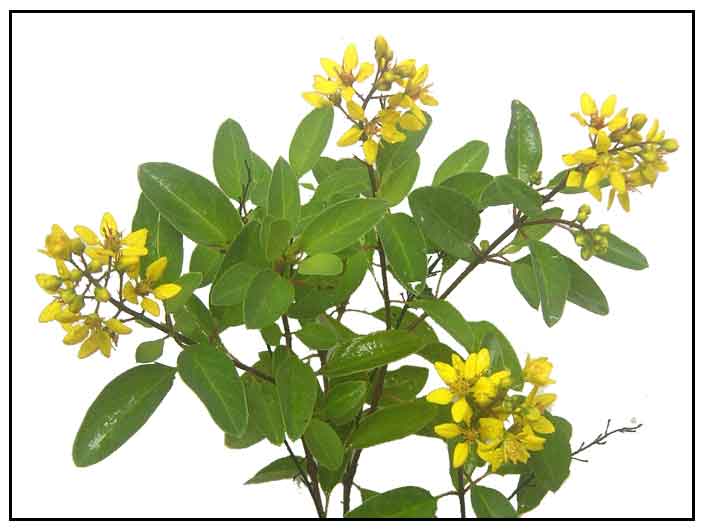
Kuisia is a small, erect, glabrous and branching
shrub, growing to 1.5 meters high. Leaves are glossy green, opposite,
up to 3 centimeters long, petioled, ovate, with a rounded tip. Flowers are in
clusters, fragrant, bright yellow, up to 1.5 centimeters across, in clusters
of 4 to 6 at the stem tips.
 Distribution Distribution
- Introduced.
-
Popularly cultivated in towns and
cities.
- Makes a good hedge plant.
- Flowers year-round.
- Native range is Mexico to Guatemala.
Constituents
- Sedative methanolic extracts prepared from aerial parts yielded nor-secofriedelanes from five major peaks that were mixtures of isomers represented by endocyclic C-20, C-21 double-bond isomers, galphimines A, B, D, and E. Galphamine C, isolated from peak III, corresponded to C-19, C-20 double-bond isomer previously known as the major sedative constituent galphimine B. (17)
Properties
- Studies have shown anti-asthmatic, anxiolytic, anti-protozoal, anti-inflammatory, antidepressant, muscle relaxant properties.
Uses
 Folkloric Folkloric
• No reported folkloric medicinal
use in the Philippines.
• In Latin American
traditional medicine, used for asthma and allergies.
• Used for treating phobias, anxiety, and stress.
• In Mexican traditional
medicine, used as a sedative and tranquilizer for mental disorders and nervous excitement.
Studies
• Homeopathic Proving:
Statistical analysis showed no significant
differences, certain symptoms were observed, i.e., relaxing, sedative,
anxiolytic and anti-allergic. Results confirmed toxicological and clinical
effects of Galphimia glauca compared to placebo, but not enough to satisfy
the ICCH criteria for distinguishing between specific and unspecific
symptoms. (1) Study describes the effectiveness of homeopathy in respiratory allergy (18 randomized trials and 9 observational studies). Some evidence demonstrates that in some conditions homeopathy shows significant promise i.e. allergic oculorhinitis, otitis, and possibly asthma and allergic complaints. (16)
• Bronchoconstriction inhibition / Asthma:
The ethylacetate fraction of the aerial
parts significantly and selectively inhibited the bronchoconstriction
induced by leukotrine D4 (LTD4). (2)
• Anxiolytic / Galphimine B: Study
has yielded an active principle, galphimine B (GB, a nor-seco-triterpene).
Aqueous extract of Gg showed anxiolytic effectiveness, similar to that
produced by lorazepam, but with regards side effects, Gg showed a higher
tolerability than lorazepam. (3)
• Anxiolytic / Galphimine B: Study evaluated the anxiolytic effects of galphimine B, A and E. Results showed the GRF (galphamine-rich fraction) had activity similar to the most active pure glaphamines (1 and 2), and the main determining factor for anxiolytic activity was the presence of free hydroxyl groups at C4,6,and 7 and the double bond A ring. (7)
• Anxiolytic / Friedelanes: Studies have isolated the anxiolytic and sedative principle consisting of a mixture of norsecofriedelanes, named the galphimine series. (6)
• Hay Fever / Pollinosis: Study
comparing Galphimia glauca to placebo in the treatment of pollinosis
showed a significant superiority of Gg over placebo, with effects comparable
to those of conventional antihistamines but with no side effects. (4)
• Anxiolytic Activity / Non-Genotoxic / Inhibition of Colon Cancer Cell Growth: Study
of extracts have yielded different triterpenes, known as galphimines. Galphimine
B possess anxiolytic activity and selectively inhibits discharges of
dopaminergic neurons in the ventral tegmental area in rats. In a 28-day study, no deaths were recorded and no histopathological alterations in studied organs; only behavioral parameters showed a diminution of spontaneous activity.
All the extracts inhibited colon cancer cell line growth with no genotoxic
effect. (5)
• Phytochemicals / Weak Anti-Protozoal Activity: Study
isolated four new terpenoids with the known sterols and flavonol quercetin. Quercetin was the only isolate that showed any antiprotozoal activity, and weak at that. (6)
• Generalized Anxiety Disorder / Clinical Trial / Comparison with Lorazepam: Study of G. glauca herbal medicinal product, standardized in 0.175 mg of glaphimine-B and administered for 15 weeks to patients with generalized anxiety disorder, showed greater anxiolytic effectiveness compared with lorazepam, with a high percentage of therapeutic tolerability and safety. (9)
• Re-Analysis of Homeopathic Use for Hay Fever: An earlier meta-analysis reached a positive conclusion regarding use of GC for hay fever. This findings from this reanalysis seem to suggest efficacy, however, important caveats prevent any firm conclusions and casts doubts on the reliability of conclusion of the published meta-analysis. (12)
• Anti-Inflammatory / Leaves: In a bio-guided isolation of anti-inflammatory compounds from extracts of leaves of G. glauca, the hexane extract showed the strongest anti-inflammatory activity. (13)
• CNS Antidepressant
/ Muscle Relaxant / Leaves / Stems: Study of G. glauca leaf methanol extract in a Swiss albino mice model using various models (Sodium pentobarbital induced sleep test, Hole-board test, Open-field test, PTZ-induced convulsions, Picrotoxin induced convulsions, Grip strengthening test and Rota rod test) showed significant depressant and muscle relaxant effects. LD50 for the leaf extract was > 2000 mg/kbw. (14) Study of methanol stem extract in Swiss albino mice showed potential CNS depressant and muscle relaxant effects compared to standard drugs. LD50 was found to be > 2000 mg/kbw. (15)
• Effect on Neuropharmacological Tests / Aerial Parts: Study of a methanolic extract of aerial parts showed sedative properties in several neuropharmacological animal models, such as: hypothermic activity, barbiturate potentiation, protection against strychnine- and leptazol-induced convulsions. (18)
• Social Anxiety Disorder / Pilot Study: A pilot study evaluated the therapeutic effectiveness of G. glauca in young people with social anxiety disorder. A double-blind clinical trial was done using sertraline as control. Patients who received the G. glauca standardized extract showed significant reduction in anxiety with a Brief Social Phobia Scale value of 41 points at the start and 11.2 points at the end of treatment, while patients on sertraline showed value of 37.7 at the beginning and 11.2 at the en d. Results suggest efficacy and safety in patients with social anxiety disorder, with no significant difference from sertraline-treated patients. (19)
• Silver Nanoparticles / Antioxidant, Antimicrobial, Antiproliferative / Leaves: Study reports on the green, eco-friendly and cost effective synthesis of silver nanoparticles from G. glauca leaf extract. The AgNPs showed effective dose dependent increase in scavenging activity. Antimicrobial testing showed efficient inhibitory activity against P. aeruginosa and C. glabrata. The AgNPs showed strong anticancer activity against SK-HEP1 liver cancer cell line with IC50 of 19.12 µg/mL. (20)
• Galphimine Extraction with Supercritical Carbon Dioxide Nanoparticles: Galphimine B has been shown to have anti-depressive and anxiolytic effects. Study reports on the supercritical extractions of glaphimines from G. glauca in the presence of carbon dioxide. (21)
• Antinociceptive / Anti-Inflammatory / Stem: In vivo study evaluated the antinociceptive and anti-inflammatory activities of Galphimia glauca stem methanol extract in Swiss albino mice and Wistar albino rats. The LD50 of the extract was >2000 mg/kbw. The stem methanol extract at 400 mg/kbw exhibited significant (p≤0.001) and dose-dependent antinociceptive and anti-inflammatory activity. It also showed central and peripheral antinociceptive actions when treated with naloxone and acetic acid, respectively. (22)
• Glaucacetalin E and Galphimidin B / Anxiolytic / Aerial Parts: Study sought to validate the use of G. glauca as an antistress and anxiolytic agent. Nor-triterpenes glaucacetalin E (1) and galphimidin B (2) were isolated for the first time along with seven known compounds, including galphimidin (3) from the CHCl3 fraction of aerial parts. Oral administration of the CHCl3 fraction and compounds 1-3 produced significant attenuation in the anxiety response in cylinder activity, decrease in ambulatory activity and head dipping. Only the extract enhanced phenobarbital-induced hypnosis. Diazepam was used as positive control. (24)
• Review of Herbal Medicines Used for Psychiatric Disorders: In a 2007 systematic review of herbal medicines studied in a broad range of psychiatric disorders, including depression, anxiety, obsessive-compulsive, seasonal affective, bipolar, psychotic, phobic, somatoform, and attention-deficit hyperactivity disorders, which covered clinical trial evidence for 24 herbal medicines in 11 psychiatric disorders, high quality evidence was found to exist for Galphimia glauca for anxiety disorders. (25)
• Tetragalloylquinic Acid / Antiasthmatic: A bioguided fractionation of an alcoholic extract of G. glauca yielded tetragalloylquinic acid (1), along with other compounds (gallic acid, methyl gallate, ellagic acid, and flavonoid acylglycoside). The compound showed highest activity against bronchial hyperactivity and allergic reactions. (26)
• Treatment of Pollinosis / Clinical Trial: A 1987 randomized double-blind, placebo-controlled trial evaluated the efficacy of G. glauca in treating patients suffering from pollinosis (hay fever). Verum-medication was saccharose globule sprinkled with Galphimia glauca D4. Outcome was measured by nasal and ocular symptoms on four level ordinal scale. Results showed statistically significant differences (α=5%) for improvement of nasal and ocular symptoms on first follow up, and ocular symptoms on second follow up. (27)
• Muscle Relaxant Activity / BS-4 / Stems: Study evaluated the muscle relaxant activity of a novel isolated phytomolecule (BS-4) from G. glauca stems using in vivo models. The LD50 of BS-4 was >2000 mg/kg. Mice treated with BS-4 showed dose-dependent significant (p≤0.001) effects on muscle relaxant activity in Rota rod test and Grip strengthening test in mice (p≤0.001). Results showed the isolated phytomolecule BS-4 has significant muscle relaxant effects. (28)
• Effect on Induced Acute Psychosis and Schizophrenic-Like Symptoms: Study evaluated the effect pf G. glauca methanolic extract, a galphimine-rich fraction (GRF) and galphamines G-A, G-B, and G-E, on acute psychosis induced by apomorphine in mice and on schizophrenic-like symptoms induced by subchronic administration of MK-801. Results showed G. glauca and their derivative products (GRF and galphimines) were able to interact with dopaminergic and glutamatergic drugs and to block different behaviors associated with some of the positive, negative, and cognitive symptoms of induced schizophrenia in mice. (29)
• Galphimine-B / Anxiolytic: Study evaluated a new phytopharmaceutical with anxiolytic effect obtained from G. glauca. In vivo and in vitro studies demonstrated anxiolytic activity of a crude extract. The pharmacologic effect was attributed to the nor-seco, triterpene galphimine-B, which showed an innovative mechanism of action, selective of dopaminergic neurons on ventral tegmental area. The therapeutic effectiveness, safety, and tolerability was compared with lorazepam on patients with Generalized Anxiety Disorder. (30)
• Antiasthmatic: Study evaluated a methanolic extract showed inhibition of acute bronchial reactions to allergen (ovalbumin, 10 mg/mL) and platelet-activating factor (PAF, 1 µg/ml) inhalation challenges, but not to histamine or acetylcholine in spontaneously breathing guinea pigs. PAF-induced bronchial hyperactivity was markedly reduced. Gallic acid and related compounds, as well as flavonoid and quercetin were identified as active compounds. (31)
• Effect on Behavioral Models: Study evaluated the effect of G. glauca extract, a galphimine rich fraction (GRF), and pure galphimines (G-A, G-B, and G-E) in Haloperidol-induced catalepsy test and in acute schizophrenia-like symptoms induced with Ketamine in mice. The methanol extract and pure galphimines interacted with the dopaminergic pathway and modified behavioral response to potentiate the cataleptic effect induced with Haloperidol and inhibited behavior induced by Ketamine in mice exposed to OFT and FST. The extract and GRF were also capable of blocking cognitive decline induced by KET in mice. Results suggest part of effect was due to interaction of Galphimines with dopaminergic and glutamatergic systems in vivo. (32)
• Muscle Relaxant Effect / BS-3 / Stem: Study evaluated the muscle relaxant activity of isolated phytomolecule (BS-3) from G. glauca stem methanol extract. The LD50 of BS-3 was > 2000 mg/kg. Treated mice showed significant (p<0.05) effects on muscle relaxant activity in Rota rod test and Grip strengthening test. (33)
Availability
- Wildcrafted.
- Ornamental cultivation.
- Pellets, extracts and supplements in the cybermarket.
|