Gen info
- Convolvulaceae, commonly known as bindweed or morning glory family,, contains about 60 genera and more than 1,650 species of mostly herbaceous vines, but also trees, shrubs, and herbs, including sweet potato and a few food tubers. (23)
-
Merremia is a genus of flowering plants in the morning glory family, Convolvulaceae. Members of the genus are commonly known as woodroses.
Botany
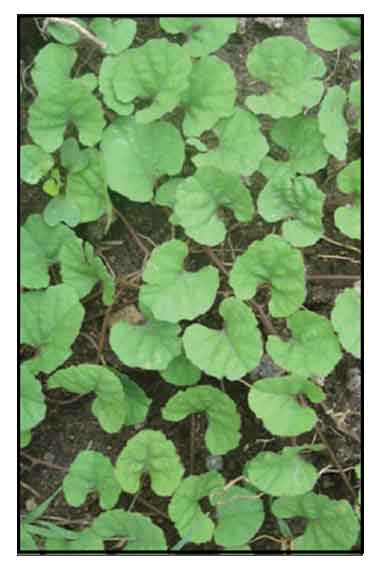
Kupit-kupit is a perennial, slender, prostate, creeping, smooth or somewhat hairy herb. Stems roots at the nodes, and are 10 to 80 centimeters in length. Leaves are small, kidney-shaped to somewhat heart-shaped, 6 to 15 millimeters long, often wider than long, and irregularly toothed. Flowers, one to three, occur in short stalks in the axils of leaves. Sepals are rounded, about 4 millimeters long, with few to many white, weak hairs. Corolla is yellow, nearly twice as long as the calyx. Capsule is rounded and about 5 millimeters in diameter.
 Distribution Distribution
- Native to the Philippines.
-
In dry, open grasslands and waste places at low altitudes in Rizal and Bataan Provinces in Luzon.
- Also native to Angola, Bangladesh, Borneo, Burkina, Burundi, Cameroon, Chad, China, Ethiopia, Hainan, India, Jawa, Lesser Sunda Is., Mauritania, Myanmar, Nepal, New Guinea, Sri Lanka, Sudan, Sulawesi, Tanzania, Thailand, Uganda, Zaire. (23)
Constituents
- Phytochemical screening yielded tannins, flavonoids, amino acids, starch, glycosides, and carbohydrates.
- Seeds yield p-coumaric acid, ferulic, caffeic, sinapic acid esters, and tropane alkaloids.
- Phytochemical screening of dried leaves yielded secondary metabolites such as alkaloids, carbohydrates and reducing sugars, glycosides, proteins and amino acids, flavanoids, fixed oils and fats, volatile oils, gums and mucilages. (see study below)
(21)
- GC-MS analysis of whole plant yielded methyl 4-0-methyl-beta-D-xylopyranoside, D-mannitol, caryophyllene oxide, 11-dodecenoic acid, 10-hydroxy-methyl ester, pentadecanoic acid, phytol, 9,12,15-octadecatrienoic acid, (Z,Z,Z)-octadecanoic acid, methyl stearidonate, eicosanoic acid, gamolenic acid, docosanoic acid, beta-tocopherol, O-methyl-, stigmasterol, beta-sitosterol, dl-alpha-tocopherol, p-coumaric acid, 1-heptatriacotanol, among others
. (22)
Properties
- Considered deobstruent, diuretic, alterative.
- Studies suggest antioxidant, antipyretic, antibacterial, antifungal, anticataract, anti-inflammatory, anticancer, antidiabetic properties.
Parts used
Leaves, tops.
Uses
Edibility
- In India, leaves eaten as greens. Young leaves are fried with groundnut oil and other spices and used with bread, called "Roti" made from Sorghum flour. Leaves are also used in soups.
Folkloric
- In the Philippines, decoction of leaves and tops used as diuretic.
- Leaves used as alterative; used in rheumatism and neuralgia.
- Also used for coughs and headache.
- Used for inflammation, epilepsy.
- Juice used as purgative.
- In India, leaf juice given for migraine; also used as ear drops to relieve abscesses and ulcers. Root is used to treat diseases of the eyes and gums.
- In Indo-China, leaves used as purgative.
- In Indonesia, infusion of leaves mixed with lumps of sugar used as remedy for cough.
Caution
• Market substitution for Centella asiatica: In the Salem district of Tamil Nadu, the plant is sold under the name Vallarai, with consumers expecting the benefits of Centella asiatica. (16)
Studies
• Antioxidant / a-Amylase Inhibition / Cytotoxicity: In a study of several extracts, the methanol showed better antioxidant activity in the DPPH radical scavenging method. The methanol and hexane extracts exhibited a-amylase inhibitory activity. An ethyl acetate extract showed cytotoxicity in brine shrimp lethality.
(1)
• Antipyretic: Study of an ethanolic extract of the plant showed significant antipyretic activity comparable to the standard drug paracetamol. (3)
• Antibacterial / Leaves: Study investigating the antibacterial activity of various leaf extracts showed the methanol extract to be more effective against Bacillus cereus and E. coli and the aqueous extract was more effective against S. aureus and P. aeruginosa. (4)
• Anti-Arthritis: Study investigating the anti-arthritic activity of M. emarginata extract using Freund's complete adjuvant in rats showed significant inhibitory effect on FCA induced paw edema. (5)
• Anticancer: Study investigated the invitro anticancer activity of Merremia emarginata. An ethylacetate fraction was found to be cytotoxic against human cervical carcinoma Hela cells lines and human breast carcinoma MCF cell lines, with IC50s of 51.57 µg/ml and 39.6 µg/ml, respectively. Results justify use in the traditional system of medicine. (7)
• Antioxidant / Antimicrobial / Quantum Dots: Study evaluated an antioxidant potential of leaves using a DPPH, ABTS, superoxide anion scavenging assay and lipid peroxidation activity using TGA-CdTe QDs (thioglycolic acid-capped cadmium telluride quantum dots). The TGA-CdTe QDs and M. emarginata complex could provide antimicrobial activity through a reactive oxygen species pathway and/or microbial endocytosis through an electrostatic attraction. Results showed the QDs act as potential probes for the in vitro antioxidant and antimicrobial activities, and as well, could be used as nanocarriers to enhance the antimicrobial capability. (8)
• Anti-Diabetic: Study evaluated the antidiabetic property of M. emarginata plant in streptozotocin induced diabetic rats. Results showed significant reduction of HbA1C and an increase in total hemoglobin, with increased activity of carbohydrate metabolizing enzymes. Histology showed pancreatic ß-cell regeneration. (9)
• Anti-Inflammatory / Anti-Arthritis / Analgesic: Study of an ethanolic extract of whole plant showed anti-inflammatory (carrageenan induced paw edema), anti-arthritis (Freund's adjuvant model) and analgesic (Hot plate analgesia) activities in mice. (10)
• Anti-Inflammatory / Rheumatoid Arthritis: Study evaluated alcoholic and ethylacetate extracts of whole plant of M. emarginata on freund's adjuvant induced arthritis. Results showed the alcoholic extract to have a more pronounced effect compared to the ethylacetate extract. Results support the folklore use of the plant in inflammatory conditions like arthritis. (11)
• Nephroprotective / Cisplatin Induced Nephrotoxicity: Study evaluated the nephroprotective and antioxidant activity of M. emarginata against cisplatin induced nephrotoxicity. Results showed nephroprotective activity as well as significant protection against oxidative stress caused by cisplatin. (12)
• Anthelmintic: Study evaluated ethanol and aqueous extracts of whole plant of Merremia emarginata for anthelmintic activity against Ecinia foetida and Pheretima posthuma. Results showed dose dependent increase in anthelmintic activity. The ethanolic extract showed a significant anthelmintic activity at highest concentration of 250 mg/ml. (15)
• Erroneous Substitution of M. emarginata for Centella asiatica (Takip kohol / Gotu kola): Medicinal plants collected from the wild are vulnerable to adulteration and substitution. Mandukaparni (Centella asiatica) is valued in Indian systems of medicine for improving memory and treatment of nervine disorders. This study reports on a plant material sold in the name of Vallarai that was not C. asiatica and identified as Merremia emarginata, a trailing plant that resembles C. asiatica. The study stresses the importance of standardization of herbal drugs at raw drug levels by use of taxonomic and other validation methods. (16)
• Diuretic / Chlorogenic Acid: Study evaluated the diuretic activity of aqueous extract of Merremia emarginata in female Wistar albino rats. Urinary hippuric acid was successfully quantified. Results showed significantly high diuretic activity (p<0.05), which was attributed to polyphenolic compound chlorogenic acid. (17)
• Nephroprotective / Phenolic Compounds: Study evaluated the the nephroprotective effect of M. emarginata against gentamicin-induced nephrotoxicity in albino Wistar rats. ULC-MS/MS analysis yielded 29 known and 19 unknown phenolic compounds. Nephroprotective activity was evidenced by histopathology study that showed regeneration of glomerular and tubular epithelial cells of the damaged kidney. (18)
• Anticataract / Aldose Reductase Inhibition (ARI) / Leaves: Study evaluated the aldose reductase inhibition (ARI) capacities of extracts of plants and lichen. Results showed the ARI capacity of leaves of Merremia emarginata, Permotrema perlatum, Tridax procumbens and Euphorbia prostrata may be attributed to their flavanoid contents. The plants may work as a base for development of anticataract agents, with potential for diabetic cataract treatment. (20)
• Antibacterial / Antifungal / Antioxidant / Leaves: Study evaluated the antibacterial, antifungal, and antioxidant activity of M. emarginata from pooled extract of dried leaves. By agar well diffusion, the highest antibacterial activity was exhibited against E. faecalis, S. aureus, P. aeruginosa, K. pneumonia at 1000 µg. Antifungal activity was carried out against Aspergillus niger and Candida albicans with fluconazole as standard. In vitro antioxidant activity was carried out using DPPH method. (21)
Availability
Wild-crafted. |