  Botany Botany
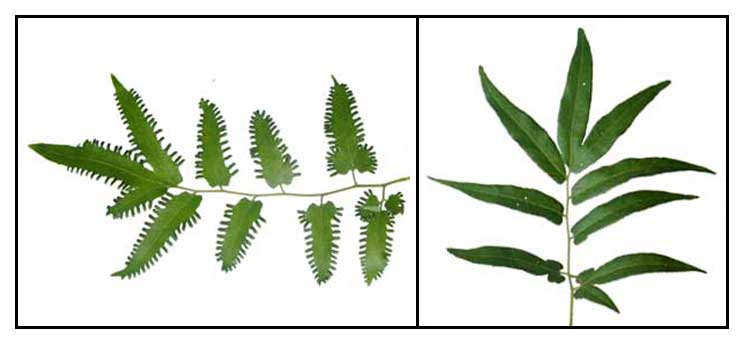
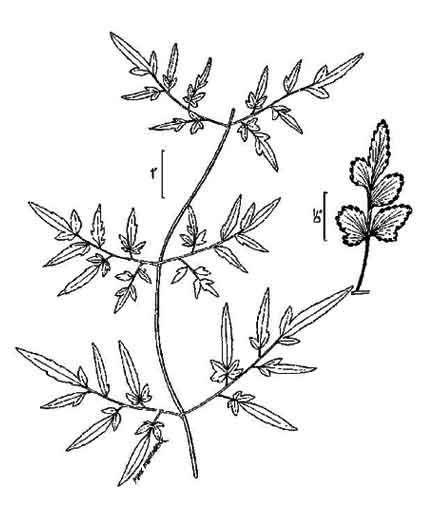
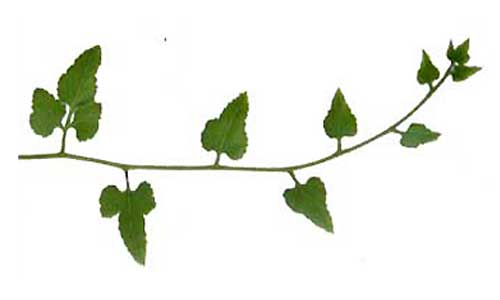
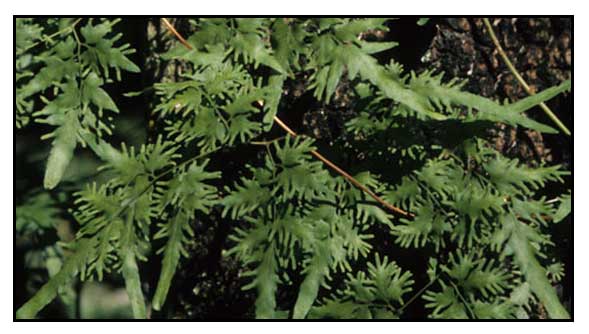
Nitong-pula is similar to Lygodium flexuosum but is more delicate. It is a very slender, twining fern growing from 1 to 3
meters in length, somewhat pubescent or nearly glabrous, the dwarfed branches 2 to 4 millimeters long. Fronds are of 2 kinds
(dimorphic). Sterile pinnae are 8 to 15 centimeters long, rarely longer, 2 to
4 millimeters wide. Pinnules (leaflets) are 2 to 5 centimeters on each side, the upper ones
simple, sessile, often subconfluent, entire, the intermediate ones somewhat
hastate and the lowest one stalked, pinnate or bipinnate (twice pinnate),
all oblong to linear, 1.5 to 8 centimeters long, tripinnate, the segments relatively
broader and shorter. Spikes (site of the fruiting bodies) are 1 to 6 millimeters
long. Spores are verruculose.
Distribution
- Very common throughout the
Philippines at low and medium altitudes.
- Also reported from Japan and Korea to India, and southward to Australia.
Constituents
- Study isolated a new 1,4-naphthoquinione and three known compounds from the roots. (1)
- Study isolated 8 compounds: tilianin, kaempferol-7-O-alpha-L-rhamnopyranoside, kaempferol, p-coumaric acid, hexadecanoic acid 2, 3-dihydroxy-propyl ester, daucosterol, beta-sitosterol, and 1-hentriacontanol. (7)
- Spores yield caffeic acid and lygodin.
- Study yielded a new phenolic glycoside, 3,4-dihydroxybenzoic acid 4-O-(4′-O-methyl)-β-D-glucopyranoside, from the roots. (13)
- Study yielded flavonols and phenolic acids identified as 3,4-dihydroxyl benzoic acid 4-O-beta-D-(4'-O-methyl) glucopyranoside (1), protocatechuic acid (2), acacetin 7-O-(6'-O-a-L-rhamnopyranosyl)-beta-sophoroside (3), 6,8-di-glucosylapigenin (vinenin) (4), tricin-7-O-beta-D-glucopyranoside (5), 2-anilino-1,4-naphthoquinone (6). (23)
- Study for chemical constituents of roots isolated six compounds: friedelin (1), hydroxyhopane (2), 2α-hydroxyursolic acid (3), daucosterol (4), succinic acid (5), kaempferol-3-O-α-L-rhamnopyranose-7-O-α-L-rhamnopyranoside (6).
(18)
- Ethanol extract of plant yielded
polyphenols, terpenoids, glycosides, saponins, flavonoids, and reducing sugar. (see study below) (20)
- GC-MS analysis for essential oil of whole herb yielded 52 volatile compounds representing 81.70% of the total oil. Main constituents were unsaturated hydrocarbon (30.43%), organic acids (14.926%), ketone (12.818%) and nonterpineols (8.296%). Compounds with contents over 3% (V/V) were 3-methyl-1-pentanol 4.097%, 2-(methylacetyl)- 3-carene 4.25%, eyclooctenone 7.616%, (E)-2-hexenoic acid 12.767% and 1-undecyne 28.611%.
(22)
 Properties Properties
- Sweet tasting, refrigerant;
antifebrile, diuretic.
- Aids lymphatic circulation.
- Expectorant, cathartic, diuretic, anti-urolithiatic.
Parts
utilized
· Entire plant.
· Collect material from May to October.
· Rinse, macerate. Dry under the sun.
· Active principles concentrated in the sporangia of the
plant.
Uses
Edibility
- Tender frond is edible.
Folkloric
- Decoction of 25 - 30 g of dried material
for urinary tract infections, lithiasis, renal edema. cough-fever, reddish
urine, enteritis-dysentery.
- Plant used as expectorant, Decoction of vegetative parts and spores used as diuretic.
Spores used as general blood tonic. Also, as anti-gonorrheal agent. (11)
- Used as a blood tonic and for cold symptoms and urinary and kidney problems.
- In China, used as an expectorant. Also used in hematuria and blennorrhagia. Also used for pneumonia and for dissolving urinary stones.
- In India, the tribal people of Nagaland apply the plant past on eczema and ringworm and wounds.
- Crushed leaves used in treatment of fresh cuts and wounds. (20)
- An ingredient of Chinese medicine Jin Bo Xiao Shi San (mirabilite 100g, Hai Jin Sha [Lygodium japonicum] 100g, Hu Po (Amber) 40 g, and Peng Sha (sodium borate) 20 g—used to treat urolithic stranguria; also used to treat mumps, ascariasis, pruritus. (17)
- In Chinese traditional medicine, spores used for treatment of various inflammatory diseases. (19) Crushed leaves used to treat hepatitis and dysentery. (20) For centuries, used for treatment of gorge gall, eczema, enteritis, nephritis, dropsy, urinary tract infection and stones. (24)
- North American Indians use hair washes derived from L. japonicum and Yucca for treatment of hair loss and thinning. (21)
Others
- Basketry: Splints from stems used in basketry, making hats and boxes. Splints sometimes mixed with buri for making fancy articles. (11)
 Studies Studies
• Phytochemical Study: Phytochemical study isolated 3,4-dihydroxyl benzoic acid 4-O-beta-D-(4'-O-methyl)glycopyranoside, protocatechuic acid, acacetin 7-O-((6'-O-a-L-rhamnopyranosyl)-beta-sophoroside, venenin, tricin-7-O-beta-D-glycopyranoside, 2-anilino-1,4-naphthoquinone. (3)
• Ecdysteroside: Phytochemical study of the roots yielded a new ecdysteroside, lygodiumsteroside A, as well as a known ecdysteroside. (4)
• Hair Growth Promotion / Spores: Aqueous ethanol extract of spore of Lygodium japonicum showed in vitro testosterone 5a-reductase inhibitory activity and in vivo anti-androgenic activity with hair regrowth after shaving in testosterone-treated mice. Study yielded lipophilic constituents, oleic acid, linoleic and palmitic acids, identified as the main active principles inhibiting 5-alpha reductase. (5)
• Antioxidant / Antibacterial / Purification Polysaccharides: Extracted purification polysaccharides showed strong antioxidant activity in various assays and also showed to be a potential source of natural broad-spectrum anti-microorganism. (8)
• Scavenging Activities: Study compared the scavenging activities of total flavone from L. japonicum with different solvents to free radical activity. A 95% ethanol extract had the best scavenging effects. (9)
• Inhibitory Effect on Renal Calculi: Study investigated an ethanol extract of Lygodii spora as preventive and therapeutic agent for experimentally induced calcium oxalate nephrolithiasis in male Wistar rats. Results showed significant decrease in levels of urinary calcium, oxalate, and uric acid, and increased levels of urinary citrate. (12)
• Enhancement of Antioxidant and Antimicrobial Activities: Pressure-assisted water extraction (PAWE) increased the phenol amount of L. japonicum to 12.8 mg GAE/g compared to conventional extraction (9.3 mg GAE/g) (p<0.05). The lowest minimum inhibitory concentrations (MIC99) of L. japonicum extracted by PAWE were 2.59, 3.33, and 7.37 mg/mL, respectively, against Listeria monocytogenes, Salmonella typhimurium, and Propionibacterium acnes. Results suggest PAWE can be an appropriate extraction method for enhancing biological and pharmaceutical properties of medicinal plants. (15)
• New Phenylpropanoid Glucoside / Antioxidant / Aerial Parts: Study of aerial parts isolated a new compound, 4-O-caffeoyl-D-glucopyranose (1), and a new natural product, 3-O-caffeoyl-D-glucopyranose (2), together with six known compounds (3-8). In vitro evaluation of compounds 1-8 showed strong antioxidative properties. (16)
• Anti-Inflammatory / Spores: Study investigated the anti-inflammatory effects of ethanol extracts of L. japonicum spores by measuring inflammatory mediators and exploring molecular mechanisms. Results showed the extracts may suppress LPS-induced inflammatory responses in murine macrophages in vitro, through negative regulation of p38 MAPK and nuclear factor [NF]-kB. Study suggests potential in therapeutic strategies for alleviating inflammation. (19)
• Antibacterial / Antioxidant: Study evaluated three indigenous medicinal plants in Nepal for antioxidant and antibacterial activities i.e., Hibiscus rosa-sinensis, Phlogacanthus thyrsiformis, and Lygodium japonicum. All extracts showed antibacterial properties against four gram negative bacteria ( E. coli, K. pneumonia, S. typhi, P. mirabilis) and two gram positive bacteria (S. aureus, B. subtilis). On antioxidant evaluation using DPPH scavenging activity, L. japonicum showed the highest activity (IC50 of 80 ± 1.3 µg/ml) compared to ascorbic acid (IC50=54 ± 0.5 µg/ml). (see constituents above) (20)
Availability
Wild-crafted.
Spores and supplements in pill or capsule form.
|