|
Botany
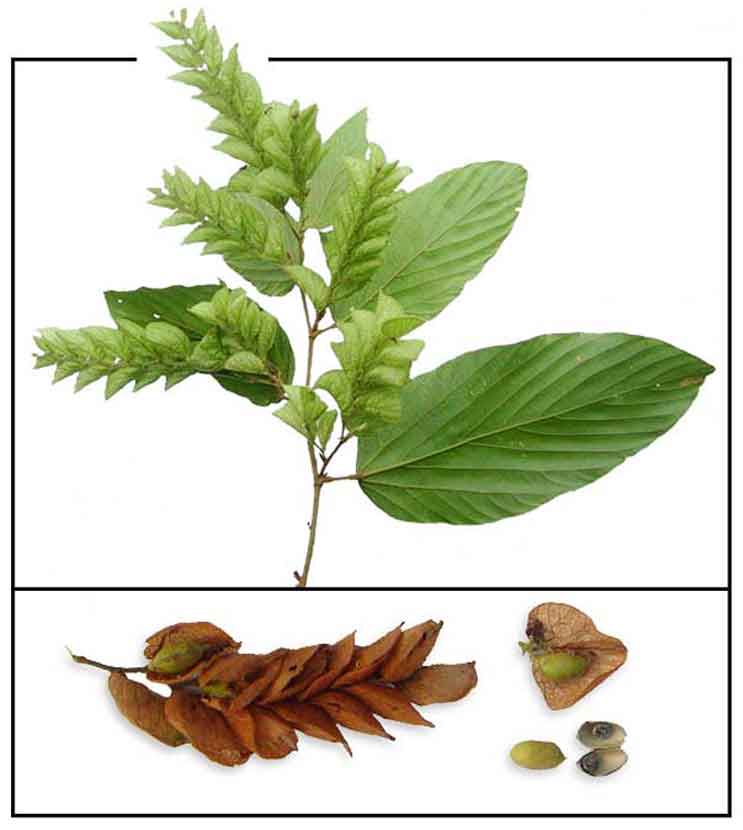
Panapanarahan is an erect, branched
shrub, growing to a height of 0.5 to 2 meters. Leaves are simple,
ovate to oblong, 6 to 14 centimeters in length, round at the base, pointed
at the tip. Racemes are terminal, at the axils of the leaves,
5 to 15 centimeters long, composed of numerous, thin, rounded or kidney-shaped, folded, imbricated, green
bracts, about 1.5 to 2.5 centimeters long, enclosing the fascicles or dwarfed cymes
of small flowers. Rachis of the racemes are zigzag. Corolla is yellowish-green, with a tinge of
purple, about 8 millimeters long. Pods are swollen, oblong, 1 centimeter long,
containing 2 seeds.
 Distribution Distribution
- Abundant throughout the Philippines in settled areas, in open, dry, waste places.
- Probably introduced.
- Also occurs in India to Malaya, Mauritius and the West Indies.
Constituents
- Phytochemical screening yielded alkaloids, glycosides, saponins, phytosterols, phenolic compounds, tannins, proteins and amino acids.
- Phytochemical screening of root and leaf showed phytosterols, lipids, phenolic compounds, carbohydrates, flavonoids and tannins.
- Study of methanol, butanol, and dichlormethane extracts of roots
yielded flemingiaflavanone (8,3-diprenyl-5,7,4-trihydroxy flavanone), genistin (5,4-dihydroxy isoflavone 7-O-glucoside, and ß-sitosterol-D-glucoside. (see study below) (2)
- Yields flavonoids, flavonoid glycosides, chalcones, epoxychromenes and pterocarpans.
- A methanol extract of root and leaf of F. strobilifera showed the presence of 13.75 and 8.84 % w/w phenolics (calculated as gallic acid), 2.14 and 3.26 % w/w respectively.
(see study below) (7)
- Study of roots yielded a new isoflavone identified as 5,7,4í-trihydroxy 8,2í,5í-tri(3-methylbut-2-enyl)isoflavone along with the known phytoconstituents viz., 5,7,2í,4í- tetrahydroxyisoflavone (2), 5,7,4í-trihydroxyisoflavone (3) and β-sitosterol (4). (see study below) (18)
- An 80% ethanolic leaf extract yielded 8 compounds viz., thiocyanic acid, ethyl ester (1), limonene (2). phenol,3,5-bis(1,1-dimethylethyl) (3), eicosane (4), heptacosane (5), hexanedioic acid, bis02-ethylhexyl) ester (6), hexacosane (7), and nonadecane (8). (see study below) (21)
- Petroleum ether extract of roots yielded fixed oils and fats; chloroform extracts yielded flavonoids, steroids, proteins, and fats; alcoholic root extracts yielded flavonoids and carbohydrates, and aqueous extract yielded tannins and carbohydrates. (see study below) (24)
· Study for total phenol and flavonoids contents in the leaf yielded 21.36 mg/g gallic acid equivalent, and 11.07 mg/g quercetin equivalent, respectively; roots yielded 29.68 mg/g GAE and 12.19 mg/g QE, respectively. (25)
· Study for phenol, flavonoid and total antioxidant capacity showed 24.53 ± 0.66 mg/g dry wt, 08.75 ± 2.62 µg/g dry wt, and 21.33 ± 0.08 %, respectively. (26)
Properties
- Studies have suggested antioxidant, antimicrobial, immune-regulatory, antiulcerogenic, anthelmintic, analgesic, anti-inflammatory, anticonvulsant, cholesterol lowering, estrogenic, anticancer properties.
Parts utilized
Leaves, flowers, roots.
Uses
Folkloric
· Decoction or infusion of leaves and flowers used for tuberculosis.
· Subanen tribe of Lapuyan, Zamboanga del Sur use decoction of roots for tuberculosis and diabetes. Pounded leaves applied to areas of inflammation. (28)
· Decoction of leaves used for postpartum baths. (See: Suob)
· In India, root paste applied externally
to body swellings. Roots also used for epilepsy.
· In Malaya, decoction of leaves administered after childbirth and for bathing.
· Decoction of leaves used for rheumatism.
· In Java, decoction of leaves used internally and externally as vermifuge for children.
· In Bangladesh leaf juice used to treat worms. Marma tribe used the plant as fly repellent.
· In Nepal, Root juice (fresh roots
crushed in cup of water by mortar and pestle) is taken twice daily for
7 days for diarrhea and dysentery. source
· In Trinidad and Tobago,
used for kidney stones and other urinary problems, gall stones, and for cooling.
· In India leaves and flowers used for tuberculosis. Roots used for hysteria, root juice for diarrhea and dysentery. (10)
· In Kerala, India, cut fresh leaves boiled in coconut oil till the green turns to black, allowed to cool and applied as medicated oil half an hour before baths for problems associated with body pains. (14)
· In Assam, India, used by different ethnic communities for various ailments including tuberculosis, epilepsy, diarrhea, dysentery, insomnia, hysteria, and rheumatism. (25)
as medicated oil half an hour before baths for problems associated with body pains. (14)
· In India, the Paraja tribe of Koraput, Odisha use the tuber paste orally for treatment of dysentery. (26)
Others
· In the Philippines, dried bracts used for stuffing pillows and cushions.
· In Bangladesh, plant used as fly repellent.
Studies
• Antibacterial: Out of twenty-five species of ethnomedicinal
plants were screened for their antibacterial activity, 13, including
F. strobilifera, showed positive response to at least one of the tested
bacteria. F strobilifera showed positive response to two bacterial species. (1)
• Antimicrobial / Flemingiaflavanone / Roots: The study of roots isolated flemingiaflavanone which showed significant antimicrobial
activity against Gram-positive bacteria ( S epidermis, S aureus, MRSA), Gram-negative bacteria (P aeruginosa, E coli) and fungi (C albicans). (see constituents above) (2)
• Isoflavone / Antibacterial / Antioxidant: Study yielded a new isoflavone from the roots of FS and was identified as 5,7,4í-trihydroxy 8,2í,5í-tri(3-methylbut-2-enyl)isoflavone along with other known phytoconstituents. The compounds were tested in vitro for antimicrobial activity and antioxidant activity and compounds (1-3) proved to be moderately active. (3)
• Phagocyte Stimulation / Immune Regulation: Study showed F strobilifera as an herbal medicine that can stimulate phagocytosis and have a potential to enhance innate immunity medications. (4)
• Anti-Ulcerogenic / Antimicrobial / Roots: Study showed pretreatments of a chloroform extract of F. strobilifera roots reduced the characteristic water immersion-induced stress ulcer lesions in female wistar rats. Free radical scavenging was observed. Antimicrobial activity of the CE was observed against both gram positive and negative bacteria. (5)
• Anthelmintic / Leaves: Study evaluated various extracts of leaves of FS for anthelmintic activity. Results showed the alcohol and chloroform extracts to exhibit significant anthelmintic activity. Piperazine citrate was used as standard drug. (6)
• Antioxidant / Roots and Leaves: Phytochemical screening showed high flavonols and phenolics. A methanolic extract of root and leaf showed a concentration dependent DPPH radical scavenging activity. A butanolic and DCM extract showed good nitric oxide radical inhibition activity with IC50 of 150.0 µg/ml in a dose dependent manner. A methanolic extract of root showed hydroxyl radical scavenging by p-NDA method with IC50 of 378.33 µg/ml. Results suggest FS as a potential source of natural antioxidant. (see constituents above) (7) Study of 80% methanol and aqueous extracts of F. strobilifera showed significant scavenging activity with low IC50s of 0.299 mg/mL and <0.25 mg/mL, respectively. The 80% methanolic leaf extract yielded 8 compounds. (see constituents above) (21)
• Analgesic: A methanol extract evaluated for analgesic activity in mice by tail flick latency in immersion method showed potent analgesic activity in all test doses. Acetylsalicylic acid was used as standard drug. (11)
• Free Radical Scavenging Activity / Root and Leaf: Study evaluated various extracts of root and leaf for antioxidant activity. Using various assays, a methanolic extract showed antioxidant activity and suggests a potential source of natural antioxidants. (12)
• Anti-Inflammatory Activity / Aerial Parts: Study evaluated methanol and hydroalcoholic extracts of aerial parts for anti-inflammatory effects in Swiss albino mice. Results showed potent anti-inflammatory activity in the carrageenan-induced paw edema and cotton pellet-induced granuloma methods. (13)
• Anticonvulsant / Roots: Study evaluated the anticonvulsant potential of 95% ethanol extract and fractions of roots against pentylenetetrazole (PTZ) and maximal electroshock (MES) induced convulsions. Results showed a crude ethanol extract and ethyl acetate fraction of roots have a central nervous system depressant action, with a potential anticonvulsant effect. (15)
• Cholesterol Lowering: Study evaluated the cholesterol lowering effect of various extracts of FS in albino mice. Results showed all treatments (leaf, root, and stem extracts) are capable of significantly reducing the blood cholesterol levels in mice. (16)
• Isoflavonoids / Antimicrobial / Antioxidant / Roots: Study isolated a new isoflavonone from the roots, together with known constituents. Compounds 1-3 showed moderate antimicrobial and antioxidant activities. (see constituents above) (18)
• Cytotoxicity / Human Leukemia Cell Line / Leaves: Study evaluated crude extracts of dried leaves of S. verticillata, F. pumila and F. strobilifera against MT-4 human leukemia cancer cell line. Crude extract of S. strobilifera showed cytotoxicity with an IC50 of 81 µg/ml. (19)
• Flemingiaflavanone / Antimicrobial / Roots: Bioactive guided fractionation of roots yielded flemingiaflavanone, genistein and ß-sitosterol-D glucoside. Flemingiaflavanone showed significant antimcrobial activity against gram-positive bacteria (S. aureus, S. epidermis, MRSA), gram-negative bacteria (P. aeruginosa, E. coli) and fungi (Candida albicans). Genistein showed moderate antibacterial activity. (20)
• Anti-Inflammatory / Anti-Arthritic / Leaves: Study evaluated the anti-inflammatory activity using and anti-arthritic activity of methanol extracts of Flemingia strobilifera and Nymphaea nouchali leaves. Both extracts showed significant anti-inflammatory activity using Human Red Blood Cell (HRBC) membrane stabilization testing and anti-arthritic activity using Bovine Serum Albumin. (22)
• Anxiolytic / Roots: Study evaluated the antianxiety activity of aqueous extract of roots using elevated zero maze test and mirror chamber test on 24 Swiss albino mice. The extract showed significant anxiolytic activity at doses of 200mg and 400 mg/kbw. Flavonoids may be responsible for the anxiolytic effect. (23)
• Anti-Inflammatory / Analgesic / Roots: Study of alcoholic and aqueous extracts of roots of F. strobilifera showed significant anti-inflammatory and analgesic activities, with indomethacin and dicofenac sodium as standard, respectively. (see constituents above) (24)
• Treatment of Gynecological Cancers and Menopausal Symptoms: This invention reports on the use of a composition containing Flemingia strobilifera extract or a compound as active ingredient for preventing or treating gynecological cancers and menopausal symptoms. Report suggests female hormonal substances from invention the can be utilized in the medicinal and functional food fields. (27)
• Estrogenic Effect / Phytoestrogens / ER-Targeted Therapy and Menopausal Symptoms: Study evaluated the F. strobiifera for estrogenic properties and phytoestrogens (PEs) using in vitro and in vivo assays. The extract and its compounds exhibited binding affinities for hERa and activated ERE transcription in MCF-7 cells. The extract and compounds also induced MCF-7 cell proliferation and trefoil factor 1 (pS2) expression. Results suggest the PEs derived from the extract are promising candidates for ER-targeted therapy for post-menopausal symptoms. (28)
Availability
Wild-crafted. |