|
 General info General info
Pandanus is a genus of monocots of about 600 known species, varying in size from small shrubs less than a meter to medium-sized trees of about 20 meters.
In the Philippines there are 48 species of Pandanus, many of them are endemic, growing in various habitats, from sandy beaches, mangroves and primary forests. The fruit of some species are edible, eaten by bats, rats, crabs, elephants and lizards. The majority of species are dispersed primarily by water.
Botany
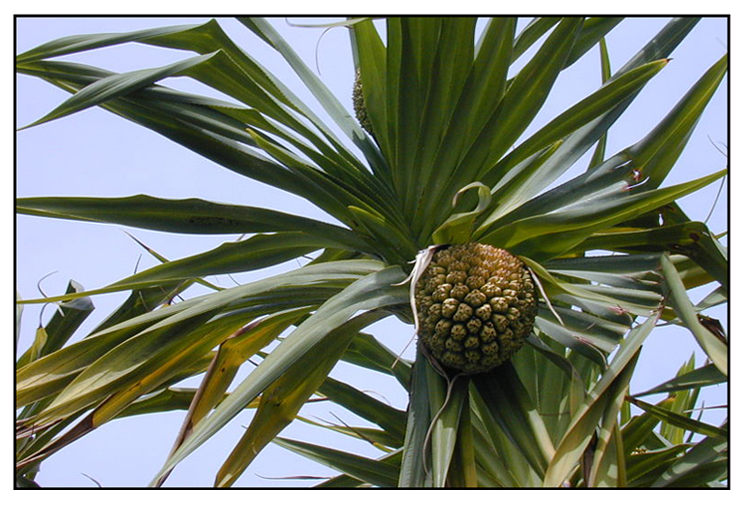
Pandan is an erect, branched
small tree, growing 3 to 5 meters high; the trunk bearing many prop roots.
Leaves are spirally crowded toward the ends of the branches, glaucous,
linear lanceolate, slenderly long-acuminate, up to 1.5 meters
long, 3 to 5 centimeters wide, the margins and midrib beneath towards the apex, armed with sharp spiny
teeth that point toward the apex of the leaf. Male inflorescence
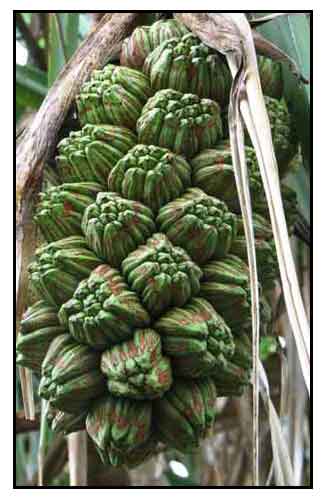
is fragrant, pendulous, up to 0.5 meter long. Fruit is solitary,
pendulous, ellipsoid to globose-ellipsoid, about 20 centimeters long,
each composed of 50 to 75 or more, obovoid, angular, fibrous and fleshy drupes,
4 to 6 centimeters long, narrow below and truncate at the apex; the stone 4- to 10-celled, slightly sulcate between the cells of the apex, becoming yellow-red to bright red-orange at maturity.
 Distribution Distribution
- In thickets along
seashores throughout the Philippines.
- Also occurs in Indo-Malayan and Polynesian regions, extending to southern China and tropical Australia.
Constituents
- Essential oil, alkaloids,
glycosides, isoprene esters, and tannin.
- Blossoms yield an essential oil.
- Keora oil contains diterpene, d-linalool, phenylethyl acetate, citral,
phenylethyl alcohol ester, ester of phthalic acid, fatty acids and steroptene.
- Pandanus fruits contain significant amounts of vitamin C.
- Also contains significant amounts of provitamin A carotenoids.
- Phytochemical study of various extracts of leaves yielded glycoside, carbohydrates, phytosterols, saponins, phenolic compounds, proteins and amino acids, terpenoids, flavanoids, fixed oil and fats.
- Qualitative analysis of fruit extracts yielded phenolics, flavonoids, terpenoid, steroids, saponins, and glycosides. (see study below) (18)
- Study of fruit yielded a new dihydrofurocoumarin, named pandanusin A (1), along with 15 known compounds i.e., one furanocoumarin (2)
, two coumarins (3,4), four lignans (5-8), one neolignan (9), two flavonoids (10,11), three phenolics (12-14), one monoglyceride (15), and one monosaccharide (16). (see study below) (19)
- Fruits yielded two new phenolic compounds, Pandanusphenol A and B.
(20)
Properties
- The prop roots possess diuretic properties.
- Oil and attar considered stimulant and antispasmodic.
- Considered emmenagogue.
- Fruits of wild forms contain calcium oxalate crystals which may cause mouth irritation.
Parts utilized
Leaves and roots.
Uses
Edibility / Culinary
- An aromatic leaf used to perfume
rice dishes.
- Ripe fruits of wild forms can be consumed after cooking and straining of the pericarp of the fruits.
Folkloric
- Decoction of fresh or dried prop root drunk for diuretic effect.
- Roots used to strengthen the gums.
- In the Philippines, as far back as 1837, water from cuts made near the base of the trunk use to stimulate urination.
Headache, arthritis, stomach spasms: Decoction of leaves.
- Poultice of
fresh leaves mixed with oil also used for headaches.
- Wound healing: Pulverized dried leaves used to facilitate wound healing.
- Poultice of mash of cabbage of plant, mixed with salt and juice of Citrus
microcarpa, for abscesses.
- Decoction of roots believed to have aphrodisiac and cardiotonic properties.
- Also used for arthritis and to prevent spontaneous abortion.
- Chewing the roots strengthens the gums.
- Decoction of aerial roots use as beverage for cases of blennorrhea.
- Decoction of roots combined with sap of banana plant for urethral injections
for variety of urinary complaints.
- Leaves of plant triturated into a mash, slightly salted and added with juice of Citrus microcarpa, used as hot poultice for new boils.
- In Ayurveda, leaves used for filarial diseases, leucorrhea, leprosy, smallpox, scabies, syphilis and
leukoderma.
- In traditional Indian systems, used for filarial disease, leucorrhea and as emmenagogue.
- Anthers of male flowers used for earaches and headaches.
- In the Marshall Islands, used for abnormal menstrual bleeding, after delivery, infant jaundice, colic and restlessness. (5)
- In Palau, roots used to make a drink to alleviate stomach cramps. Leaves used to alleviate vomiting.
- In Vanuatu, a spoonful of grated stem bark mixed with a small cup of grated coconut flesh used to induce sterility. (26)
Others
- Perfume: Male flowers used for making perfume. (17)
- Decorative: Use of flowers or seeds in making leis.
- Craft: Leaves and roots used as wreathing material for making mats, baskets, ropes and nets. (17)
Studies
• Anti-Inflammatory: Fresh juice of the aerial root of Pandanus tectorius produced i34.5 % inhibition of carrageenin-induced edema.
• Intestinal Motility / Uterine Stimulant: Study in rats suggest stimulant property on gastrointestinal motility and uterine stimulant action.
• Antibacterial: Study results indicate that Pandanus tectorium have antibacterial effects on B subtilis but not on E coli, P aeruginosa, C albicans or S aureus. (3)
• Antitubercular / Triterpenes and Phytosterols: Study of a chloroform extract of leaves yielded a new tirucallane-type triterpene, 24,24-dimethyl-5β-tirucall-9(11),25-dien-3-one (1), squalene and a mixture of the phytosterols stigmasterol and β-sitosterol. Compound 1 inhibited the growth of Mycobacterium tuberculosis H37Rv with a MIC of 64 μg/mL, while squalene and the sterol mixture have MICs of 100 and 128 μg/mL, respectively. (7)
• Fruits /Phenolic Compounds and Flavonoids: Study isolated 15 compounds (ten phenolics and five flavonoids) from the fruits of P. tectorius. Of the compounds, trans-ethyl acetate was the highest one with about 0.1% of the dry material. Most of the compounds possessed anti-oxidative activities, with some anti-inflammatory activities. (10)
• Diuretic / Leaves: A previous study has shown diuretic activity in a leaf extract. This study isolated squalene (1) from a chloroform extract. Both squalene 1 and the chloroform extract exhibited positive diuretic effects, although no comparable to the positive control, furosemide. (13)
• Neurobehavioral Activity / Leaves: Study evaluated an ethyl acetate fraction and n-butanol fraction of hydroalcoholic leaf extract for neurobehavioral activity using elevated plus maze, open field test and forced swim test in mice models. Results showed antidepressant and anxiolytic action. Phytochemical screening yielded flavonoids which could be responsible for the pharmacological action. Acute toxicity study on mice per OECD guidelines showed no significant toxicity. (14)
• Anti-Hyperlipidemic / Caffeoylquinic Acids: Study evaluated the anti-hyperlipidemic effect and mechanism of action of P. tectorius fruit extract in hamsters fed a high fat-diet. Treatment with PTF-b (fruit ethanol extract) enriched in caffeoylquinic acids (CQAs) significantly stimulated the activation of AMP-activated protein kinase (AMPK) as well as serum and hepatic lipoprotein lipase, with moderation of hyperlipidemia and improvement of liver lipid profile. (16) Study yielded ten caffeoylquinic acids (CQAs) from the anti-hyperlipidemic extract of fruits of P. tectorius. Three CQAs tested in HepG2 cells significantly reduced the intracellular content of total cholesterol and total triglycerides. (22)
• Antioxidant / Antibacterial / Cytotoxicity Study / Fruits:Study evaluated the antibacterial and antioxidant activities, total phenolic content and cytotoxicity properties of P. tectorius fruit extracts against normal and cancer cell lines (HeLa, HepG2 and MCF-7). An ethyl acetate extract from fruit core parts showed highest antioxidant capacity (IC50=0.8 ± 0.20 mg/mL), while an ethyl acetate extract from key parts showed highest antibacterial activity with inhibition zone of 10-15 mm, but less than commercial antibiotics. On cytotoxicity study, all extracts did not show activity against all selected cell lines (IC50>30 µg/mL. (see constituents above) (18)
• α-Glucosidase Inhibitory Activity / Fruits:Study of fruits yielded one new dihydrofurocoumarin, named pandanusin A, along with 15 known compounds (2-16). The isolated compounds (1-12, 14) showed better α-glucosidase inhibitory activity (IC50 range of 14.4-81.5 µM) than standard drug acarbose (IC50=215.5 µM). (see constituents above) (19)
• Antitubercular
Triterpenes and Phytosterols / Leaves: Bioassay-guided chromatographic purification of the antitubercular chloroform extract of P. tectorius var. laevis leaves yielded a new tirucallane-type triterpene, 24,24-dimethyl-5β-tirucall-9(11),25-dien- 3-one (1), squalene and a mixture of the phytosterols stigmasterol and β-sitosterol. The new triterpene inhibited the growth of Mycobacterium tuberculosis H37Rv with MIC of 64 µg/mL, while squaline and the sterol mixture have MICs of 100 and 128 µg/mL, respectively. (21)
• Cytotoxic Steroids / KB (Human Epidermal Carcinoma) Cell Line / Stem Bark:Study of n-hexane extract of stem barks showed good cytotoxicity activity against KB (a human epidermal carcinoma) cell line with IC50 of 45.33 µg/mL. Study of the extracts isolated four compounds viz. stigmast-4-en-3-one (1), stimasta-4,22-dien-3-one (2), cycloucalenol (3), and stigmast-22-en-3ß-ol (4). Compound 2 showed moderate cytotoxic activity against KB cell line with IC50 of 88.96 µg/mL. (23)
• Anti-Inflammatory / Antinociceptive
/ Leaves: Study evaluated the anti-inflammatory and antinociceptive activity of ethanolic extract of fresh leaves of P. tectorius using carrageenan-induced paw edema in rats and tail-flick method in mice. Results showed anti-inflammatory activity equivalent to phenylbutazone; activity was attributed to inhibition of prostaglandins and leukotrines release. Antinociceptive activity was comparable to ibuprofen. Phytochemical screening yielded tannins, steroids, triterpenes, and flavonoids. (24)
• Increase Insulin Sensitivity / Regulation of Hepatic Glucose and Lipid Metabolism / Caffeoylquinic Acid / Fruit: Study evaluated the antihyperglycemic and antihyperlipidemic effects of CQA-rich P. tectorius fruit extract in diabetic mice. Treatment with the fruit extract significantly decreased body weight and fasting glucose levels, alleviated hyperinsulinism and hyperlipidemia, and decreased glucose levels in OGTT. Results suggest CQA-rich fruit extract may alleviate hyperglycemia and dyslipidemia via activation of AMPK-AS160-GLUT 4 pathway in skeletal muscle and inhibition of gluconeogenesis and lipogenesis in the liver. (25)
Availability
Wildcrafted.
Small scale commercial production. |