|
 Botany Botany
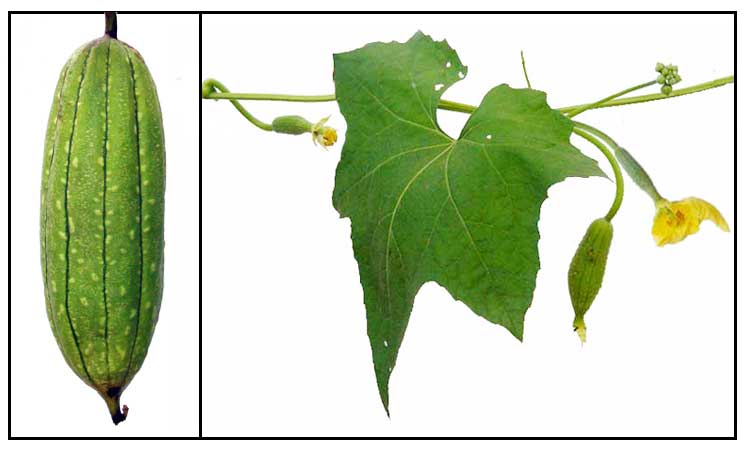
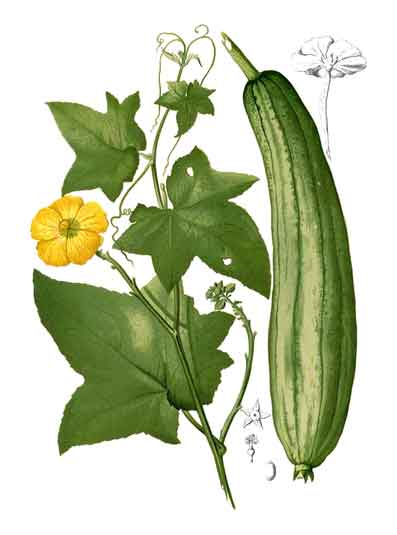
Patolang-bilog is a climbing, hairy,
smooth vine, reaching a length of 12 or more meters. Stems are
four-angled. Leaves are rounded-ovate to kidney-shaped, 10 to 20
centimeters across, shallowly 5- to 7-angled or lobed, denticulate scabrous, with pointed tips and heart-shaped bases. Male flowers occur singly in the axils of the leaves on long-peduncled racemes, and are crowded at or near the apex of the peduncle. Calyx is green; lobes are ovate-lanceolate,
about 1 centimeter long. Corolla is rotate, yellow, 5 to 7 centimeters in diameter. Female flowers are solitary and peduncled. Fruit
is oblong, cylindric, smooth and green, 12 to 30 centimeters long. Seeds
are black, about 1 centimeter long, very narrowly winged, smooth or very sparingly tubercled. Fruit is
sweet and larger than the common and bitter wild form.
Distribution
Cultivated for its edible
fruit.
 Constituents Constituents
- Fruit contains abundant
saponin.
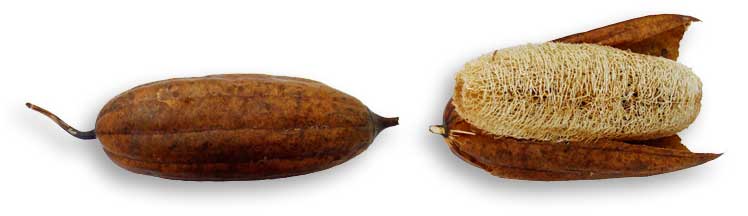
- Luffa, the spongy fiber, contains cellulose, xylan, mannan, galactan,
and lignin.
- Seeds contain a fixed oil (45%).
- Antioxidant-guided assay of L. cylindrica fruit
for hydrophilic antioxidant constituents yielded eight compounds: p-coumaric acid (1), 1-O-feruloyl-β-d-glucose (2), 1-O-p-coumaroyl-β-d-glucose (3), 1-O-caffeoyl-β-d-glucose (4), 1-O-(4-hydroxybenzoyl)glucose (5), diosmetin-7-O-β-d-glucuronide methyl ester (6), apigenin-7-O-β-d-glucuronide methyl ester (7), and luteolin-7-O-β-d-glucuronide methyl ester (8). (see study below) (5)
- Study confirmed the presence of a saponium, m.p. 268-270 C, which is crystalline, white, and bitter.
- Methanolic extracts of leaf and flower yielded alkaloid, tannin, saponin, phytate and oxalate which were quantitatively higher in the flower extract than the leaf extract.
(see study below) (15)
- Phytochemical screening of seed and leaf extracts for secondary metabolites yielded alkaloids, saponins, and cardiac glycosides.
(see study below) (2)
- Nutrient analysis of Luffa fruit (serving size 1 cup/178g) yielded 100 Kcal, and 5.49 Kcal from fat; (Nutrients) protein 1.17g, total fat 0.61g, ash 0.66g, carbohydrate 25.53g, dietary fiber 5.2g, total sugars 9.2g; (Minerals) manganese 0.397mg, potassium 806mg, copper 0.151mg, magnesium 36 mg, iron 0.64mg, phosphorus 55 mg; (Vitamins) vitamin A 463 µg, vitamin B5 0.892 mg, vitamin B6 0.176 mg, vitamin C 10.1 mg, vitamin B1 0.082 mg, vitamin B2 0.075 mg; (Lipids) saturated fatty acid 0.048 g / palmitic acid 0.034 g, monosaturated fatty acids/oleic acid 0.112 g, and polyunsaturated fatty acids/linoleic acid 0.263 g. (20).
- Study for functional components showed abundance of phenolics and flavonoids in the aqueous extract of peel, with dominance of oleanolic acid, carotenoids, and chlorophylls in the ethyl acetate extract of peel.
(see study below) ( 28)
- Preliminary phytochemical screening of fruit extract yielded carbohydrates, proteins, steroids, flavonoids, terpenoids, and tannins. (see study below) (30)
- Phytochemical screening of leaves yielded saponins, flavonoids glycosides, terpenoids, and alkaloids, with absence of steroids, quinolones, tannins, and phenols. (see study below) (31)
- Phytochemical screening of seed extracts yielded saponins, tannins, flavonoids, carbohydrates, cardiac glycosides, deoxy-sugars, terpenes, phlobatannins, and alkaloid. (see study below) (35)
Properties
- Antiseptic, carminative, antitubercular, pectoral, cooling, antiseptic, galactagogue, emmenagogue.
- Root is hydragogue.
- Seeds are emetic and cathartic.
- Fruit considered anthelmintic, carminative, laxative, depurative, emollient, expectorant, diuretic, and lactagogue.
Parts
utilized
Leaves, seeds, fruit.
 Uses Uses
Nutrition
· Fruits are edible, eaten as vegetable.
Folkloric
· Root is a hydragogue cathartic even in small doses.
· Liquid from steeped dried fruit used as emetic.
· Fruit of bitter form is a violent cathartic and emetic.
· Vine and root used for decaying teeth and parasitic infections.
· Leaves used for skin diseases and orchitis.
· In Java leaf juice used for amenorrhea.
· Infusion of seeds or an alcoholic emulsion is a drastic purgative
and anthelmintic
· In Uganda, used to hasten childbirth.
· Seeds have been used in the treatment of asthma, sinusitis and fever.
· Tincture of seed oil used for various skin diseases.
· Fruit used in treatment of ascites, jaundice, biliary and intestinal colitis, fever, syphilis, tumors, bronchitis, splenomegaly and leprosy.
· Fruit used for bowel and bladder hemorrhage, hemorrhoids, toothache, smallpox, and scarlet fever.
· Fresh fruit considered cooling to the intestines, warming to the stomach, and tonic to the genital organs.
· Seeds used as emetic and cathartic.
· Infusion of seeds used as drastic purgative and anthelmintic.
· In Nigeria, plant used in the treatment of cancer. (27)
Others
· Sponges: Cultivation is
sometimes done for the ripe fruit for use in the manufacture of
bath sponges.
· Seed oil: Cylindrical seed oil has been used in sunscreens, sunless tanning lotions, anti-aging products, facial moisturizers, body oils, and facial cleansers. (17)
· Fish poison: In Nigeria,
L. cylindrica is the most frequently used botanical fish poison in Rivers, Lagos, and Adamawa States. (41) (see study below 40)
Studies
• Oxytoxicity / Leaves:
Study was done to validate
the uses of Bidens pilosa and Luffa cylindrica in inducing labor in
Western Uganda. Results showed the aqueous leafy extracts to be oxytocic, increasing rat uterine motility. Its
bioactivity supports its therapeutic use as herbal remedies in childbirth. (1)
• Antibacterial: Study showed
the seed extracts of LC to contain alkaloids, saponins and cardiac glycosides
with antimicrobial activities against E coli, S aureus, S typhi and
B subtilis. (2)
• Disinfection of Waterborne Coliform Bacteria: Study of the aqueous extracts of seeds and fruits of Lc for its activity as drinking water disinfectant showed highly variable and dose-dependent inactivation of both faecal coliforms and total coliforms, the seed extract achieving higher coliform inactivation than the fruit extracts. Although the antimicrobial potential of fruits and seeds was demonstrated, the disinfection performance was less than required to be considered a reliable disinfectant for drinking water. (6)
• Immunomodulatory: Isolated
triterpenoids from LC showed immunostimulatory effect with significant
dose-dependent activities in lymphocyte proliferation and phagocytic
activity of macrophages. (3)
• Cytotoxic / Abortifacient: Study
isolated two proteins with ribosome-activating, cytotoxic, and abortifacient
activities from the seed of L cylindrica. (4)
• Antioxidant / Fruit: Hydrophilic antioxidant constituents in the fruit of Lc yielded eight compounds. Results showed that consumption of sponge gourds can supply antioxidant constituents to the human body. (see constituents above) (5)
• Antitumor: Polysaccharides, aqueous extracts and proteins of M charantia, M balsamina and L cylindrica showed remarkable effects in reducing the number of viable Ehrlich Ascites tumor cells, as well as DNA, RNA and protein synthesis in the cells. (7)
• Oxytocic: Study to validate the claimed uses of Bidens pilosa and Luffa cylindrica inducing labor during childbirth showed the aqueous leafy extracts of Bp and Lc increased rat uterine motility suggesting oxytocic activity and validates their therapeutic herbal uses in childbirth. (8)
• Antihyperglycemic / Fruit: Study of methanol extract of fruit in alloxan-induced diabetic Wistar rats showed remarkable dose-dependent antihyperglycemic activity. (9)
• Antimicrobial: Study of extracts of whole plant of Luffa cylindrica showed significant antibacterial and antifungal activity in the chloroform extract. (10)
• Anthelmintic: Leaf extracts of Lc were tested for anthelmintic activity against Indian earthworm Pheretima posthuma. Dose dependent activity was observed, with the methanolic extract showing more activity than the others. (12)
• Hepatoprotective / Paracetamol Induced Toxicity / Fruit / Leaves: Study evaluated the hepatoprotective activity of ethanol and aqueous extracts of the fruit of L. cylindrica in paracetamol-treated albino rats. Results showed significant hepatoprotective effect, with supporting histopathological studies. (13) Study evaluated a methanolic extract of L. cylindrica leaves for hepatoprotective potential against paracetamol intoxicated wistar rats. Extract showed dose-dependent reduction of elevated serum enzyme levels. Serum markers were reduced to near normal levels, along with significant reduction of lipid peroxidation level, with increase in antioxidant enzymes SOD, GSH, and catalase levels. (37)
• Luffin / Protein-Synthesis Inhibitory Protein / Seeds: Luffin, a protein which inhibits protein synthesis in rabbit reticulocyte lysate, was purified from the seeds of L. cylindrica. It showed weak cytotoxicity against murine leukemia L1210 cells. (14)
• Comparable Antimicrobial Activity / Flower and Leaf: Study investigated the antimicrobial activities of leaf and flower methanolic extracts against four bacterial and two fungal strains. Results showed the methanolic leaf extract was more potent than the flower against the bacterial strains (E. coli, Klebsiella spp., S. aureus, and S. typhi) while the flower extract showed better antifungal activity against C. albicans and A. niger. (see constituents above) (15)
• Antibacterial / Antifungal:Study screened L. cylindrica and Momordica charantia for antibacterial, antifungal, and phytotoxic activities. Both plants showed potent antifungal activity as the BuOH fraction of L. cylindrica showed significant activity against F. solani and T. longifusus. Crude methanolic extract showed moderate activity against B. subtilis and K. pneumonia. (16)
• Seed Flour: Study investigated the amino acid, fatty acid, and phytochemical compositions of Luffa cylindrica seed flour. Study yielded a total amino acid concentration of 72.71g/100g protein and a total essential amino acid of 38.76g/100g protein. Arginine was the most concentration essential amino acid at 9.75g/100g protein while linoleic acid (31.47%) was the most abundant fatty acid. Total concentration of polyunsaturated fatty acids was 52.02%. Flavonoids (4.53%) were the most concentrated phytochemical in the seen flour. L. cylindrica yielded a high proportion of essential amino acids, a potential source of healthy fat, and exhibits low atherogenic potential. (18)
• Antioxidant / Antibacterial / Cytotoxicity: Study compared the antioxidant, antibacterial, and cytotoxic activities of various extracts of L. cylindrica and L. acutangula. Both plants showed concentration dependent antioxidant activity by DPPH assay and disc diffusion method. All extracts showed low to moderate levels of antibacterial activity. All extracts displayed considerable toxicity towards brine shrimps with LC50 of 15.92 µg/ml (LC) and 33.69 µg/ml (LA). (19)
• Silver Nanoparticles / Antimicrobial: Study reports on an simple, efficient, and ecofriendly synthesis of nanoparticles using Luffa cylindrica fruit extracts. Antimicrobial study of nanoparticles showed the zone of inhibition to be relevant for both gram positive and gram negative bacteria. (21)
• Lipid Effects of
Sponge Gourd Seed Oil: Study evaluated the effects of sponge gourd (L. cylindrica) seed oil and yukdomok (Chionanthus retusa) seed oil intake on lipid levels of blood and organs in mice. Group treated with sponge gourd seed oil showed the highest total cholesterol level (171.75 ±27.15 mg/dL in the blood and showed significantly higher HDL-cholesterol level of 142.75 ± 16.32 mg/dL. (22)
• Anti-Inflammatory / Bronchodilator / Antibacterial / Seeds: Study evaluated seeds of L. cylindrica for anti-inflammatory (carrageenan-induced paw-edema), bronchodilator (Guinea pig trachea), and anti-microbial activity. Isolated compounds, Cu-1 and Cu-3 showed anti-inflammatory activity. Cu-4 showed significant bronchodilator activity. Cu-2 and Cu-4 showed significant antibacterial (S. aureus) and antifungal (C. albicans) activity. (23)
•
Cellulose from Luffa Fiber as Tablet Binder: Study evaluated the cellulose from the fiber of L. cylindrica as binder in the formulation of acetaminophen tablets. Study showed the fiber is a good source of cellulose. The powder showed fair and passable flow properties. However, the used of LC-MCC as binder did not conform to the US pharmacopeia specifications. (24)
• Luffachitin / Sin Substitute / Wound-Healing Enhancement:Study evaluated luffachitin obtained from the residue of the sponge-like fruit of Luffa aegyptica as a weavable skin substitute. The pulp like residue of the dried fruit was woven into a thin, porous membrane as a skin substitute for conducting wound-healing on rats. The luffachitin membrane showed significant wound-healing enhancement compared to cotton gauze. (25)
• Luffa Fruit Fibers / Tensile Strength / Potential Uses: Study showed Luffa cylindrica's fiber has high medical potential with a high tensile strength of 8.363 newtons, which is equal or higher than some suturing material. Study suggest potential use as dental material such as suturing material, dental floss or even bristle dental brush. (26)
• Genotoxicity & Antigenotoxicity Studies: Study evaluated aqueous and hydromethanol extracts of S. mombin, N. lotus, and Luffa cylindrica using animal bioassays. All the extracts were able to ameliorate MMS (methyl methane sulfonate) induced genotoxicity in bone marrow cells of exposed mice. Results show the potential of the extracts to induce somatic and germ cell mutation in male mice. (27)
• Functional Components in Peel and Pulp
/ Anti-Inflammatory: Study evaluated peel and pulp of Luffa cylindrica for functional components and its anti-inflammatory activity on RAW 24.7 murine macrophage cells. Both ethanol and ethyl acetate extracts in peel and pulp decreased production of NO in LPS-induced RAW 264.7 cells, while an ethanol extract reduced the secretion of prostaglandin E2. All extracts inhibited IL-6 production. Both EA extracts of peel and pulp reduced expression of p-IkBa, while the EA extract attenuated expression of p.ERK. (28)
• Suppression of Induced Atopic Dermatitis: Study evaluated the anti-inflammatory and anti-atopic dermatitis effects in vitro and in vivo of a 70% ethanol extract of Luffa cylindrica. Results showed LC can inhibit AD-like lesions and reduce the generation of IgE via inhibition of the inflammatory responses. LC has potential as therapeutic agent in treating allergic diseases, including atopic dermatitis. (29)
• Thrombolytic Activity / Fruit: Study evaluated the thrombolytic activity of an ethanolic fruit extract of Luffa cylindrica. Results showed significant thrombolytic activity (45%), compared to streptokinase (57%) as positive control and water (0%) as negative control. (see constituents above) (30)
• Effect on Hematological Parameters / Leaves: Study evaluated the effect of a methanolic leaf extract of L. cylindrica on hematological parameters of Swiss albino mice. Results showed dose-dependent changes including significant increases in lymphocyte and platelet counts. The plant has potential for the treatment of disease caused by thrombocytopenia and lymphocytopenia in mammals. (31)
• Anti-Emetic
/ Fruit Peel: An ethanol extract of fruit peel of Luffa cylindrica showed significant (p<0.001) antiemetic effect in young chicks. The protective effect of the extract against copper sulfate induced retching in young chicks is probably via peripheral action through excitation of visceral afferent nerve fibers of the gastrointestinal tract. It has been previously established that peripheral 5-HT3 of NK1 receptors are involved in emesis. The anti-emetic activity was attributed to receptor antagonism and peripheral anti-emetic action. (32)
• Anti-Inflammatory / Fruit Peel: Based on previous reports, this study suggests that the inhibitory effect of fruit peel of L. cylindrica on carrageenan-induced inflammation in rats could be due to inhibition of cyclooxygenase leading to inhibition of prostaglandin synthesis. In the study, rats pre-treated with L. cylindrica showed a significant edema inhibitory response at 5th hour following carrageenan injection. Results suggest LC extracts act by suppressing the later phase of inflammatory process by inhibition of cyclooxygenase. (32)
• Effect on Oxidative Stress Markers in Hydrogen Peroxide Induced Cataract / Fruit: Study evaluated the in vitro ability of L. cylindrica fruit extract in modulating biochemical parameters in hydrogen peroxide induced cataract on isolated goat lenses. Results showed LC extract can delay the onset and/or prevent the progression of cataract which can be attributed to presence of phenolics, flavonoids, and vitamin A, along with its high nutritional value. (33)
• Antibacterial / Antifungal / Fruit: Study evaluated the antibacterial and antifungal activities of an ethanolic extract of L. cylindrica fruit. The ethanolic fruit extract showed effective activity against all organisms tested i.e., Gram-positive and Gram-negative bacteria, and fungal species Aspergillus fumigatus, A. niger, and Candida albicans. (34)
• Wound Healing / Antimicrobial / Seeds: Study investigated the wound healing and antimicrobial activities of various seed extracts of Luffa cylindrica in Wistar albino rats using full-thickness skin excision wound model. Results showed significant (p<0.05) wound contraction, with the diethyl extract showing the most prominent wound healing activity. The median lethal dose (LD50) of the methanol seed extract administered intraperitoneally was 24.5 mg/kg. Various extracts were tested for antimicrobial activity against selected wound pathogens viz. S. aureus, P. aeruginosa, K. pneumonia, E. coli, P. vulgaris, and C. albicans. MICs of various extracts ranged from 0.04-0.6 g/ml. (35)
• Free Radical Scavenging Activity / Leaves: Study evaluated the free radical scavenging activity of methanolic extract of leaves of Luffa cylindrica in invitro systems viz. DPPH,, hydroxyl radical, superoxide and NO assays. Results showed a significant correlation between extract concentrations and percentage inhibition of free radicals. Preliminary phytochemical screening yielded terpenoids, steroids, flavonoids, and glycosides. The extract yielded 53.78 ± 1.01 µg/ml (GAE) total polphenolics. (36)
• Analgesic / Antimicrobial / Fruit: Study evaluated alcoholic and aqueous extracts of L. cylindrica fruit for analgesic activity by acetic acid writhing method and tail immersion method and for antimicrobial activity by disc diffusion method. Phytochemical screening yielded carbohydrates, flavanoids, glycosides, and saponins. Results showed moderate analgesic activity, with almost similar activity to pentazocin. The extract showed maximum zone of inhibition for S. typhi and S. aureus, and moderate inhibition for B. subtilis and V. cholera. (38)
• Potential For Paper Application: Study evaluated the fibrous plant for paper application. This part focused on the morphological, chemical and physical characterization of raw material of fruit of L. cylindrica. The fruit is composed of an assembly of dependent cords of four differentiated parts: external, internal wall, core and bond, each cord consisting of hollow and flexible cylindrical fibers. The external part is richest in cellulose (80%). The structure of vessels, cells of parenchyma and short fibers suggests similarity with wood of leafy trees or annual plants such as sorghum, bagasse or straw. A second article will deal with the paper application of fibers obtained by cooking the vegetal. (39)
• Piscicidal / Acute Toxicity of Fruit Extract on African Catfish / Potential Contamination of Aquatic Ecosystem: Study evaluated the acute toxicity of sponge plant (Luffa cylindrica) fruit extract (a piscicide) on Clarias gariepinus juveniles under laboratory conditions over a period of 96 hours with an LC50 of 14125.28 mg/L. Results showed the extract of LC fruit is toxic to fish. Effect on lower biota and non-target organisms could be far more devastating. Study suggests stringent measures should be taken to ensure restraint of its use by local fishers and to reduce the potential risk of poisonous fish consumption and pollution of the aquatic ecosystem. (40)
• Acute and Subacute Oral Toxicity Study / Fruits: Study evaluated L. cylindrica fruit decoction for safety in Wistar rats at dose of 2000 mg/kbw for acute (single dose) toxicity and 1000 mg/kbw (consecutive exposure) for 14 days. Results suggested safety as evidenced by absence of morbidity and mortality at tested dose levels. (42)
• Anticancer
/ Breast Cancer Cell Line / Leaves: Study evaluated the effects of aqueous-ethanol leaf extracts on different types of breast cancer cell lines. LC-MS analysis revealed phenolic compound derivatives and saponin as constituents that may be responsible for the extract activity. Results showed effective anticancer activity against MCF-7, BT-474, and MDA-MB-231 cells lines, as suggested by molecular analysis of apoptotic and proliferative markers. (43)
Availability
- Cultivated.
- Common market vegetable.
- Seeds in the cybermarket.
|