 Gen info Gen info
- Etymology: The genus name Adenanthera derives from Greek words aden meaning "a gland", and anthera meaning "anther", referring to the flower anthers being tipped with sticky glands. The specific epithet pavonina derives from Latin pavo meaning peacock blue.
- Cultural / Religious: Powdered wood provides a red dye used by Brahmins in India to mark the forehead. (50)
- Malaysia's first national car, the Proton Saga, is named after the plant.
(50)
- Seeds look similar to the red-black and very toxic seeds of Abrus precatorius (Rosary pea / Prayer beads / Saga).
- In long ago India, seeds were once used as a unit of weight for measurement for gold,
since the seeds weighed the same as each other. The Malay name for the tree, 'saga', derives from the Arabic world for 'goldsmith'.
Botany
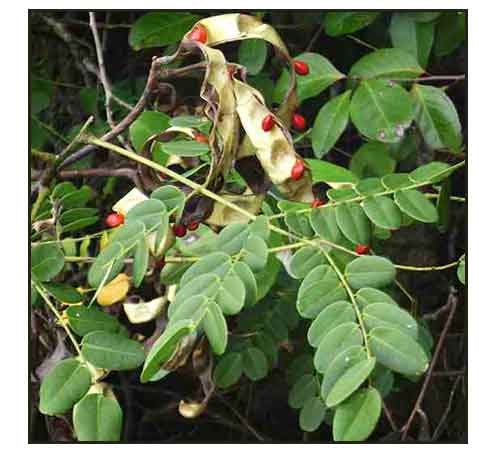
Saga-hutan is a deciduous, erect, large tree. Leaves are bipinnate. Pinnae are 8 to 12, opposite, short-stalked, 10 to 20 centimeters long. Leaflets are 12 to 18, oblong or elliptic-oblong, evenly alternate, short-stalked, and 2 to 3.5 centimeters long. Racemes are 5 to 15 centimeters long, simple from the axils of the leaves, panicled at the end of the branches. Flowers are fragrant. Calyx is small and bell-shaped with short teeth. Five petals are united at the base. Pods are linear, 15 to 21 centimeters long, curved and twisted when opening. Seeds are 10 to 12 in a pod, usually bright scarlet, shining, lenticular and compressed.
Adenanthera pavonina is a tree, up to 40 m tall, and rarely develops buttresses. The tree crown is uneven and rounded, The bark is brown-grey and slightly peeling to flaking. Leaves bipinnately-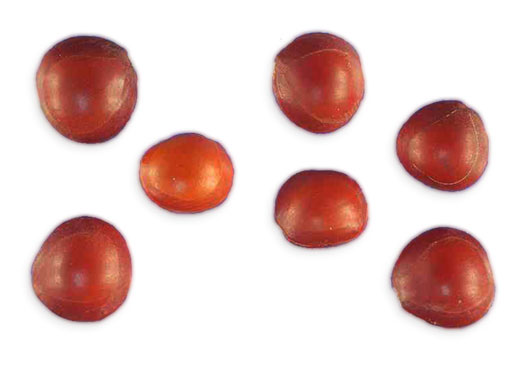 compound with 2-6 pairs of secondary stalks, about 6.5 – 20 cm long. Each secondary stalk has 4 – 9 compound with 2-6 pairs of secondary stalks, about 6.5 – 20 cm long. Each secondary stalk has 4 – 9
(- 11) pairs of leaflets. Leaflet is pale green, thin, elliptic to ovate shaped (1.5 – 4.5 cm long and 1 – 2.2 cm wide). It has rounded to truncate tip and unequal base. The upper surface of the leaflet is smooth while the underside is covered with appressed fine hairs. Flowers occur in a cluster (Raceme). The raceme is 12 – 30 cm long and flowers open from the base to the tip of the inflorescence. Flowers are white to yellow and turning dark yellow after anthesis. Flowers are small (0.3 – 0.5 cm) and strongly fragrant. Fruit pod is woody, curved and about 25 cm long and 1.3 – 1.8 cm wide. The pod is green and almost straight when young. As it matures, the pod turns brown, twists spirally and splits open to reveal the seeds within. Each fruit contains up to 25 seeds. They are bright scarlet red, shiny, hard and lens-shaped (0.7 – 0.9 cm long, 0.7 – 0.95 cm wide, 0.65 cm thick), with faint “heart line” (pleurogram) around the margin.
Distribution
- Introduced from India.
-
Cultivated in Manila as a shade tree.
- Native to tropical Asia to N. Australia.
- Now pantropic.
 Constituents Constituents
- Phytochemical screening of bark yielded alkaloids, carbohydrates, glycosides, saponin, phytosterols, fixed oil and fats, phenolics and flavonoids.
- Methanolic seed extract yielded cardiac glycosides, tannins, flavonoids, essential oils, phlobatanins, and saponins. (see study below) (22)
- Phytochemcial screening of stem bars
yielded alkaloids, flavonoids, glycosides, tannins, steroids, and saponins in the methanolic, chloroform and water extracts. (34)
-
Chromatographic analysis of seed oil was found to be rich in neutral lipids (86.2%) and low in polar lipids (13.8%). Neutral lipids were mainly triacylglycerols (64.2%). Unsaturated fatty acids were as high as 71%; saturated fatty acids 29%. GC and GC/MS analysis yielded linoleic, oleic, and lignocerotic acid as predominant fatty acids, while stigmasterol was the major steroid in the oil. (35)
- Phytochemical screening of methanolic extract of leaves yielded alkaloids, glycosides, carbohydrates, phenolic compounds, flavonoids, terpenoids, saponins, sterols, proteins, and resins. (see study below) (37)
- Study of ethanol extract of dried powder leaves and successive fractionation yielded a new methoxy flavonol glycoside named as quercetin 3-O-α-dirhamnopyranosyl-(1‴ → 2″,1″″ → 6″)-β-glucopyranoside-4′-methoxy (1), as well as kaempferol-3-O-α-dirhamnopyranosyl-(1‴ → 2″,1″″ → 6″)-β-glucopyranoside (2), isovitexin (3), quercetin-3-O-rhamnopyranosyl(1‴ → 4″)-β-glucopyranoside (4), quercetin-3-O-β-glucopranoside-4′-O-rhamnopyranoside (5), kaempferol-3-O-α-rhamnopyranosyl(1‴ → 2″)-β-glucopyranoside (6), quercetin-3-O-rhamnopyranosyl(1‴ → 2″)-β-glucopyranoside (7), quercetin-3-O-β-glucopyranoside (8), kaempferol (9) and quercetin (10). (see study below) (39)
- Study of bark isolated seven compounds, namely: ethyl 3,3-dimethyl-13-hydroxytridecanoate (1), stigmasta-5,22-dien-3β-ol (2), tert.butyl tridecanoate (3), 6-α-hydroxy stigmast-20(21)-en-3-one (4) of dichloromethane extract and 18-(2′, 3′-dihydroxyphenyl)nonadec-17-en-2-ol (5), 1-(N-propyl amino)-2-henecosanone (6), and stigmast–5(6), 20(21)-diene-3-one (7). (46)
- Phytochemical screening of methanolic leaf extract yielded alkaloids, saponin, flavonoids, carbohydrates, anthocyanin and betacyanin, quinones, cardiac glycoside, terpenoids, triterpenoids, coumarin, steroids, and acids while oxalates, phenol, and tannins were absent.
(48)
- Proximate analysis showed the plant possess significant amount
of protein 8.050%, crude fiber 11.088%, moisture content 7.135%, crude fat 0.845%, carbohydrates 67.79%, ash content 5.09%, organic matters 94.91%, and vitamin A 0.196. Qualitative mineral analysis yielded Mn 125.35 mg/kg, Fe 878.45 mg/kg, Ni 15.85 mg/kg,, Cr 15.85 mg/kg, Cu 11.95 mg/kg, /Zn 24.50 mg/kg,, K 0.721%, Na 0.074%, Ca 0.988%, Mg 0.988%.
(48)
- GC-MS analysis of leaves and fruits for essential oils identified 27 compounds. Leaves consisted mainly of monoterpene hydrocarbons (68.01%) and major compounds of sabinene (27.9%), D-limonene (14.79%), 3-carene (8.46%), caryophyllene (6.57%), and
γ-terpinene (6.16%) Fruits consisted mainly of sesquiterpene hydrocarbons (62.8%) with major compounds of ß-elemene (39.6%), sabinene (11.7%), and caryophyllene (11.38%). (49)
 Properties Properties
- Seeds considered to have toxic properties; when cooked, edible and rich in fats and proteins.
- Leaves considered astringent.
- Roots considered emetic.
- Bark considered astringent, vulnerary, and aphrodisiac.
- Studies have suggested analgesic, anti-inflammatory, blood pressure lowering, antibacterial, antidiabetic, hypolipidemic, tyrosine inhibitory, antioxidant, anthelmintic, neuroprotectiive, nephroprotectiive, anticancer, CNS depressant,
antimalarial, antiproliferative , antidiarrheal, cytoprotective, antiemetic, anti-quorum sensing properties.
Parts used
Seeds, leaves, bark.
Uses
Edibility
- Seeds and leaves may be eaten.
- Raw seeds are poisonous, but edible when cooked. When cooked, easily digestible by humans and livestock, and are rich in fats and proteins.
-
Although seeds have been reported to have toxic properties, used as a condiment in Malabar.
- Leaves are edible when cooked.
- Flowers are edible.
Folkloric
- Roots are used as an emetic.
- Decoction of leaves used for chronic rheumatism and gout; also useful for bowel hemorrhage and hematuria.
- Leaves are astringent and tonic; used for diarrhea and dysentery.
- Bark used in rheumatism, hematuria, ulcers, and gonorrhea.
- Seeds used for boils and inflammation.
- Powdered seeds used externally to hasten suppuration of boils.
- Powdered seeds also used for headaches.
- Seeds used for cholera; also used for general paralysis.
- In Sri Lankan folk medicine, used for treatment of diabetes. (33)
Others
- Decorative / Crafts: Seeds used as beads for necklaces and decorative items. In Singapore, seeds used as fill for tetrahedral bags used in children's game of "five stones". Seeds are collected in bottles as "love beans". (50)
- Symbolism: In China, seed are considered a symbol of love.
- Wood: Extremely hard, used for furniture making, construction, flooring, boat building.
- Dye: Wood yields a red dye. Red dye from powdered wood used the Brahmins in India to mark the forehead.
- Fuel: Esteemed in the Pacific Islands as fuelwood; yields a good charcoal.
- Poisonous: Raw seeds considered poisonous.
- Fodder: Cultivated as fodder source.
Studies
• Anti-Inflammatory / Analgesic / Seeds: Study evaluated a methanol extract of seeds of Adenanthera pavonina on animal models for analgesic and anti-inflammatory activities. Results showed significant (p<0.05) inhibition of carrageenan-induced paw edema in rat and acetic acid-induced vascular permeability in mice. Extract also showed dose-dependent and significant (p<0.05) analgesic activity in acetic acid- induced writhing in mice and inhibition of both early and late phases of the formalin-induced paw licking in mice. LD 50 of the extract was 1.36 g/kg. (2)
• Physiochemical Characterization of Seed Oil / Nutrient Assessment: Study showed the seeds of AP contain appreciable amounts of proteins, crude fat and minerals comparable to commonly consumed staples. Study suggests AP seeds represent a potential source of oil and protein that can alleviate shortages. (3)
• Blood Pressure Lowering Effect: Study showed Adenanthera pavonina seed extract has the potential to have a blood pressure lowering effect. Serum biochemistry changes suggest the extract has a tonic effect on kidneys and liver and may play a central role in drug metabolism. Absence of kidney, liver and testes lesions suggest the plant is safe for medicinal use. (4)
• Seed Oil and Emulsions: Study showed the seed oil to be rich in neutral lipids (86.2%) and low in polar lipids (13.8%). Unsaturated fatty acids were as high as 71%, the predominant FA showed to be linoleic, oleic and lignocerotic acids. Stigmasterol was the major steroid. Results indicate the possible applications of the oil in the pharmaceutical and medical fields as drug and cosmetic active ingredient carriers. (5)
• Antioxidant: Study showed the the stem- bark of AP showed significant antioxidant activity, presumably with more activity than α-tocopherol.
• Anthelmintic / Phytochemicals: Bark extracts were tested for anthelmintic activity against Pheretima posthuma and Ascardia galli. Phytochemical screening of bark yielded alkaloids, carbohydrates, glycosides, saponin, phytosterols, fixed oil and fats, phenolics and flavonoids. Results showed significant anthelmintic activity. (7)
• Robinetin / Roots: Study isolated robinetin as the predominant flavonoid in the root. Results confirmed the protective effects of Robinetin in reducing the severity of perioxidative damage. (11)
• Trypsin Inhibitor: Study isolated a trypsin inhibitor (ApTI) from A. pavonina seed and was tested for insect growth regulatory effect. Chronic ingestion resulted in significant reduction in larval survival. Results showed ApTI have a potential antimetabolic effect when ingested by A. kuehniella.(127)
• Antidiabetic / Hypolipidemic: Study of alcoholic and aqueous seed extracts in alloxan-induced diabetic rats produced favorable changes in the lipid profile of diabetic rats along with better glycemic control. (13)
• Protective Effect of Oil Emulsions: Study developed very stable formulations of submicron oil-in-water emulsions from AP. Results suggest nonionic surfactant/phospholipid-based emulsions containing the edible oil of AO has a potential as an alternative formulation matrix for pharmaceutical, nutritional or cosmetic applications. (14)
• Antibacterial / Bark: Study of different bark extracts were studied for antibacterial activity. The ethanolic and aqueous extracts showed the highest activity against the tested extracts - P. aeruginosa, B. subtilis, E. aerogenes, Staph epidermis, and Salmonella typhimurium. (16)
• Neuroprotective / Seed: Study of seed extract in neuropathic pain in streptozotocin-induced diabetic rats showed attenuation of development of diabetic neuropathy when compared to pregabalin. Results suggest a possible benefit in preventing progression of diabetic nephropathy. (17)
• Antibacterial Soap / Seed Oil: Extracted saga seed oil yielded three main components: Methyl Linoleate Natural, Ethyl Palmitate, and Butyl Stereate. An antibacterial soap prepared from the extracted oil compared with commercial antibacterial soap bacterial removal with handwashing. (18)
• Anticancer / Bark: Study evaluated a stem bark extract for antitumor activity on Dalton's ascitic lymphoma in male Swiss albino mice. Results demonstrated tumor inhibitory activity with increase in life span accompanied by reduction in WBC in treated mice. (19)
• Renal Protective / Reduction in Diabetic Neuropathy: Study evaluated an aqueous seed extract in streptozotocin-induced diabetic rats. Results showed reduced development of diabetic nephropathy in STZ-induced diabetic rats and can have a beneficial effect in reducing progression of diabetic nephropathy. (20)
• CNS Depressant Effect / Seed: Study evaluated a methanolic extract of A. pavonina for antidepressant effect in various animal models. The LD50 was found to be 1360 mg/kg. Results showed CNS depressant activity with significant dose related potentiation of phenobarbitone sleeping time in mice. It offered 80% protection against leptazol-induced convulsion in mice and a dose dependent reduction in spontaneous locomotor activity. There was significant reduction in acetic acid inducting writhing in mice and inhibition of increased paw size in carrageenan induced paw edema. (see constituents above) (22)
• Biosorption of Copper / Seeds: Removal of Cu(II) from industrial waste water is an important issue. Study showed powdered Adenanthera pavonina seeds are efficient in biosorption of Cu (II) ions from aqueous solution and can be employed in designing wastewater treatment plants for copper. (23)
• Anti-Inflammatory / Antidiarrheal / Leaves: Study evaluated ethanolic extract of A. pavonina leaves in both acute and chronic inflammatory models and antidiarrheal model. Results showed anti-inflammatory activity on acute phase inflammation in carrageenan-induced paw edema and subacute model of cotton-pellet granuloma formation. The anti-inflammatory activity may be due to influence of beta-sitosterol and stigmasterol. An anti-diarrheal effect may be due to the inhibition of prostaglandin synthesis, evidenced by the delay in wet faeces formation. (24)
• Antinociceptive / Leaves: Study evaluated the antinociceptive activity of ethanol extract of leaves of A. pavonina using various nociceptive models induced thermally or chemically in mice, including hot plat and tail immersion test, acetic-acid induced writhing and glutamate- and formalin-induced licking tests. Results showed significant and dose-dependent anitinociceptive activities. The reversal effect of naloxone suggested central activity with the association of opioid receptors. Enhancement of writhing inhibitory activity by methylene blue (MB) suggests possible involvement of cGMP pathway in the mediation of antinociception. (25)
• Cytoprotective / Anti-Inflammatory / Kernel: Study evaluated the anti-inflammatory activity of kernel extracts of Adenanthera pavonina. Pretreatment with kernel extract suppressed nitric oxide, superoxide anion, cell death, nuclear fragmentation in lipopolysaccharide and H2O2 stimulated or induced macrophages in rats. Results suggest the extract suppresses intracellular peroxide production. (26)
• Antibacterial / ß-Sitosterol Glucoside / Leaves: Study evaluated hexane and ethanolic extracts of leaves and pure compound (ß-sitosterol glucoside) for antibacterial activity against Enterococcus spp., S. aureus, P. aeruginosa, S. typhi, E. coli, Proteus spp., K. pneumonia and A. baumanii. Results showed antibacterial activity with varying zones of inhibition. Only Proteus spp. showed resistance to all the extracts. Ethanol extract was effective against Enterococcus spp., E. coli, S. aureus, and A. baumannii with ZI of 7 mm, 17.5 mm, 8 mm, and 17 mm, respectively. Hexane extract showed ZI of 10 mm for S. aureus, P. aeruginosa, and S. typhi and 11 mm for Enterococcus spp. Adenanthera pavonina pure compound, ß-sitosterol glucoside, showed activity against S. aureus, E. coli, and A. baumanii with ZI of 15 mm, 9 mm, and 11 mm, respectively. (27)
• Reno-Protective in Diabetic Nephropathy / Seed: Study investigated the renal protective effect of A. pavonina seed aqueous extract in STZ-induced diabetic rats. STZ induced severe hyperglycemia with marked increase in proteinuria and albuminura. Extract treatment significantly reduced proteinuria, albuminuria, lipid levels, and HbA1c deposition in diabetic rats. Results suggest reduction in development and progression of diabetic nephropathy in STZ-induced diabetic rats. (28)
• Antimicrobial / Anticancer / Seeds and Leaves: Study evaluated the antimicrobial and anticancer effects of seed and leaf extracts of red wood plant. Methanolic extract of seeds and leaves exhibited efficacious antimicrobial activity against various pathogens and anticancer effect against bone cancer cell line. (30)
• Anti-Inflammatory / Bark: Study evaluated various extracts of dried and ground bark of A. pavonina for anti-inflammatory activity by carrageenan-induced hind paw edema rat model. Extracts at doses of 200 and 400 mg/kbw exhibited significant (p<0.001) dose-dependent anti-inflammatory effects. Effect was comparable to reference drug diclofenac sodium. (31)
• Antidiarrheal / Acute Toxicity Study / Bark: Methanol extract of A. pavinona bark showed antidiarrheal activity in a castor oil-induced diarrhea model in rat as evidenced by significant dose dependent reduction of cumulative wet fecal mass. The highest dose (1000 mg/kbw produced inhibition of defecation comparable with loperamide. Acute toxicity study of methanolic extract showed an LD50 value of 1453.44 mg/kg. (32)
• Hypoglycemic / Antihyperglycemic / Safety / Leaves: Study evaluated the glycemic regulatory properties of hot water extract of mature leaves of Adenanthera pavonina in a rat model. Results showed the HW extract of AP leaves possesses significant (p<0.05 hypoglycemic and antihyperglycemic effects. Except for watery stools, subchronic administration (21 days) of leaves was well tolerated with no hepatotoxic, nephrotoxic, or neurotoxic effects. (33)
• Antimalarial / No Antioxidant Effect / Seed: Study evaluated the antimalarial and antioxidant activities of methanol seed extract of Adenanthera pavonina in Plasmodium berghei infected mice.
The percentage of parasitemia decreased significantly in the group treated with the crude extract (p<0.001). Crude extract at 800 mg/kg exhibited antimalarial activity (92.11%) higher than chloroquine (88.73%). In invivo antioxidant studies, the extract showed an IC50 > 400 µg/ml, which was significantly higher than standard ascorbic acid (IC50 1.20 µg/ml). Results showed the seed extract exhibited significant antimalarial activity but did not exert an antioxidant effect over parasitized treated mice. (36)
• Antiproliferative / HEp-2 Cells: Study evaluated the cytotoxicity and anti-proliferative activity of a decoction composed of Adenanthera pavonina and Thespesia against Hep-2 cells. Mean values of EC50 were 195.50, 120.02, and 77.06 µg/ml for LDH, MTT, and SRB assays, respectively. Results suggest the decoction possesses anti-proliferative activity and induces apoptosis on the HEp-2 cancer cells but showed no toxicity against toxicity against Artemia salina. (37)
• Scavenging Activity / Leaves: Study evaluated the scavenging activity of methanolic extract of leaves for its ability to counteract oxidative damages by ROS. Total phenolic and flavonoid contents in MEAP yielded 55.43 ± 1.07 µg/ml GAE and 52.87 ± 1.8 µg/ml equivalent to rutin. IC50 values for scavenging of DPPH free radical and NO anion were 425 µg/ml and 352 µg/ml, respectively, compared to standard ascorbic acid 320 µg/ml and 280 µg/ml, respectively. (see constituents above) (38)
• Flavonol Glycosides / Free Radical Scavenging / HepG-2 Cytotoxicity / Leaves: Study of 95% ethanol extract of dried powdered leaves and solvent fractions isolated a new methoxy flavonol glycoside along with 9 other compounds. The ethanol extract and ethyl acetate extract showed 49.30% and 62.67% free radical scavenging activity, respectively. The ethanol extract showed significant cytotoxicity against HepG2 (IC50 2.50 µg) as compared with cisplatiin (IC50 > 10 µg). (see constituents above) (39)
• Effect on Cisplatin Induced Genetic Damage: Study evaluated the effect of plant extracts of Acacia sinuata and Adenanthera pavonina on cisplatin induced genetic damage in cultured human peripheral lymphocytes. The extracts of the plants at different concentration significantly increased the mitotic index compared to cisplatin treated cell alone. The reduction in cell cell proliferation which may be due to repair of cisplatin induced DNA damage. Both plants showed little genomic activity with increased concentration. All tested concentrations showed no genotoxic effect on human blood in vitro. (40)
• Antidiarrheal / Seed: Study evaluated the antidiarrheal potential of Adenanthera pavonina aqueous seed extract using castor oil and magnesium sulphate-induced diarrhea in rats. Loperamide was used as reference drug. Results showed significant (p<0.05) dose-dependent antidiarrheal potential in both models. (41)
• Alpha-Amylase Inhibition / Antidiabetic Potential / Antioxidant / Cytotoxicity / Leaves: Study evaluated methanol extract of leaves for alpha-amylase inhibitory activity. The IC50 values of a-amylase inhibitory activity of MeOH, EtOAc, petroleum ether, and water were 16.15, 59.93, 145, and 213.85 µg/ml, respectively. The EtOAc fraction showed highest phenolic content (34.62 ± 1.14 mg/g extract) and highest DPPH scavenging activity with IC50 of 249.92 ± 3.35 µg/ml. A crude ME on cytotoxicity evaluation using brine shrimp was estimated at 1963 µg/ml, indicating absence of cytotoxic compounds in the extract. (42)
• Anti-Emetic Activity / Leaves: Study evaluated crude methanol extracts of leaves of A. pavonina, P. roxburghii, P. cineraria and P. juliflora for anti-emetic activity in emesis induced by oral administration of copper sulphate to male chicks of four days age. All extracts at 150 mg/kbw orally was compared with same dose of standard drug chlorpromazine. All tested extracts showed anti-emetic activity. Adenanthera pavonina showed lowest activity at 50.17%. (43)
• Galactomannans / Antidiabetic /
Seeds: Study evaluated the antidiabetic effect of galactomannans extracted from seeds of A. pavonina in STZ-induced diabetic mice. Galactomannan-enriched food treatment decreased glycemia, total cholesterol, and triacylglycerol. Results suggest galactomannans have potential as therapeutic alternative for treatment of DM. The antidiabetic effect may be related to intestinal glucose and lipid absorption inhibition. There is also potential involvement in the reabsorption inhibition of biliary salts. (44)
• Anti-Quorum Sensing: Quorum sensing (QS) in Pseudomonas aeruginosa plays a role in virulence factor production, biofilm formation and antimicrobial resistance. Study evaluated the anti-QS activity ethanol extract of AP using Chromobacterium violaceum CV026 biosensor strain and inhibition of QS-regulated violacein. Bioassay guided fractionation yielded an ethyl acetate fraction with strong anti-QS activity and was evaluated for inhibition of QS-regulated procyanin, proteolytic, elastolytic activity, swarming motility, and biofilm formation in P. aeruginosa PAQ1. Results suggest A. pavonina can be an effective anti-QS agent. (45)
• Trypsin Inhibitors / Seeds: Study highlights: Trypsin inhibitors are abundant in the seeds of A. pavonina. Its trypsin inhibitors cross react with soybean trypsin inhibitor antibodies. Boiling of seeds inactivates the trypsin inhibitors. The trypsin inhibitors are resistant to pepsin digestion and are localized in the cell cytosol. (47)
• Antihyperglycemic / Neuroprotective / Bark: Study evaluated the antihyperglycemic and neuroprotective activity of 50% methanol extract of A. pavonina bark in STZ-induced diabetic rats. Extract treatment reduced blood glucose levels, SGOT, SGPT, glutamate and lipid peroxidase levels. Behavioral parameters such as pain behavior (Hot Plate method and Tail Immersion Method) and locomotor behavior (actophotoometer) were significantly improved in treated rats. Results confirm antihyperglycemic and neuroprotective activity. (51)
• Hepatoprotective / Antioxidant / Leaves: Study evaluated the hepatoprotective and antioxidant effects of hexane and ethanol extracts of leaves along with isolated pure compound ß-sitosterol glucoside in carbon tetrachloride (CCl4) induced liver damage in rat. Extract treatment showed dose-dependent reduction of CCl4-induced elevated activity of serum enzymes and direct bilirubin. Oral administration of ß-sitosterol glucoside significantly reduce activity of ALP, γ-GT, direct bilirubin, total bilirubin, and ALT. The hepatoprotective effect was attributed to the presence of antioxidant phytochemicals in leaves and reducing power of free radicals. (52)
Availability
Wild-crafted.
|