Botany Botany
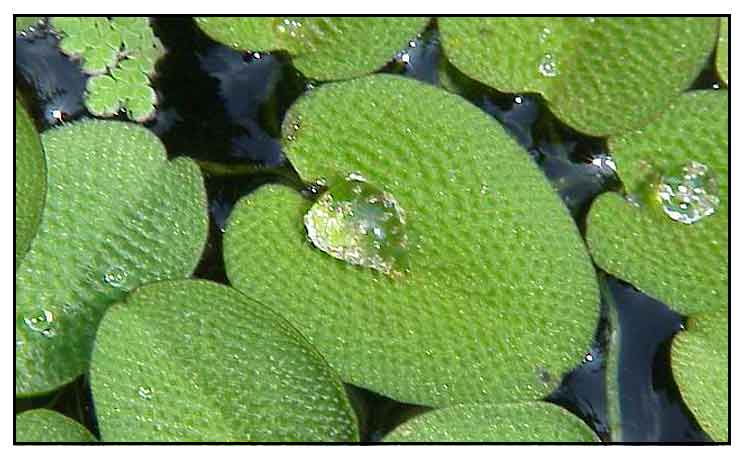
Salvinia auriculata is a free-floating aquatic fern, up to 20 centimeters long. Horizontal rhizome lies below the water surface. Fronds are of two types, buoyant or submerged, light-green to medium green, with brownish edges when mature, with a distinctive fold in the center. Floating leaves are boat-shaped, up to 2.5 centimeters long and 3.5 centimeters wide. Upper surface has even rows of papillae, each with a tuft of hairs at the distal end, joined together at the tips into a form similar to an inverted egg-beater. The cagelike structure of the end hairs give the plant buoyancy in water.
 Distribution Distribution
- Widespread in ponds, pools, and lakes throughout the Philippines.
- Occasional ornamental cultivation.
- Originated from South America.
Constituents
- Yields proteins, nutrients, lignin, ash, and tannin.
- Phytochemical screening yielded alkaloids, flavonoids, phenols, tannins, and saponins. (11)
- Bioassay guided assay isolated three main compounds i.e., stigmasterone, stigmasterol, and friedelinol. (see study below) (9)
Properties
- Studies have suggested antimicrobial, phytoremediative, biosorbent, antioxidant properties.
Uses
Folkloric
- No reported folkloric medicinal use in the Philippines.
Others
- Potential as forage.
- Used as mulch, compost, biofertilizer.
- Handicrafts and papermaking.
- Bio-gas generation.
Studies
• Chemical Composition: SM was analyzed for its suitability as source of forage for ruminants. The concentration of 12.4% crude protein in sand-corrected dry matter and of other nutrients is comparable to that in conventional forage. However, its high content of crude ash, lignin, and presence of tannins may reduce its acceptance and digestibility and its potential as forage for ruminants. (2)
• Antimicrobial Source Potential / Bovine Mastitis: In a study of extracts of two aquatic plants, S. auriculata and H. nymphoides, against bovine mastitis pathogens. Study concluded the aquatic plants to be potential sources for the investigation of new antimicrobial compounds. (3)
• Paper-making Potential: Study describes the potential use of S. molesta alone or in combination with rice-straw or waste textile cuttings in the paper industry, such as low grade papers such as kraft paper, newsprint, or tissue paper for packaging. (4)
• Phytoremediation / Waste-water Decontamination / Nickel: (1) S. natans has been shown to have great potential for the removal of heavy metals like lead (Pb), cadmium (Cd), nickel (Ni), copper (Cu), chromium (Cr) and mercury (Hg) from waste water. (2) In the absence of other pollutants, Salvinia plants may be used for the removal of Ni from effluents. (6)
• Natansnin / Antioxidant / Hepatoprotective: Study isolated natansnin, an unusual, novel, 1,2-dibenzoyl glycoside. Natasnin (1) showed 60.6% radical scavenging activity, (2) reduced lipid peroxidation and enzymes induced by CCl4, (3) restored activities of antioxidant enzymes, (4) reduced the levels of apoptotic and inflammatory proteins. This was the first study that showed prior administration of natansnin ameliorated CCl4-induced acute liver injury in rats. (5)
• Impediment for Commercial Use: Main impediment to the commercial use of floating aquatic weeds such as Salvinia is the high water content, often up to 90% of harvest weight—only a small proportion is actually plant matter. (7)
• Antibacterial / Antiseptic Herbal Soap: Study isolated three main compounds, viz., stigmasterone, stigmasterol, and friedelinol. The extract showed antibacterial activity similar to the pure form of diketosteroid with its potential antibacterial activity against Staphylococcus aureus isolated from animals with mastitis infection. Results suggest a potential as excipient for the production of antibacterial soaps to control bovine mastitis infections. (9)
• Bioindicator / Cadmium Contamination: Leaves exposed to Cd showed chloroplast deformations and deterioration in cell wall. Results showed S. auriculata showed good potential for use as a bioindicator and can be used in biomonitoring of aquatic ecosystems contaminated by cadmium. (10)
• Antibacterial: Antibacterial assay of various extracts showed the methanol and acetone extracts to have maximum activity against Pseudomonas aeruginosa, Escherichia coli, and Staphylococcus aureus. (11) Study evaluated the antibacterial activity of two water plants, Nymphaea alba and Sal
• Nariginin / Antioxidant: Study evaluated the antioxidant activities and total phenolic contents of acetone/methanol extracts from Salvinia molesta and Eichomia crassipes. S. molesta exhibited the highest antioxidant activity. Nariginin was the major phenolic compound found in the extracts, followed by myricetin. (12)
• Biosorbent of Cr (III) / Biomass: Study reports on the potential of Salvinia auriculata as biosorbent for chromium III. (13)
• Ecological Threat: Giant salvinia forms dense mats over lakes and slow moving rivers which can cause economic losses and a wide range of ecological problems to native species and communities. It can clog water system pipes, reduce habitat for game birds, and limit access to fishing areas. (14)
Availability
Wild-crafted.
|