Botany Botany
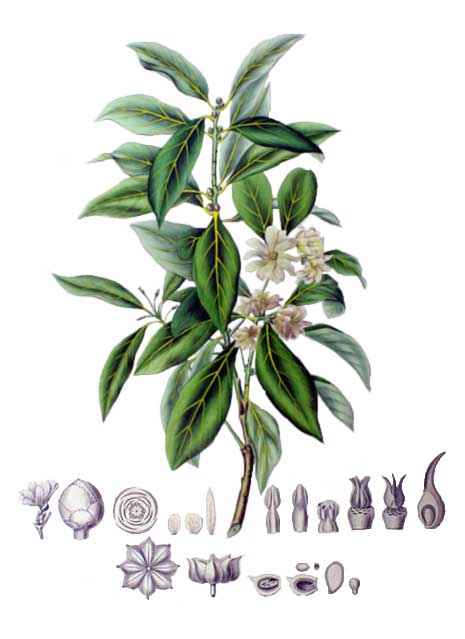
Sanke is an evergreen shrub or small tree growing up to 8 meters high. Leaves are alternate, simple, narrowly ovate or lanced-shaped, 4 to 12 centimeters long, 1.5 to 5 centimeters wide, wedged-shaped at the base, tapering, and blunt at the apex. Flowers are axillary, usually crowded, sometimes solitary, with 12 to 15 perianth lobes, spirally arranged, 3 millimeters wide, pale yellow to white. Carpels are 7 to 9, arranged in a single row or close circle. Fruit is a capsule-like follicetum, 2.5 centimeters in diameter, with an aggregate of 7 to 8 follicles arranged around a central star-shaped axis. Each follicle is boat-shaped and 1-seeded.
Distribution
- Sanke does not occur in the Philippines. However, the fruits are imported in considerable quantities by the Chinese.
- Native to Japan.
- Cultivated in Taiwan and China.
 Constituents Constituents
- Fruit contains a volatile oil and fixed oil, besides the chief toxic principle, shikimin; shikimic acid, protocatechuic acid; shikimipicrim; abundant starch and furfurol.
- The volatile oil (0.4 to 1 percent) consists of safrol, sineol, eugenol, palmitic acid, methylchavicol, borneol, terpene, sesquiterpene, anethol and linalool.
- Study reported the fixed oil (12.5% in the seed and 1 % in the fruit) to consist of glycerides of oleic (60.2%), palmitic (22.5%), linoleic (9.8%) and stearic acids (2.5%).
- Study of flowers isolated two new prenylated C6-C3 compounds, illicinin A (1) and (4S)-illicinone I (2). (see study below) (11)
Properties
- Similar to I. verum, but the fruit is smaller with a weaker odor, more similar to cardamon than to anise.
-
The taste and color are quite distinct; the Japanese star-anise having a balsamic, but not aniselike color, and a disagreeable taste.
- In China, the powdered fruits are considered stimulant and carminative.
Toxicity
- Fruit of specie Illicium religiosum is considered very toxic. Reports of toxicity from use of fruit decoction have been reported.
- According to some studies, all parts of the plant is considered poisonous.
- All illicium species contain sesquiterpene lactone compounds, most contain a number of secondary metabolite products related to anisatin, neoanisatin and pseudoanisatin, the potent neurotoxins found in Japanese star anise.
- Although Chinese star anise is considered safe for consumption, the species also contain toxic compounds - veranisatins A, B and C. Although the veranisatins are not as potent as anisatin of the Japanese star anise, neurologic symptoms are observed at higher doses.
- Anisatin compounds at believed to act as potent noncompetitive g-aminobutyric acid antagonists
Confusion and Adulteration
- (Some compilations have confused the true star-anise (Illicium verum) and the poisonous kin (Illicium anisatum), and included in their synonyms two endemic species (Illicium montanum and Illicium philippinense).
- Chinese star anise (Illicium verum Hook F.) is the well-known spice used in many cultures, used in the treatment of infant colic, and is commonly known to be safe and non-toxic. It has the same star-shape as the Japanese star anise (Illicium anisatum) which contains toxic compounds. Japanese star-anise has been documented to have both neurologic and gastrointestinal toxicities attributed to its sesquiterpene anisatin.
- There have been reports of adulteration of Chinese star anise with Japanese star anise. (See studies below.)
Parts used
Fruits.
Uses
Folkloric
- No reported folkloric use in the Philippines.
- In China, the poisonous star-anise is used as local application in the treatment of toothache and certain forms of dermatitis and parasitism. The volatile oil is used for colics in children.
- In China, powdered fruits considered stimulant and carminative.
Studies
• Essential Oil / Anti-Inflammatory / Antioxidant / Anti-Aging Cosmetic Potential: Study showed essential oil of Illicium anisatum may be considered an anti-aging and anti-inflammatory candidate for cosmetic materials, pending additional studies for safety and efficacy. EIA exhibited moderate DPPH scavenging and anti-elastase activities, with effective inhibition of LPS-induced NO and PGE2 production in RAW 264.7 cells. (1)
• Toxicity Report: There have been reports of adverse neurologic reactions in infants with home use of star anise tea. There have been confirmed reports of Chinese star tea (Illicium verum) contaminated with Japanese star anise (Illicium anisatum). Because of the potential danger, star anise should not be administered to infants. (2)
• Lipase Inhibitory Activity: Of the aqueous ethanol extracts obtained from 19 medicinal plants, evaluated for pancreatic lipase inhibitory activity, Juniperus communis (bark) and illicium religiosum (wood) exhibited the strongest activity. (3)
• Hair Growth Promoter: Extract of Illicium anisatum has been shown to increase subcutaneous blood flow in mice. In the study, follicles treated with water-soluble extract of leaves, fruits and roots of IA or shikimic acid grew significantly longer than controls. Results suggest the WS extract of IA promotes hair growth and may be a useful additive in hair growth products. (4)
• Anisatin / Neoanisatin / Toxic Sesquiterpenes: Study isolated two toxic compounds, anisatin and neoanisatin. (5)
• Illicium anisatum as Adulterant of Illicium verum: The well known spice Illicium verum Hook has been reportedly adulterated with toxic Japanese star anise. A molecular method detects and distinguishes between I. anisatum and other Illicium species in powdered samples. (6)
• Essential Oil: Analysis of essential oil by gas-liquid chromatography showed the major constituents to be cineole 18.1%, linalool 10.1%, methyleugenol 9.8%, a-terpenyl acetate 6.8%, safrole 6.6%, and a sesquiterpene of unknown constitution 7.2%. The composition significantly differs from that of commercially used star anise oil from Illicium verum which has an anethol content of 88% compared to 1.2% in Illicium anisatum. (7)
- Neurotoxicities with Consumption of Star Anise Tea for Infant Colic: Chinese star anise (Illicium verum Hook) is used as treatment for infant colic. Japanese star anise (Illicium anisatum) concerns have been raised because of adulteration of Chinese star anise with Japanese star anise. This study reports on 7 cases of adverse neurologic reactions in infants from use of contaminated Chinese star anise with Japanese star anise. Because of this danger, it is suggested star anise tea should not be administered to infants. (8)
• Toxic Components / Anisatin / Fruit: Of the four kinds of crystals from Japanese star anise (Illicium anisatum) fruit reported as poisonous components, anisatin alone seems to be a unity while others must be a mixture. Extraction of anisatin is best accomplished using fruits from which seeds have been removed. (10)
• Illicinin A / Neurite Outgrowth Promoting Activity / Flowers: Study isolated two new prenylated C6-C3 compounds, illicinin A (1) and (4S)-illicinone I (2) from the flowers of Illicium anisatum, along with 4-allyl-2,6-dimethoxy-3-(3-methylbut-2-enyl)phenol (3) and (4S)-illicinone A (4). Compounds 1 and 3 were found to exhibit neurite outgrowth promoting activity in primary cultured rat cortical neurons. (11)
• Neurotoxic Anisatin: Anisatin may induce severe side effects such as epileptic convulsions. LC-MS/MS analysis of several illicium species and star anise samples purchased on the Swiss market revealed high levels of anisatin in Illicium anisatum, I. lanceolatum, and I. majur, which may cause health concerns if misidentified or mixed with edible illicium verum. Quantification range was between o.2 and 0..8 mg/kg. (12)
Availability
- Imported as fruits.
- Seeds in the cybermarket.
|