 |

Family • Acanthaceae
Sapin-sapin
Blechum pyramidatum (Lam.) Urban
GREEN SHRIMP PLANT
| Scientific names | Common names |
| Barleria pyramidata Lam. | Bamburia (Ilk.) |
| Blechum brownei Juss. | Dayang (Tag.) |
| Blechum luzonium Nees | Karibusuk (Ilk.) |
| Blechum pyramidatum (Lam.) Urb. | Kopis-kopis (Ilk.) |
| Ruellia blechum L. | Sapin-sapin (Tag.) |
| Tari-tari (Ilk.) | |
| Blackweed (Engl.) | |
| Browne's blechum (Engl.) | |
| Green shrimp plant (Engl.) | |
| John bush (Engl.) | |
| Blechum pyramidatum (Lam.) Urb. is an accepted name. The Plant List | |
| Other vernacular names |
| CHUUK: Ererion, Fetinin namocels. |
| GUAM: Yerbas babui, Yetbas babney, Yetbas babui. |
| MAYAN: X akab xiu, Xaka xiu. |
| SPANISH: Yierba de la noche. |
| YAP: Gacel, malai, malai. |
Constituents Properties
Availability |
© Godofredo U. Stuart Jr., M.D. / StuartXchange |
 Studies
 Updated October 2018 / August 2016

 |
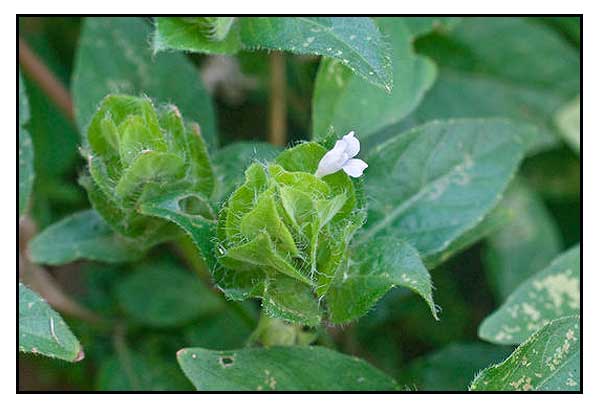
| IMAGE SOURCE: / Photo / Blechum pyramidatum Urb / Forest & Kim Starr - Plants of Hawaii / Creative Commons Attribution 3.0 License / BioLib.cz |
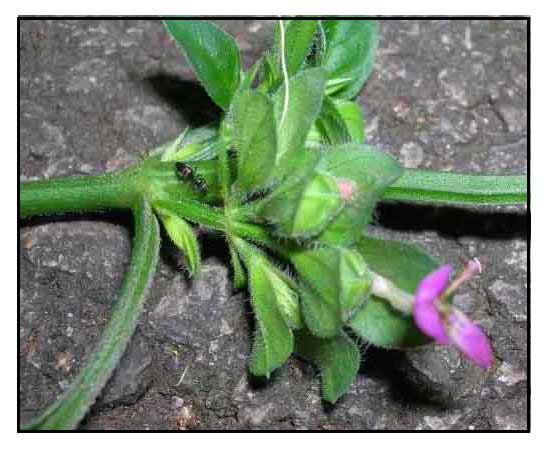
| IMAGE SOURCE: / Photo: Ruellia blechum / Andres Hernandez Dumbleton / Creative Commons Attribution / click on image to go to source page / flickr: EOL Images |
| IMAGE SOURCE: / PHOTO / Blechum pyramidatum / © University of Guam: College of Natural & Applied Sciences / click on image to go to source page / CNAS |
| Additional
Sources and Suggested Readings (1) Blechum pyramidatum / Common names / People and Plants of Micronesia (2) Taiwanese Native Medicinal Plants / Phytopharmacology and Therapeutic Values / Thomas S.C. Li, Ph.D. / Taylor & Francis (3) Blechum pyramidatum / Synonyms / The Plant List (4) EVALUATION OF PHYTOTOXIC ACTIVITY OF Blechum pyramidatum, A WEED OF PANAMANIAN COFFEE CROPS / Lilia Cherigo, Marcos Salazar and *Sergio Martínez-Luis / INTERNATIONAL JOURNAL OF CURRENT RESEARCH, Vol. 7, Issue, 12, pp.24172-24176, December 2015 (5) First Report of a Novel Begomovirus Associated with Yellow Vein Disease of Browne's Blechum (Blechum pyramidatum) / Wen-Shi Tsai, Su-Ling Shih, Li-mei Lee, Lawrence Kenyon / Plant Disease, 98 (5): May 2014 / DOI: http://dx.doi.org/10.1094/PDIS-10-13-1025-PDN (6) ADJUVANT EXTRACT FOR USE AGAINST DIABETES AND RELATED DISEASES (PAT - WO2009104944) / MONTERO JACOME JULIO MONTERO JACOME, JULIO / Publ.of the Int.Appl. with Int.search report - World Intellectual Property Organization (7) α-Glucosidase Inhibitor Isolated from Blechum pyramidatum / Lilia Cherigo, Sergio Martinez-Luis / Natural Product Communications, April 2018; 13(4) (8) A Quarter Century of Pharmacognostic Research on Panamanian Flora: A Review / Catherina Caballero-George, Mahabir P Gupta / Planta Med, 2011; 77: pp 1189–1202 (9) Medicinal Plants for the Treatment of Local Tissue Damage Induced by Snake Venoms: An Overview from Traditional Use to Pharmacological Evidence / Juliana Félix-Silva, Arnóbio Antônio Silva-Junior, Silvana Maria Zucolotto, and Matheus de Freitas Fernandes-Pedrosa / Evidence-Based Complementary and Alternative Medicine, Volume 2017, Article ID 5748256 / https://doi.org/10.1155/2017/5748256 (10) Maya Medicine: Traditional Healing in Yucatan / Marianna Appel Kunow / University of New Mexico Press (11) A Review of Medicinal Plant Research at the University of the West Indies, Jamaica, 1948–2001 / SA Mitchell, MH Ahmad / West Indian Med J, 2006; 55(4): pp 243-269 (12) Ruellia blechum / Plants of Saint Lucia |
| It is not uncommon for links on studies/sources to change. Copying and pasting the information on the search window or using the DOI (if available) will often redirect to the new link page. |
• |
 |
|
