Botany
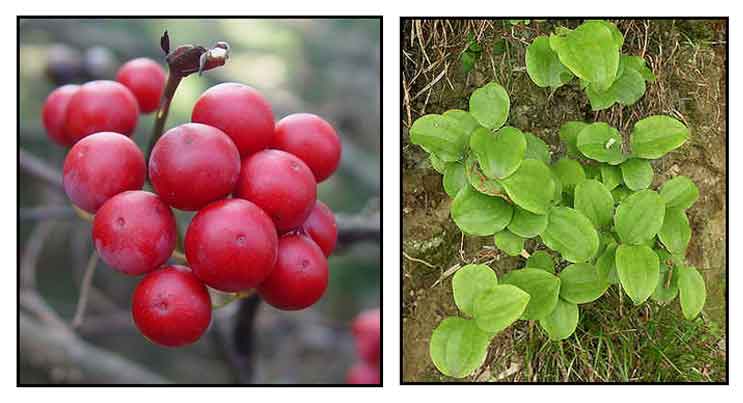
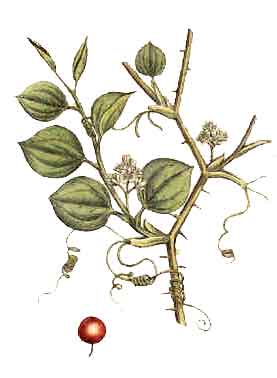
Sarsaparillang-china is a woody vine armed with small thorns all over the stem. Rhizomes are long, thick and gray colored. Leaves are simple, alternate, elliptically oblong to subrounded, 5 to 8 centimeters long, 2.5 to 4 centimeters wide; those toward the end of the branches are much smaller and veined. Petioles are about 7 millimeters long, with adnate spiculate stipules which frequently are extended into tendrils. Inflorescence arises from the upper leaf axils, 3 to 5 centimeters long. Flowers are white to yellowish-green, their pedicels subtended by bracteoles, umbellate. Berries are globose, reddish when ripe.
 Distribution Distribution
- In mossy forests at altitudes of 1,600 to 2,400 meters in Bontoc, Lepanto, Benguet, and Zambales Provinces in Luzon, and in Mindanao and Negros.
- Occurs in Japan and China, where is it indigenous.
Constituents
- Phytochemical screening of methanol extract yielded flavonoids, tannins, alkaloids, saponins, and glycosides.
- Root contains fat, sugar, glucoside, coloring matter, gum and starch.
- Root also yields smilacin, tannin, resin, cinchonin and saponin.
- Dried rhizomes yield fat, sugar, glycoside,
glycoside, coloring matter, saponin, tannin, cinchonin. smilacin, and starch.
- Leaves reported to contain rutin.
- Ethyl acetate fraction of an ethanol extract of rhizomes yielded seven compounds, structure of three were established as
dihydrokaempferol-5-O-beta-D-glucoside (1), beta-sitosterol (2), and daucosterol (3). (12)
- Study of leaves yielded two new flavonoids, bismilachinone and smilachinin, together with 14 known
compounds. (see study below) (23)
- Study of rhizomes yielded 13 compounds and identified as kaemperol-7-O-beta-D-glucopyranoside (1), engeletin (2), isoengeletin (3), kaempferol (4), dihydrokaempferol (5), dihydrokaempferol-5-O-P-D-glucopyranoside (6), rutin (7), kaempferol- 5-O-beta-D-glucopyranoside (8), 3, 5, 4'-trihydroxystibene (9), vanillic acid (10), 3, 5-dimethoxy4-O-beta-D-glu-copyranosylcinnamic acid (11), beta-sitosterol (12), and beta-daucosterol (13). (27)
- Flavones isolated included
kaempferol, kaemperide, morin, kaempferol 7-O-a-L-ramnodise, kemperin, quercetin-4'-O-ß-D-glucoside, vitexin, kaempferitrin, lapidoside, and rutin; isoflavones included pratensein, puerarin, smilachinin. (28)
- Study of rhizomes isolated a new triflavanoid, kandelin B-5 (1), along with six known phenylpropanoid substituted flavan-3-ols (2-7), nine flavonoids (8-16), two stilbenoids (17,18), and two other compounds (19,20).
(see study below) (32)
- Bioassay-guided fractionation of ethanol extract of S. china stems isolated nine phenylpropanoids including six new compounds, smilasidesA-F (1-6) and three known phenylpropanoids, smiglaside E, heloniosides B, and 2',5'-diacetyl-3,6-diferuloylsucross. (see study below) (36)
Properties
- Depurative, demulcent, diaphoretic, stimulant, alterative, antisyphilitic, aphrodisiac.
- Studies have suggested anti-inflammatory, antinociceptive, COX-inhibitory, anti-hyperuricemic, anticonvulsant, nephroprotective, antioxidant, anticancer, antidiabetic, antimicrobial, antihepatotoxic, antiobesity, antiviral, antihyperlipidemic, anti-psoriatic properties.
Parts used
Roots, leaves and rhizomes.
Uses
Edibility
- Roots, cooked.
- Young shoots and leaves, raw or cooked.
- Used as potherb.
- Tea made from leaves.
- Fruit eaten raw.
Folkloric
- In the Philippines, decoction of roots and rhizomes used as depurative in cases of herpetism and syphilis.
- In India, used to some extent like sarsaparilla, in decoction as a depurative, diaphoretic, stimulant, alterative, antisyphilitic, and aphrodisiac.
- Sudorific and demulcent, used in rheumatism.
- Used as alterative in old syphilitic cases and in chronic rheumatism.
- In large doses, causes nausea and vomiting.
- Used for various skin diseases.
- In Ayurveda, Siddha and Unani medical systems, used for syphilis, skin diseases, epilepsy, insanity, flatulence, dyspepsia, constipation, fever, neuralgia, rheumatism, gout and general debility. Smilax china is the accepted botanical source of the Ayurvedic drug Chopachinee.
- In traditional Chinese medicine, used as diuretic and for treatment of rheumatic arthritic conditions; also used for detoxification, treatment of gout, tumors, and lumbago.
- in Korea used as a remedy for inflammatory disease and ischuria.
- Inhalation from sarsaparilla roots used in asthma.
Studies
• Anti-Inflammatory / Antinociceptive / COX Inhibition: Study in rats of aqueous extract of tubers of Smilax china showed anti-nociceptive and anti-inflammatory effects. Results showed inhibition of both COX-2 activity and COX expression. (2)
• Chemical Constituents: Study of rhizomes isolated 13 compounds: kaemperol-7-O-beta-D-glucopyranoside, engeletin, isoengeletin, kaempferol, dihydrokaempferol, dihydrokaempferol-5-O-P-D-glucopyranoside, rutin, kaempferol- 5-O-beta-D-glucopyranoside, 3, 5, 4'-trihydroxystibene, vanillic acid, 3, 5-dimethoxy4-O-beta-D-glu-copyranosylcinnamic acid, beta-sitosterol, and beta-daucosterol. (3)
• Nephroprotective / Anti-Hyperuricemic: An ethyl acetate fraction exhibited strong anti-hyperuricemic activity. Caffeic acid, resveratrol, rutin and oxyresveratrol isolated from the EAF showed different inhibitory effects on xanthine oxidase in vitro. The EAF also prevented renal damage against tubulointerstitial pathologies in hyperuricemic rats. (4)
• Anticonvulsant / Rhizome: Study evaluated the anticonvulsant activity and neurotoxicity of ethanolic extract and ethyl acetate extracts of Smilax china rhizomes in mice. Anticonvulsant activity was assessed by maximal electroshock (MES) and pentylenetetrazole (PTZ)-induced seizures in mice and neurotoxicity was assessed by rota rod test. The duration of hindleg extension in MES test was significantly (p<0.001) reduced. Seizure latency was prolonged. Results of study of ethanolic extract and ethyl acetate fraction of the rhizome of SC in mice showed it may help control petit mal and grand mal seizures. (5)
• Sieboldogenin / Anti-Inflammatory: Study isolated seiboldogenin from ethyl acetate fraction of the plant crude extract. Seiboldogenin showed significant lipoxygenase inhibition and significant inhibition of carrageenan-induced hind paw edema and presents as a potential new anti-inflammatory compound. (6)
• Stilbenes / Antioxidant: Study isolated 3 compounds: resveratrol, oxyresveratrol, and 3, 5, 3′ , 4′ - tetrahydroxylstilbene. The compounds showed strong antioxidant activity and effective scavenging of DPPH free radicals. (7)
• Circulatory Benefits / Coagulation Effects: Study results conclude S china has a pharmacologic benefits on promoting circulation which may be from inhibition of platelet aggregation and prolongation of clotting time. (8)
• Flavonoid Glycoside / Anticancer: Study of eight crude extracts of Smilax china showed a fraction rich in flavonoids to show good activity against HeLa cells. Study isolated kaempferol-7-O-ß-D-glucoside, a flavonoid glycoside, and exhibited marked anticancer activity. The antiproliferative effect may be due to cell cycle arrest at G1 phase and induction of apoptosis. (9)
• Anti-Diabetic / Roots: Study of various extracts of roots were evaluated for hypoglycemic activity in alloxan-induced diabetic Wistar rats. Alcoholic and aqueous extracts showed significant blood glucose reduction. A petroleum extract exhibited very weak anti-diabetic activity. (13)
• Antioxidant / Antimicrobial: Various leaf extracts were evaluated for antioxidant and antimicrobial activities. The ethanol extract showed the highest DPPH, ABTS radical scavenging activity, and reducing power. All extracts inhibited the growth of Listeria monocytogenes, S. aureus, and Salmonella typhimurium. Results suggest potential use in the food and cosmetic industry. (14)
• Antioxidant / Phenolic Composition: Various extracts were tested for radical scavenging and antioxidant activities. The ethyl acetate fractions showed the highest antioxidant activity, correlating with the high phenolic levels, particularly catechin and epicatechin. (15)
• Anti-Diabetic / Rhizomes: In a study of various extracts in rats with allloxan-induced diabetes, the hydroalcoholic and aqueous fractions exhibited anti-diabetic activity. (16)
• Antihyperglycemic / Antihyperlipidemic: Study of a hydroethanolic extract of Smilax china in alloxan-induced diabetic rats showed pretreatment for 30 days reverted the biochemical parameters almost to normal. (18)
• Testicular Antioxidant Activity / Spermatogenesis Benefits: Rats subjected to forced swimming stress showed increase lipid peroxidation and decrease in testicular SOD, catalase, sperm count, viability and motility. Results showed pretreatment of rats with rhizome ethanol extracts showed good protection against testicular antioxidant activity and improved spermatological parameters. (17)
• Antihepatotoxic / Roots: Study evaluated an methanolic extract of roots against CCl4-induced hepatotoxicity in albino rats. Results showed a dose-related protective action against CCl4-induced liver damage with significant effect on serum enzyme levels and morphological parameters supported by histopathological changes. The hepatoprotection was attributed the flavonoid content. (19)
• Effects on Nicotine-Induced Endothelial Dysfunction: Study investigated the effects of 10 compounds isolated from a 70% EtOH extract of Smilax china on nicotine-induced endothelial dysfunction in human umbilical vein endothelial cells. Kaempferol, kaempferol 7-O-a-L-rhamnopyranoside, puerarin and ferulic acid showed strong inhibition of vascular cell adhesion molecule expression, while kaempferol, kaempferin and caffeic acid attenuated intercellular adhesion molecule expression. There was also up-regulated expression of endothelial nitric oxide synthase and inhibitory effects on inducible NO synthase (iNOS) expression, inhibition of IL-8 and IL-1ß. Results showed the potential of the isolated compounds in reversing the toxic effect of nicotine on the endothelium. (21)
• Antiobesity Effects: Study investigated the lipolytic actions of a water soluble fraction of Smilax china leaf ethanol extract in 3T3-L1 adipocytes. Results showed potential antiobesity activity, which may be due, at least in part, to stimulation of cAMP-PKA-HSL signaling. The wsSCLE-stimulated lipolysis induced by signaling is mediated by activation of ß-adrenergic receptor. (22)
• Anti-Diabetic / PTP1B, α-Glucosidase and DPP-IV Inhibitory Effects: Study of leaves isolated two new flavonoids, bismilachinone and smilachinin, together with 14 known compounds, from the leaves of Smilax china. Compounds 4, 7, and 10 showed moderate DPP-IV inhibitory activities, while compounds 3, 4, 6, 11, 12, and 16 showed strong PTP1B inhibitory activities. Compounds 2-7, 11, 12, 15, and 16 showed α-glucosidase inhibitory activities. Results show the leaves of Smilax china may contain antidiabetic compounds. (23)
• Apoptosis in Ovarian Cancer Cells / Rhizomes: Study investigated the effects of rhizome extract of SC on ovarian cancer cells A2780. The rhizome extract suppressed A2780 cell proliferation in a dose-dependent manner (p<0.05, p<0.01), arrested cells in G2/M phase and induced apoptosis by activating cspse-3, PARP and Bax. SC rhizome extract effectively inhibited NF-kB, induced apoptosis, and reduced chemoresistance to cisplatin and adriamycin in ovarian cancer cells, which may be the molecular basis for the treatment of ovarian cancer. (24)
• Herb/Drug Interactions: (1) Interacts with digoxin (Lanoxin) increasing the absorption of digoxin. (2) Sarsaparilla might also decrease the elimination of lithium from the body. (25)
• Hypoglycemic / Hypolipidemic: Study evaluated the anti-diabetic effects of methanol extracts of Smilax chinensis in alloxan-induced diabetes rats. Results showed significant reduction of blood glucose (p<0.01) in a time-dependent manner. Extract treated groups also showed significant reduction (p<0.01) in serum levels of total cholesterol and triglycerides. (26)
• Antioxidant / Enzyme Fortifying Activity / Root: Study of a methanol root extract of Smilax china showed high DPPH free radical scavenging activity (IC50 7.4 microg/ml) and protective property of cell's viability. Also, V79-4 cells treated with the methanol root extract induced an increase of superoxide dismutase, catalase, and glutathione peroxidase activities in a dose-dependent manner. (29)
• Anti-HIV activity / Phenolics and Extracts: Study evaluated four extracts (EtOH, CHCl3, EtOAc and BuOH) and five phenolics i.e., dihydrokaempferol (1), resveratrol (2), kaempferol-7-O-ß-D-glucoside (3), dihydrokaempferl-3-O-α-L-rhamnoside (4), oxyresveratrol (5) for anti-HIV activities and cytotoxicity activities in vitro. All extracts and phenolics showed lower or no cytotoxicity. BuOH extract and compound 2 showed higher anti-HIV activities than other extracts and compounds. EtOAc and compounds 1 and 3 showed moderate anti-HIV-activities at concentrations higher than 4 µg/ml. (30)
• Anti-Inflammatory / Phenolics / Rhizomes: Study of rhizomes isolated a new triflavanoid, kandelin B-5 (1), along with six known phenylpropanoid substituted flavan-3-ols (2-7), nine flavonoids (8-16), two stilbenoids (17,18), and two other compounds (19,20). Compounds 10, 15, and 17 showed slight inhibition of IL-1ß expression on LPS-induced THP-1 cells, with inhibition rte of 15.8%, 37.3%, and 35.8%, respectively, at concentration of 50 µg/ml. (32)
• Antimetastatic on MDA-MB-231 Cells: Smilax china has shown anti-inflammatory, detoxification and anti-cancer effects. The effect of SC on breast cancer cell metastasis and underlying mechanism. was yet to be elucidated. This study investigated the effect of SC ethanol extract on proliferation and migration of MDA-MB-231 human breast cancer cell, and expression of urokinase plasminogen activator (uPA), uPA receptor (uPAR) and tissue inhibitors of metalloproteinases (TIMPs). Results showed the SC extract exerted an antimetastatic effect on human breast cancer cells, which may involve the modulation of ECM (extra-cellular matrix) degradation. (33)
• Endophytic (-)Mycousnine Derivative / Immunosuppressive: Endophytic fungus, Mycosphaerella nawae ZILQ129, isolated from the leaves of Smilax china, yielded a dibenzofurane compound, (-)mycousnine (1). Modification to amide derivative (-)mycousnine enamine (2), the compound showed high and selective immunosuppressive activity, similar to cyclosporin A. Compound 2 selectively inhibited T cell proliferation, suppressed expression of surface activation antigens CD25 and CD69 and formation and expression of cytokines interleukin-2 and interferon-y in activated T cells, without any effect on B cell proliferation and cancer cells (PANC-1 and A549). Cytotoxicity of compound 2 was lower than cyclosporin A, with a therapeutic index five fold higher. Results conclude (-)mycousnine enamine (2) is an effective novel immunosuppressant with low toxicity and high selectivity. (34)
• Anti-Psoriatic / Rhizome: Study evaluated an ethanolic extract and ethyl acetate fraction of S. china rhizome for antipsoriatic activity. using mouse tail test. in Swiss albino mice. The ethyl acetate fraction of rhizome at 200 mg/kg showed maximum antipsoriatic activity with increase orthokeratotic region by 29% compared to the methanol extract. (35)
• Cytotoxic Phenylpropanoid Glycosides / Stems: Bioassay-guided fractionation of ethanol extract of S. china stems isolated nine phenylpropanoids including six new compounds, smilasides A-F (1-6) and three known phenylpropanoids, smiglaside E, heloniosides B, and 2',5'-diacetyl-3,6-diferuloylsucrose. The new phenylpropanoids were evaluated against several human tumor cell lines. (36)
• Inhibition of Testosterone Propionate-Induced Prostatic Hyperplasia / Macroporous Resin: Study evaluated the effect of a fraction of macroporous resin (FMR), a bioactive component of smilax china, on benign prostatic hyperplasia (BPH) in castrated rats induced by testosterone propionate. FMR treatment inhibited prostatic hyperplasia, reducing the dihydrotestosterone (DHT) level in serum and improved prostatic gland morphology. Results suggest the FMR is effective at inhibiting experimentally induced prostate enlargement, and presents potential valuable resource for treatment of human BPH. (37)
• Cytotoxic Phenylpropanoid Glycosides / Stems: Invention relates to a Smilax china polyoses extract, with polyoses content of more than 20% w/w. The invention suggests that S. china polysaccharide has good anti-inflammatory activity, promoting blood circulation and removing blood stasis. The invention seeks to provide a polyoses extract and its production for use in treating pelvic infection. (38)
• Anti-Inflammatory Components / Reverstroal: Study evaluated the anti-inflammatory activity of S. china in rats. Compounds isolated were identified as reverstroal (1) and oxyreverstroal (2). Reverstroal inhibited cotton-induced granuloma in rats (p<0.05). (39)
• Effect on Testiscular Antioxidant Activity and Spermatological Parameters: Study evaluated the potential benefits of ethanolic extract of S. china rhizomes on testicular antioxidant activity and spermatological parameters in rats using forced swimming stress. On forced swimming stress, rats showed a significant increase in lipid peroxidation and decrease in testicular SOD, catalase, sperm count, viability, and motility, with abnormal sperm forms. Pretreatment with rhizome extract prevented stress-induced changes. Results suggest the extract showed free radical scavenging activity and restored normal spermatological parameters. Activity was attributed to known phytochemical constituents and unknown chemical constituents in the rhizomes extract. (40)
• Protective Effect against Testicular Dysfunction / Rhizomes: Study evaluated an ethanolic extract of S. china rhizomes in treating male reproductive dysfunctions induced by forced swimming in rats. The ethanolic extract showed promising improvement in fertility parameters in stressed rats. Results showed good protection against forced swimming induced male reproductive dysfunctions by inhibition of ∆-38 and 176-HSD enzymes. (41)
Availability
- Wild-crafted.
- Herbs, capsules, tablets, tinctures, root powder in the cybermarket.
|