 Botany Botany
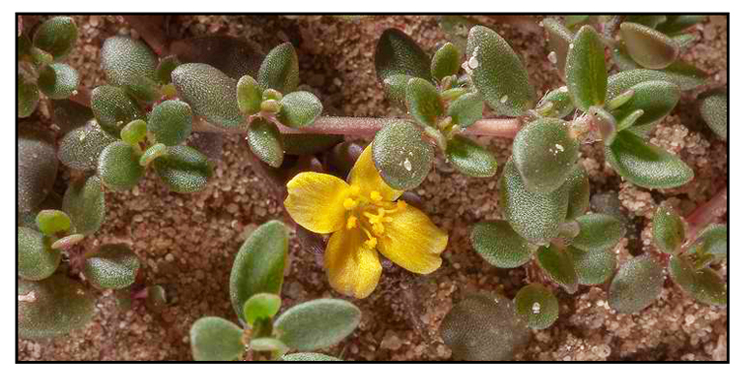
Sayikan is a slender, prostrate, annual, succulent herb, the stems rooting at the nodes from each of which grows a ring of hairs. Leaves are very shortly toothed, ovate-elliptic, and about 5 millimeters long. Flowers are small, terminal, and solitary, surrounded by a 4-leaved involucre and copious white hairs. Petals are four and yellow. Capsule dehisces horizontally, and contains minutely tubercled seeds.
Distribution
- A weed in and about towns.
- Found
in the Batan Islands and in the Island of Luzon from Cagayan to Rizal Provinces.
- Probably introduced.
- Also occurs in Tropical Asia and Africa to Malaya, and the Marianne and Caroline Islands.
Constituents
- Leaves contain mucilage and acid potassium oxalate.
- Phytochemical screening of ethanolic extract yielded alkaloids, saponins, flavonoids, triterpenoids/steroids, tannins and glycosides.
- Aqueous extract yielded flavonoids, alkaloids, carbohydrates, glycosides, amino acids and saponins.
Properties
- Antiscorbutic, anticephalic, emetic.
- Studies show antimicrobial, antioxidant, hepatoprotective, anticancer and CNS depressant properties.
Parts used
Seeds, leaves.
Uses
Edibility
- Like P. oleracea, leaves used as vegetable.
- Used as traditionally leafy vegetable and famine food in many African countries as Uganda, Kenya, Ghana, Nigeria, Zambia, among others. In the Kusume and Derashe areas, when consumed in larger quantity and/or for prolonged periods of time, reported to cause anemia and body weakness.
Folkloric
- Plant use in skin diseases and diseases of the kidneys, bladder and lungs.
- Uses of seeds and leaves similar to those of Portulaca oleracea.
- Used for asthma, cough, urinary discharges, inflammations and ulcers.
- Poultice of plant applied to erysipelas, hemorrhoids and abdominal complaints.
- In Guam, plant is used as an antiscorbutic.
- In Egypt bruised leaves are used as an anticephalic.
- Zulus use a plant infusion as emetic.
- In Ayurveda, used for treatment of urinary and inflammatory disorders. Leaf juice applied to abscesses. Leaf decoction used in dysentery. Plant decoction used as anthelmintic and for treatment of stomach complaints and diarrhea. (10)
- In Indo-China, leaf juice applied to abscesses and used as colyrium. In Nigeria, leaves applied locally to swellings. (11)
Others
- Fodder: (Caution) Plant may contain oxalate in toxic quantities that may be fatal to livestock. (12)
Studies
• Neuropharmacologic Effects / CNS Depressant: Study of ethanol extract of Portulaca quadrifida in mice showed a significant reduction in spontaneous motor activity, antinociceptive activity, and reduction of recovery time from electrically induced convulsions. The effects were central rather than peripheral. (1)
• Reproductive Effects / Seeds: Study evaluated the reproductive effect of P. quadrifica seed extract in male mice. Extract treatment caused mass atrophy of the spermatogenic elements, involution of seminal vesicle. In conclusion, the alcoholic extract of seed induced infertility state in male albino mice. (5)
• Anticancer Effects: Study evaluated ethanol and polyphenol extracts of P. quadrifica on proliferation of Human colon cancer HT-29 line. Both extracts exhibited significant effect against HT-29 cells lines with less activity against normal L-6 cell lines indicating a cancer specific effect. (6)
• Antimicrobial / Aerial Parts: Study evaluated ethanolic extracts of aerial parts for antimicrobial activity against gram positive bacteria (S. aureus, B. subtilis, B. polymexia and Streptococcus faecalis), gram negative bacteria (P. aeruginosa, S. typhii, S. dysenteriae and E. coli) and fungus (P. notatum, A. niger, and C. albicans). Results showed concentration dependent antimicrobial activity against tested strains, with better effectiveness against gram positive bacteria than gram negative bacteria. (8)
• Hepatoprotective / Antioxidative: Study evaluated aerial parts of P. quadrifica for in vitro and in vivo antioxidant and hepatoprotective effects in paracetamol-induced hepatotoxicity in albino rats. Results showed the EPQ extract and Silymarin produced significant hepatoprotective effect with decreased enzymes and in vivo lipid peroxidation and antioxidative effect on hepatocytes. (9)
Availability
Wild-crafted.
|