 Botany Botany
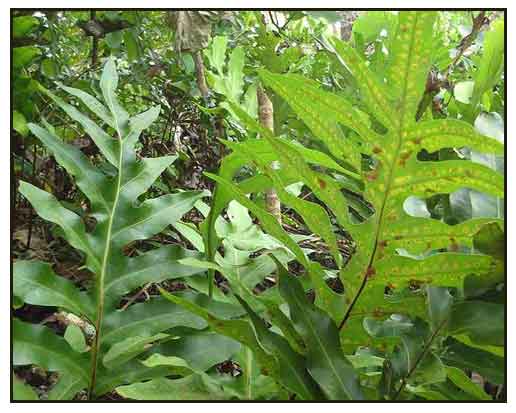
Serpent fern is an epiphyte with wide, creeping and glabrous
rhizomes. Stipes are scattered, 5- to 40 centimeters long, and naked. Fronds are shiny
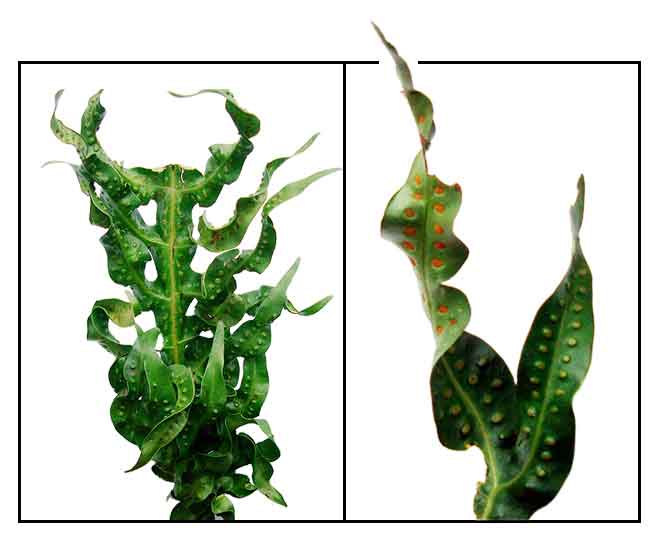
green, variable in size, from simple lanceolate to deeply pinnatifid,
10 to 40 centimeters long. Costae are prominent, but the venation is hardly visible.
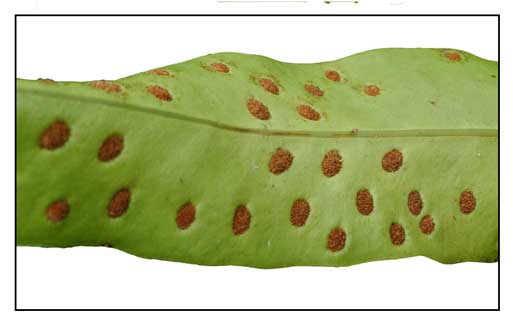
Sori are very large, shallowly immersed and conspicuous on the upper
surface, in single rows along the main veins, or scattered, but not
numerous.
Distribution
- Native to the Philippines.
-
Commonly distributed
in the Philippines, growing in the crown or trunks of trees and on rocks
along streams, at low and medium altitudes.
- Also found from Polynesia to Africa.
 Constituents Constituents
- Contains glycirrhizin
and saponin.
- An excellent source of ecdysone (0.16% of dry weight) and 20-hydroxyecdysone (0.20%), and significant amounts of makisterones a and C (0.01-0.02%), inokosterone and amarasterone A, along with lower amounts of poststerone and a compound tentatively identified as 24,28‐diepi‐cyasterone. Study also isolated three new minor phytoecdysteroids viz. 20‐deoxymakisterone A, a 25(?)‐epimer of amarasterone A and 25‐deoxyecdysone 22‐glucoside. (1)
- Study showed ecdysteroids concentration of 11.17 mg/g in rhizomes and 4.69 mg/g in fronds. Rhizomes yielded six ecdysteroids with two major components of 20-hydroxyecdysone (6.76 mg/g) and ecdysone (3/41 mg/g) at concentrations 3 and 2.5 times higher than corresponding fronds. Other phytoecdysteroids (mg/g dw) were inokosterone 0.42, makisterone A 0.24, 2-deoxy-20-hydroxyecdysone 0.09, and makisterone C 0.25. (9)
- GC-MS study of methanolic extract yielded four phytoconstituents, namely dodecanoic acid, 1,2,3-propanetriyl ester (8.98%), myristic acid vinyl ester (53.29%), 4-nitrophenyl laurate (26.91%) and hexadecanoic acid, 4-nitrophenyl ester (10.82%). (10)
Properties
- Fronds are fragrant.
-
Considered diaphoretic, aromatic and aperative.
- Studies have suggest antioxidant, antimicrobial, anti-inflammatory, bronchodilatory properties.
Parts used
Roots, branches, leaves.
Uses
Folkloric
- In Indo-China, the Annamites are reported to use the young
leaves of the fern for chronic diarrhea. (3)
- In New Guinea, plant is heated over fire and the smoke inhaled to relieve catarrh. In Tonga, leaf or bark infusion used to treat filariasis in infants. Pounded leaves applied to boils. (6)
- In Samoa, frond used in treated of headaches and stomach catarrh. Lotion of fronts used on wounds, sores, and abscesses. Pounded leaves mixed with young coconut pulp used as poultice for arthritis. Pounded leaves in coconut oil used in massage to induce postnatal discharge.(6)
 - In the Cook Islands, crushed rhizomes used to treat fistula and other internal ailments. Also used as purgative. (6) - In the Cook Islands, crushed rhizomes used to treat fistula and other internal ailments. Also used as purgative. (6)
- In Fiji, leaf juice used to treat stomachache, breast swelling associated with breastfeeding, and boils Infusion of leaves and roots taken by women as postpartum tonic. Infusion of leaves used for postpartum depression. Infusion of stem used for fish poisoning. (6
-
Mixed leaves decoction of Phymatosorus scolopendria and Hoya australis used as postpartum tonic and to treat body aches and headaches. (7)
- In Madagascar, used to treat respiratory disorders.
- In Indo-China, young leaves of the fern used in chronic diarrhea. (3)
- In Polynesia, the leaves are pounded and mixed with scrapings from Atuna racemose to make perfume. On Ifaluk, leaves are traditionally used the cover the private parts of young girls; mashed leaves are wrapped with Lei (Morinda citradolia), cooked and used as medical bandage. (13)
- In Samoa, infusion of scraped rhizome and/or crushed leaves taken as a potion for various kinds of inflammation; also applied to skin for infected or slow-healing wounds. (14)
- In Kosrae, light green leaves chewed to stop diarrhea. (15)
- In Benin, sold in markets as an anti-hemorrhagic plant. (16)
Others
- Decorative: In Hawaii used to scent tapa cloth, to adorn hula altars and dancers, and used for making lei.
- Repellent: Young fronds are spread on the sped to keep off bed bugs. (3)
- Fragrance: Fronds used to perfume clothes and coconut oil. (6)
In Polynesia, the leaves are pounded and mixed with scrapings from Atuna racemose to make perfume.
- Good luck frond: In Yap, the glossy green fronds are tied to outriggers of canoes for good luck when fishing. (8)
- Rituals: In Pohnpei, used by young dancers as a mwaramwar (head garlands)--the erect crown of fronds act as a "fence" to protect against ghosts brought on the dancers or as protection against any magic being cast on them. (15)
Studies
• Ecdysteroids: Study showed M scolopendria is an excellent source of ecdysone (0.16% of dry weight) and 20-hydroxyecdysone (0.20% dw), and also significant amounts(0.01-0.02%) of makisterones A and C, inokosterone and amarasterone A. along with lower amounts of poststerone and a compound identified as 24,28-diepi-cyasterone. Study also yielded three minor phytoecdysteroids, namely 20-deoxymakisterone A, a 25(?)-epimer of amasrasterone A and 25-deoxyecdysone 22-glucoside. The ecdysteroids are considered to be responsible for some of the medicinal properties.
(1)
• Bronchodilator: Bioassay-guided fractionation using guinea pig trachea pre-contracted with histamine led to isolation of 1,2-benzopyrone (coumarin) as main active constituent. It induced a concentration dependent relaxation of histamine pre-contracted guinea pig trachea, and provoked 100% relaxation at 72.10 µg/ml.
The bronchodilator effect of coumarin is partly due to the endothelium-dependent tracheal relaxatiom, and may be mediated through a non-specific tracheal relaxation. (11)
• Antioxidant / Antimicrobial / Anti-Inflammatory Effects / Rhizome and Leaf: Study evaluated the radical scavenging, antimicrobial, and anti-inflammatory properties of Microsorum scolopendria rhizome and leaf extracts. The most abundant compounds were phenolic acids, 46 - 57% in rhizome and leaf extracts, respectively; followed by flavonoids protocatechic acid 4-O-glucoside, cirsimaritin, and isoxanthohumol, among others. MS extract inhibited and disaggregated bacterial biofilm formed and showed selective anti-inflammatory activity against COX-2 enzyme. RAE generated 64% reduction of ROS formation in the presence of S. aureus and 87.35% less ROS in the presence of S. epidermis on HDFa cells. (12)
Availability
Wildcrafted. |





_2.jpg)