Gen info
- Chamaedorea is a genus of 107 species of palms, native to subtropical and tropical regions of the
Americas.
- In NASA's list of air-purifying plants, some rank Chamaedorea seifrizii (bamboo palm)
as one of the four best for indoor use. (The other three: Gerbera (Gerbera jamesonii, Scindapsus (Epipremnum aureum), Sansevieria (Sansevieria trifasciata). (9) (10)
- Etymology: The genus name Chamaedorea comes from Greek words chamai, meaning 'on the ground, on the soil' and dorea, meaning 'gift'', the German botanist Carl Ludwig Willdenow (1765-1812), who created the genus in 1806, did not specify the exact meaning of the name. The species honors its collector, the American biologist and botanist of German origin, William Seifriz (1888-1955). (11)
- Some suggest the "gift" refers to the fruit's easy accessibility.
However accessible as it may be, the flesh can cause skin irritation and should not be handled. (12)
Botany
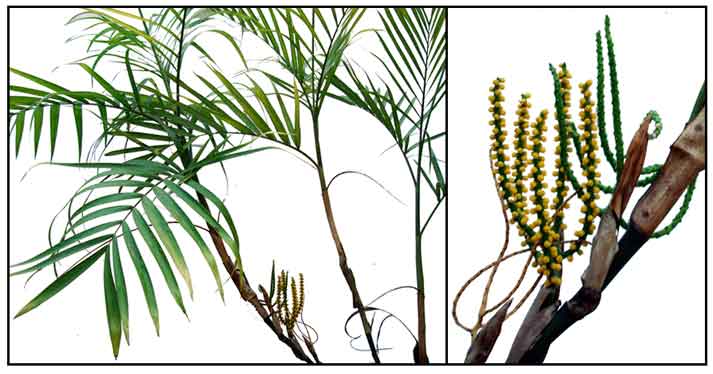
Chamaedorea seifrizii is a small, clustering palm growing to a height of 2.5 meters. Stem is green, up to 2.5 centimeters in diameter, with distinct annular rings. Leaves are petioled, pinnate, up to 60 centimeters long, dark green, gracefully arching, with slightly ribbed margins. Fruit is green, turning red to black, about 1 centimeter in diameter.
Distribution
- Native to South America.
- Recently introduced to the Philippines.
Uses
Folkloric
• No reported folkloric medicinal use in the Philippines.
Others
• Anti-pollution plant: An air-purifying plant. (See studies below)
Studies
• Indoor Air Purifying Plant: In Dr B C Wolverton's research for NASA, Seifrizii ranks 3rd in his top 20 plants, rating an 8.4 out of 10, based on ability to remove chemical vapors, indoor air toxins, ease of growth and maintenance, resistance to insect infestation, rate of water evaporation from the leaves. The study reports the plant as effective in removing benzene, trichlorethylene and formaldehyde. For formaldehyde, it also ranks 3rd, with a removal rate of 1350 mcg/hr.
• Phytoremediation of VOCs: Volatile organic compounds (VOCs) in indoor air have raised public concern due to their adverse health effects. One of the hazardous VOCs is formaldehyde, which can cause sensory irritation and induce nasopharyngeal cancer. Study evaluated a potted plant-soil system ability to remove formaldehyde from indoor air using Chamaedorea elegans. inside a chamber under controlled environment. Findings showed the plant efficiently removed formaldehyde from purified air by 65-100%, depending on inlet concentration. Plants could remove more formaldehyde in light rather than dark environment. Results suggest phytoremediation of VOCs from indoor air by ornamental potted plants is an effective method, which can be economically applicable in hoes and offices. (7)
Counterpoint
• Can plants control indoor air pollution? Recent reports in the media and promotions by the decorative houseplant industry characterize plants as "nature's clean air machine," from the National Aeronautics and Space Administration (NASA) research showing plants remove indoor air pollutants. While it is true that plants remove carbon dioxide from the air, and the ability of plants to remove certain other pollutants from water is the basis for some pollution control methods, the ability of plants to control indoor air pollution is less well established. Most research to date used small chambers without any air exchange which makes extrapolation to real world environments extremely uncertain. The only available study of the use of plants to control indoor air pollutants in an actual building could not determine any benefit from the use of plants. As a practical means of pollution control, the plant removal mechanisms appear to be inconsequential compared to common ventilation and air exchange rates. In other words, the ability of plants to actually improve indoor air quality is limited in comparison with provision of adequate ventilation.
• While decorative foliage plants may be aesthetically pleasing, it should be noted that excessively damp planter soil conditions may actually promote growth of unhealthy microorganisms.
Availability
Wild-crafted. |