|
Gen info
- Zingiberaceae, also referred to as the gingers, the largest family in the order Zingiberales with 56 genera and over 1,500 species, widely distributed in the tropics, especially in Southeast Asia. The Philippines has about 108 species in 16 genera. (7)
Botany
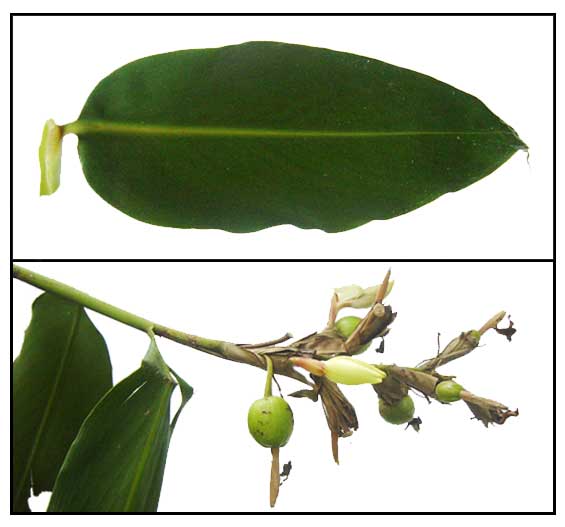
Tagbak is a stout herbaceous plant, growing
to a height of 2 to 4 meters, with stout rootstocks. Stems are
swollen at the base, and leafy throughout. Leaves are leathery,
spreading or reflexed, oblong-ovate to lanceolate, 25 to 60 centimeters
long, 5 to 20 centimeters wide, with a pointed tip. Petioles are short
and stout. Inflorescence is about 30 centimeters long, the base of
the peduncle having oblong-lanceolate, chartaceous, 8 to 12 centimeters
long bracts. The branches are about 8, scattered, spreading,
stout, about 5 centimeters long, covered with persistent bracts, each
branch bearing several to many flowers, opening one at a time. Calyx
is about 4 centimeters long. Corolla is pale straw-colored, about 7 centimeters long, with the tube cylindric, and the upper lobe about 4 centimeters long, concave, and erect, while the other two are as long but are reflexed and oblong-ovate. Lip is about as long as the corolla-lobes, and spreading. Capsule is ellipsoid, woody and 3 to 4 centimeters long, split into
3 valves and crowned by a persistent calyx.
Distribution
- In thickets along streams, at low and medium altitudes in Apayao, Amburayan, Lepanto, Nueva Viscaya, Pampanga, Bulacan, Nueva Ecija, Bataan, Rizal, Laguna, Quezon, and Sorsogon Provinces in Luzon; in Polilio; in Mindanao; and Leyte.
- Endemic species.
Constituents
- A study for repellent constituents yielded α-pinene, α-terpinene, ß-phellandrene, linalool, ß-pinene, p-cymene, camphene, 1,8,cineole, and citronellol. (see study below) (4)
- An ethanol extract of leaves yielded flavonoids, steroids, saponins, tannins, alkaloids and cyanogenic glycosides, with absence of anthraquinone. (see study below) (7)
Properties
- Studies suggest repellent, antimicrobial, free radical scavenging properties.
Parts
utilized
Rhizomes, leaves, stems.
Uses
Edibility
- Fruit rind is edible, a little woody in texture. (3)
Folkloric
- Decoction of rhizomes used for hemoptysis.
- Pounded leaves, mixed with a little salt rubbed on paralyzed extremities.
- Juice from macerated young stems used for urticaria.
- Reported use for musculoskeletal diseases in the Surigao del Sur mountain range. (5)
- Used for musculoskeletal diseases, migraines, stomachaches, and as anti-relapse treatment for women.
(7)
- Pounded leaves mixed with a little salt rubbed on paralyzed extremities. (7)
Studies
• Antimicrobial:
Studies on the antimicrobial properties of Zingiber purpureum Rosc.
and Kolowratia elegans Presl. (Family Zingiberaceae) (1)
• Pacovatinins A-C::
Study isolated three new labdane diterpenoids, pacovatinins A-C from the seeds of the Brazilian plant Renealmia exaltata.
• Repellent: Study investigated the mechanism for reduced green leaf hopper population in rice fields with tagbak (Alpinia elegans). Results showed N. virescens, an important vector of tungro, was repelled by the odors released from the leaf discs of tagbak. The repellent chemicals were the green leafhopper were α-pinene, α-terpinene, ß-phellandrene, linalool, ß-pinene, p-cymene, camphene, 1,8,cineole, and citronellol. Results suggest tagbak can be used to reduce dependence of synthetic insecticides, an alternative pest management strategy in organic and low-input rice production. (4)
• Mosquito Repellent / Leaves: Study evaluated the efficacy of a crude extract of leaves of Alpinia elegans against Aedes aegypti. (6)
• Free Radical Scavenging Effects / Leaves: Study evaluated
an ethanol extract of leaves for in vitro antioxidant activity using DPPH antioxidant assay. Results showed high radical scavenging activity with percent DPPH inhibition of 95.11 ± 1.00 at 500 µg/ml. (see constituents above) (7)
• Antipneumonic Effect / Essential Oil / Leaves: Study evaluated
the essential oil isolated from six Philippine plant species for in vitro growth inhibitory effect against pneumonia causing bacteria. Alpinia elegans and A. cumingii showed the most effective antibacterial potential against H. influenza with MIC of 256 µg/ml. GC-MS analysis showed caryophyllene epoxide to be the major leaf oil component of A. elegans. (8)
• Vapor Effect on Bioassays: Study of ethanol showed a broad spectrum of biological effects. Due to its volatility, conventional microplate-based bioassays can be significantly affected by the vapors. Study evaluated the antimicrobial, antioxidant and cytotoxic activities of three essential oils (Alpinia elegans, Cinnamomum iners, and Xanthostemon verdugonianus) one supercritical CO2 extract (Nigella sativa), and four plant-derived compounds (capsaicin,caryophyllene oxide, 8-hydroxyquinoline and thymoquinone). Results showed vapor transition to adjoining wells caused false-positive results of performed bioassays.
(9)
Availability
Wild-crafted. |