Gen info
- Coldenia is a monotypic genus of flowering plants traditionally placed in the borage family, Boraginaceae. The sole species is Coldenia procumbens.
Botany
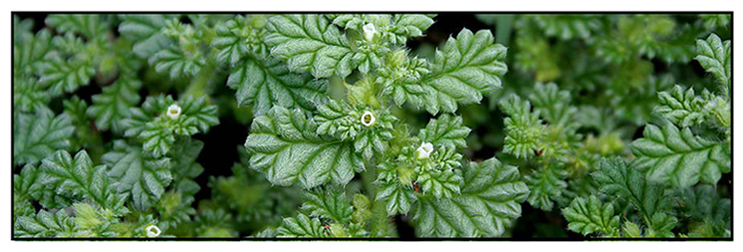
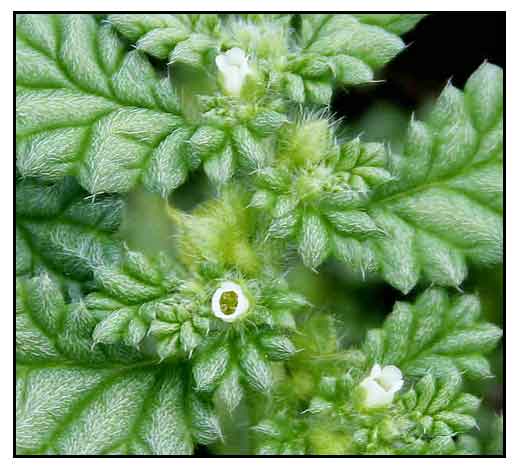
Tapiasin is an annual, hairy herb. Branches are procumbent, spreading flat on the ground, and growing as long as 25 centimeters. Leaves are elliptic to oblong-obovate and 1.5 to 2.5 centimeters long, with coarsely toothed margins, blunt tip, and a very unequal base. Flowers are white and small, and borne in the axils of the leaves. Sepals are four, narrow, with four lobes which are imbricate in bud. Fruit is conical, 3 to 4 millimeters in diameter, containing four 1-seeded pyrenes.
 Distribution Distribution
- Native to the Philippines. (21)
-
Found in Cagayan, La Union, Pangasinan, Zambales, Pampanga, and Rizal Provinces in Luzon; and in Mindoro, in dry open places, fallow rice paddies, etc. at low and medium altitudes.
- Also native to Andaman Is., Angola, Assam, Bangladesh, Benin, Borneo, Burkina, Cambodia, Cameroon, Cape Verde, Central African Repu, Chad, Djibouti, East Himalaya, Egypt, Ethiopia, Gambia, Ghana, Guinea, Guinea-Bissau, Hainan, Himalaya, India, Jawa, Kenya, Laos, Lesser Sunda Is., Madagascar, Malaya, Mali, Maluku, Mauritania, Mozambique, Myanmar, Nepal, New Guinea, Niger, Nigeria, Northern Provinces, Northern Territory, Pakistan, Queensland, Senegal, Somalia, Sri Lanka, Sudan, Taiwan, Tanzania, Thailand, Uganda, Vietnam, West Himalaya, Western Australia, Zambia, Zaïre, Zimbabwe. (20)
Constituents
- Phytochemical screening of leaves yielded alkaloids, flavonoids, carbohydrates, and phenolic compounds. (11)
- Study of aerial parts of Coldenia procumbens yielded rare cyano nitrile glucosides, Ehretioside A1 and Lithospermoside (Griflonin) 2. (19)
- GC-MS analysis characterized the lipoidal matter i.e., unsaponifiable and saponifiable fractions of hexane extract of C. procumbens leaves. Unsaponifiable matter contained sterols (61.06%) and hydrocarbons ( (34.4%), while the saponifiable matter contained 20 compounds with 49.43% saturated fatty acid methyl esters and 50.57% unsaturated fatty acids. (24)
Properties
- Studies have suggest analgesic, antimicrobial, hepatoprotective, anti-inflammatory, CNS depressant, antidiabetic, antiviral, anti-HIV, anthelmintic, antiarthritic properties.
Parts used
Leaves, juice, aerial parts.
Uses
Folkloric
- In the Philippines, leaves are applied as poultice to mature abscesses.
- Dried leaves, when pulverized, provoke sneezing.
- In India, fresh leaves are ground up and applied to rheumatic swellings. Leaves applied externally to cause suppuration of boils. Leaves also used for fever, piles, and scorpion stings. Powdered roots are included in formulations used for leucorrhea and menorrhagia. Root decoction used as aid for digestion.
- In Tamil Nadu, juice of leaf taken orally to prevent white discharge in women.
- In southern India, a herbal concoction made with a mixture of leaves of C procumbens, flowers of Ixora coccinia, leaves of Centella asiatica and stem bark of Madhuca longifolia is boiled in water and the decoction applied topically with coconut oil for wound healing.
- Decoction of aerial parts used for tendonitis.
- In Tamil Nadu, India, Malasar tribes take powdered leaves internally to improve resistance power. (•)
Studies
• Antidiabetic: Study of C. procumbens on alloxan-induced diabetic rats showed the test drug to have good hypoglycemic effects. Results showed reduction of blood glucose, triglycerides and cholesterol levels. (1)
• Anti-Inflammatory: Ethanolic extract of the aerial parts of C. procumbens exhibited significant anti-inflammatory activity with inhibition of carrageenan-induced rat paw edema and inhibition of leukocyte migration and reduction of pleural exudates in the cotton pellet granuloma method. (2)
• Antibacterial: Study of aqueous extract showed antibacterial activity against B. subtilis, S. aureus, E. coli, P. aeruginosa, P. vulgaris and K. pneumonia in comparison with standard drug ciprofloxacin. (6)
• Antibacterial / Leaves: Ethanolic extracts of leaf of C. procumbens showed significant antibacterial activity against S. aureus, Strep pyrogenes. (7)
• CNS Depressant Effects / Analgesic: Alcoholic extract of whole plant produced central nervous system depression and significant prolongation of pentobarbitone sleeping time. The extract also exhibited significant analgesic effect. (8)
• Antioxidant / Leaves: Study evaluated the in vitro antioxidant activity of ethanolic extract of C. procumbens by DPPH and Nitric oxide radical inhibition activity assays. Results showed promising results. Standards used were ascorbic acid and rutin. (10)
• Anthelmintic / Leaves: Study evaluated various extracts of leaves for anthelmintic activity against earthworm Pheretima posthuma. Ethanolic and aqueous extracts showed potent anthelmintic activity compared with Albendazole. (11)
• Hepatoprotective / D-Galactosamine Induced Liver Injury: Study evaluated a chloroform extract of shade-dried and coarsely powdered whole plant for hepatoprotective activity against D-Galactosamine induced liver injury in rats. Results showed significant reversal of biochemical changes involving SGOT, SGPT, ALP, total protein, albumin, globulin, total cholesterol, total bilirubin, and blood sugar changes in the liver.(13)
• Antimicrobial / Leaves: Study evaluated ethanol extracts of Heliotropium indicum and Coldenia procumbens for antimicrobial activity against S. aureus, B. subtilis, Strep pyogenes, P. aeruginosa, K pneumonia, Aspergillus niger, T. viride and Candida albicans. Results showed the leaf extract to showed the highest activity against both bacteria and fungi. H. indicum leaf extract showed highest inhibitory activity. (15)
• Analgesic Activity: Study evaluated a methanolic extract of whole plant for analgesic activity in Swiss mice. In vivo evaluation using hot plate, tail-flick, and tail-immersion tests for central analgesic effect showed significant (p<0.001) analgesic effect comparable to Pentazocine at dose of 10 mg/kbw. Peripheral analgesic effect by acetic acid-induced writhing test in mice showed significant (p<0.001) analgesic effect comparable to standard drug Aspirin at dose of 20 mg/kbw. (16)
• Anti-Viral
/ Anti-HIV Activity / Cytotoxicity: Study evaluated the anti-viral activity of aqueous extracts of Coldenia procumbens and Sphaeranthus indicus. The extracts contain antiviral activity that may be useful in the treatment of patients with AIDS. The extract inhibited HIV replication without producing cytotoxicity. The aqueous extract of Coldenia procumbens inhibited both HIV-1 and HIV-2 replication at comparable IC50 values , 32.10 and 41,60, respectively. The aqueous extract of C. procumbens showed more potent anti-HIV activity than S. indicus. (17)
• Antioxidant / Anti-Inflammatory / Anti-Arthritic / Leaves: Study evaluated the antioxidant activity of C. procumbens by DPPH, total antioxidant, total phenolic, and reducing power assays, anti-inflammatory activity by HRBC membrane stabilization method, and anti-arthritic activity by inhibition of Protein denaturation method. Percent inhibition by DPPH method was 76.26% qt 500 µg/0.1ml compared to quercetin (87.74). Total phenolic content was 31.9 mg Pyrcathecol equivalent/gm of extract. Manixum membrane stabilization was 98.09% and inhibition of protein denaturation at 52.84%. (18)
• Antidiabetic: Study sought to identify the bioactive components of chloroform and methanol extracts of C. procumbens and its antihyperglycemic activity against streptozotocin induced animals. IR Spectrum and NMR analysis yielded four compounds: α-amyrin, ß-sitosterol, ß-stigmasterol and wedelolactone. The methanol extract of C. procumbens decreased glucose levels. Histopathology of pancreas showed excellent recovery from damage induced by streptozotocin. Results showed significant anti-diabetic, insulin mimetic, and insulin secretory activities. (23) Availability
Wild-crafted.
|