Gen info Gen info
- Etymology: Birthwort derives its name from the similarity of the the curved flower to a womb. Likewise, "Dutchman's pipe" is shape-derived. Aristolochia is derived from two Greek words: cristos (noble) and locheia (childbirth).
- Taxon : Aristolochia tagala is now known as Aristolochia acuminata Lam. (J.Bosser, Adansonia Ser.3, 19(1):169-170(1997)
 Botany Botany
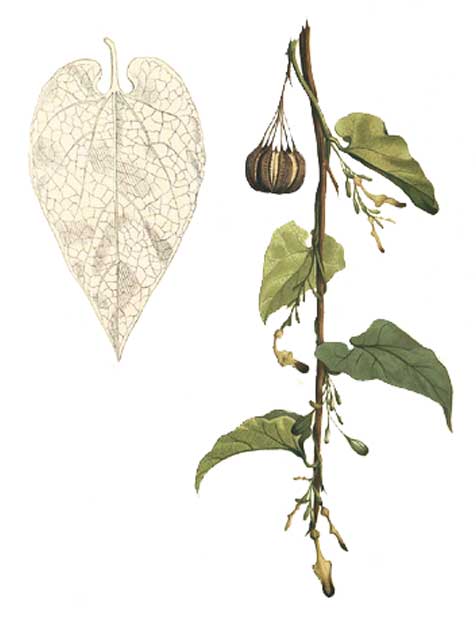
Timbañgan is a twining, half-woody, nearly smooth vine. Leaves are simple, alternate, ovate to oblong-ovate, 6 to 25 centimeters long, 4 to 10 centimeters wide, with a tapering pointed tip and prominent heart-shaped base. Flowers are borne in axillary racemes, 3 to 3.5 centimeters long, with purplish, slender perianths. Inflated globular base of the flower narrows into a curved, cylindrical tube, the tip opening into a large and oblique yellow and purple-rimmed mouth. Capsule is pendulous, ovoid, obovoid or oblong-obovoid, 2 to 4 centimeters long with a long stipe.
Distribution
- Throughout the Philippines in thickets, at low and medium altitudes.
- Also occurs in India to Malaya.
Constituents
• Roots probably contain the alkaloid aristoloquin and a yellow bitter principle isoaristolochic acid and allantoin.
• Phytochemical study of crude methanol extract yielded phenolics, tannins, flavonoids, terpenoids, etc., together with anthocyanidin 3-glycosides, 6-hydroxylated flavonols, some flavones and chalcone glycosides.(see study below) (20)
Properties
• Powdered roots are considered tonic, carminative and emmenagogue.
• Studies have shown antioxidant, antimicrobial, larvicidal,
anti-inflammatory, anthelmintic, carcinogenic and mutagenic properties.
Parts
utilized
Roots, leaves.
Uses
Folkloric
• For infantile tympanites, powdered and pulverized roots are applied to the abdomen.
• Used for snake bites and malaria.
• For fever, the Malays apply the pounded leaves to the forehead.
• In Indonesia, poultice of leaves used for swollen abdomen and limbs.
• In India, roots are used for bowel complaints. Oil from leaves applied to the skin at night to prevent snakebites.
• In India, dried roots rubbed on rough surface of Ochlandra stem, adding sufficient amounts of human urine, for internal administration to counter snake poison. Leaves in medicated oil used as external application for prevention of snake bites. Pounded roots used internally and externally for snake and scorpion poison. (11)
• In China, used for dysentery, hypertension, beriberi and swollen feet.
• In Telugu, used for treating rheumatic pains and fever.
Studies
• Aristolochic Acid / Toxicity Concerns:
Nephrotoxic aristolochic acid is found in man Aristolochia species and used in many regions of the world for abdominal problems and snakebites. In China and Europe, species of Aristolochia have been associated with nephropathy. (2) In mice treated with aristolochic acid 1, the acute toxic manifestations were tachycardia, increases respiratory rate, ataxia, sedation and marked vasodilation. (4)
• Antioxidant / Radical Scavenging Activity:
In a study of five Aristolochiaceae species for antioxidant properties, Aristolochia tagala showed the highest antioxidant activity, with the highest reducing power and amount of total phenolic compounds. (5)
• Aristolochic Acid / Toxicity Study: In a 1970 study, mice treated with aristolochic acid 1, the acute toxic manifestations were tachycardia, increases respiratory rate, ataxia, sedation and marked vasodilation. Short-term chronic toxic effects included hepatotoxicity, marked renal damage and mild hematologic dyscracias.
• Aristolochic Acid Nephropathy: Aristolochic acid nephropathy, a progressive renal interstitial fibrosis, was reported in more than 100 patients after taking a Chinese herb, Aristolochia fangchi. Another report of a series of more than 2000 Indian patients from a population that used more than 7500 plant species raises the question that some of them could be related to Aristolochia species, including A bracteata, A tagala and A indica. (7)
• Antimicrobial:
In a study of 61 Indian medicinal plants belonging to 13 families used for various infectious disorders and screened for antimicrobial activity, Aristolochia indica was one of 10 crude extracts that exhibited significant antimicrobial activity.
• Larvicidal Acid: Bioefficacy of leaf and root extracts of Aristolochia tagala was evaluated on its effects on Spodoptera litura's feeding, larvicidal and pupicidal activities. Dose-dependent effect of test extracts were observed. Results suggest a potential for a new botanical formulation in pest management. (8)
• Anthelmintic / Roots: Study evaluated the anthelmintic potential of aqueous root extracts of A. indica Linn. and A. tagala Cham. against adult earthworm Pheretima posthuma and round worms Ascaridia galli. Extracts showed dose-dependent anthelmintic activity. Results showed A. tagala to be more potent and effective. (12)
• Anti-Inflammatory / Roots: Petroleum ether, ethyl acetate, and ethanol extracts of roots were investigated for anti-inflammatory activity. All extracts exhibited significant anti-inflammatory activity. The ethyl acetate extract inhibited the induction of PGE2. (13)
• Aristolochic Acid / Carcinogenicity / Mutational Signature of Exposure: In humans, exposure to aristolochic acid (AA) is associated with urothelial carcinoma of the upper urinary tract. Exome sequencing of UTUCs from 19 individuals exposed to AA showed a remarkable number of somatic mutations and unusual mutational signature attributable to AA. Results directly link an established environmental mutagen to cancer. (15)
• Genome-Wide Mutational Signatures of Aristolochic Acid / Screening Tool: Aristolochic acid (AA) is a group 1 carcinogen that can cause nephrotoxicity and upper urinary tract urothelial cell carcinoma. Whole-genome and exome analysis showed a strikingly high somatic mutation rate (150 mutations/Mb), exceeding smoking-associated lung cancer (8 mutations/Mb) and ultraviolet radiation-associated melanoma (111 mutations/Mb). The study highlights an unusual genome-wide AA mutational signature and a potential use of mutation signatures as "molecular fingerprints" to infer previous carcinogen exposures. (16)
• Aristolochic Acids / Human Carcinogen: Aristolochic acids are known to be human carcinogens based on sufficient evidence of carcinogenicity from human studies and supporting data on mechanisms of carcinogenesis, with carcinogenicity evidence from experimental animal studies supporting the findings in humans. (17)
• Aristolochic Acid-Associated Urothelial Cancer in Taiwan: Aristolochic acid (AA), a potent human carcinogen produced by Aristolochia plants, is associated with urothelial carcinoma of the upper urinary tract (UCC). Following metabolic activation, AA reacts with DNA to form aristolactam (AL)-DNA adducts. Lesions concentrate in the renal cortex, where they serve as a sensitive and specific biomarker of exposure, giving rise to a unique-mutational signature in the TP53 tumor-suppressor gene. UCC is highest in Taiwan, where Aristolochia remedies have been used extensively for years. (18)
• Anticancer / Tumor Necrosis Factor-α-Mediated Decrease in Nuclear Factor KappaB Binding Capacity: Study evaluated phytoconstituents of crude methanol extracts of A. tagala and Curcuma caesia and their antioxidant properties and possible effects on tumor progression. Both extracts showed antioxidant activity. Both AT and CC reverted the DEN induced increased effect in TNF-α and NF-kC binding activity in BABL/c mice. Results showed both extracts showed antioxidant, anti-inflammatory, and anticancer activity probably through TNF-α-mediated decrease in NF-kB binding activity. Active components may have potential use in hepatocellular carcinoma. (20)
• Apoptotic Effect in HeLa Cells / Roots: Study reported on the chemopreventive potential of crude aqueous-methanol extra t against diethylnitrosamine induced hepatocellular carcinoma in BALB/v mivr. The study sought to identify the biologically active compounds to provide an insight into its mechanism of action. The compounds were tested for its cytotoxic effect in HeLa cells. A total of 21 compounds were isolated, among then aristolochic acid I, aristolactam IIIa, ß-sitosterol, kaempferol and stigmasterol which were previously reported in A. tagala, and other compounds in other Aristolochia species. In the study, compound S7, identified as Aristolochic I, showed highest cytotoxic and apoptotic activity. (21)
• Safety of Homnawakod Herbal Formula containing A. tagala: Study evaluated the chemical profiles of original HNK+ATC and the Homnawakod Ayurved Siriraj Herbal Formulary (HNK) and investigated its potential for nephrotoxicity or aggravation of LPS-induced organ injuries in vivo. Results suggest the similarity of the HPLC chromatograms suggest the qualities of both formulas are nearly the same in terms of chemical profile. The ATC, HNK+ATC, or HNK, at animal dose equivalent to that used in human, do not cause acute nephrotoxicity in rats and do not aggravate LPS-induced organ injuries even further. (22)
• Antimicrobial / Leaves: Study evaluated the antimicrobial activity of different solvent extracts of A. tagala leaves (acetone, chloroform, ethanol, methanol and aqueous against few pathogenic bacterial and fungi. The pattern of inhibition varied with the plant extracts, solvent used for extraction, and organism tested. (23)
Caution / Alert
• Practitioner Alert: In Australia, all species of Aristolochia are prohibited for supply, sale or use in therapeutic goods under the Standard for the Uniform Scheduling of Drugs and Poisons (SUSDP). However, Aristolochia species are finding their way into other herbal-based TCM products, including herbs in raw form, because they are easily confused with other herbs by being very similar, either in appearance or in name, to some other TCM herbs. The Alert provides a comprehensive list: (1) Botanicals known or suspected to contain aristolochic acid (Group A); (2) Botanicals which may be adulterated with aristolochic acid*(Group B); and (3) Products which have MuTong and Fang Ji as declared ingredients (Mu Tong and Fang Ji are TCM names for products which may contain Aristolochia species) (Group C). (14)
• Occupational Exposure: Although occupational exposure to aristolochic studies has not been documented, herbalists are potentially exposed while gathering plants or preparing or applying botanical products. Handling of Aristolochia plants can result in dermal exposure and dermatitis. To reduce the likelihood of accidental ingestion, workers are cautioned to wash their hands before eating, drinking, or smoking. (17)
Availability
Wild-crafted. |