 Gen info Gen info
- Harpullia is a genus of about 27 species of small to medium-sized forest tress.
Botany
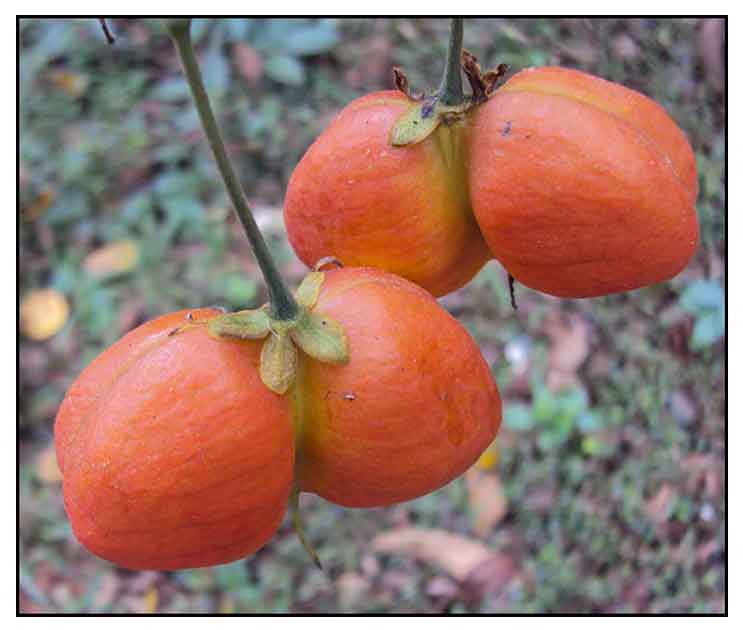
Uas is a tree that reaches a height of about 20 meters. Leaves are alternate, 10 to 30 centimeters long, with 5 to 9 leaflets. Leaflets are smooth, oblong or broadly lanceolate, 7 to 15 centimeters long, about 5 centimeters wide, the tip being pointed and the base blunt and oblique. Flowers are small, greenish, borne on panicles arising from the upper leaf axils. Fruit is inflated, smooth, yellowish-red, dehiscent, about 1.5 centimeters long and 2.5 centimeters wide, and divided into two lobes, each containing a few seeds.
Distribution
- Common in thickets and second-growth forests at low and medium altitudes throughout the Philippines.
- Also occurs in India, Bangladesh, Thailand, Laos, Vietnam, Malesia, Myanmar, Sri Lanka, and Australia.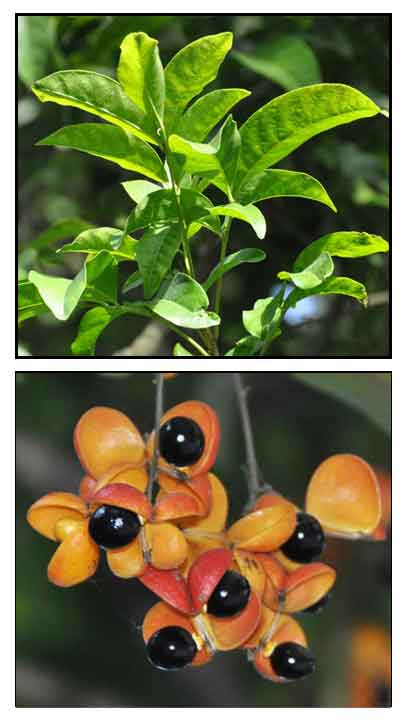
Constituents
- Seeds yielded glycosides, steroids, saponins, and resins. (See study below) (1)
- Study of leaves isolated a new horhopane triterpenoid, 3ß-eicosanoyl-6ß-hydroxy-21αH-24-norhopan-4(23),22(29)-diene. (7)
- Phytochemical screening of various seed extracts yielded the presence of glycosides, steroids, saponins, and resins. (see study below) (9)
- Study of leaves yielded a new triterpenoid, 3beta-eicosanoyl-6beta-hydroxy-21alphaH-24-norhopa-4(23),22(29)-diene, together with a lupane-type triterpenoid, lupeol; a sterol, alpha-spinasterol and an inositol derivative, quebrachitol. (see study below) (10)
Parts used
Bark, fruit, seeds.
Uses
Folkloric
- Bark is pounded and used as a substitute for gogo (Entada phaseoloides).
- Watery exudate from bark and fruit used to prevent leech bites.
- Oil of seed sometimes used as anti-rheumatic.
- Fruit extract with coconut oil and castor oil used for digestive problems and as appetizer.
- In Kerala, India,
bark, fruits, and seeds used by ethnic communities as leech repellent, hair wash, and anti-rheumatic. (1) (11)
- In Sri Lanka, used for snake bites. (12)
Others
- Fish poison: Finely chopped bark placed on fresh-water streams to kill fish.
Studies
• Antibacterial / Seeds: Phytochemical screening of seeds yielded glycosides, steroids, saponins, and resins. Extracts showed inhibitory activity against Bacillus subtilis, Salmonella typhi, Pseudomonas aeruginosa, E. coli, and Proteus vulgaris. The methanol extract was more potent than the aqueous extract. (1)
• Leaves / Quebrachitol / Stimulatory Effect on Lymphocyte Proliferation: Phytochemical study of leaves yielded a a new triterpenoid, 3beta-eicosanoyl-6beta-hydroxy-21alphaH-24-norhopa-4(23),22(29)-diene, together with a lupane-type triterpenoid, lupeol; a sterol, alpha-spinasterol and an inositol derivative, quebrachitol. A methanol extract and quebrachitol exhibited in vivo stimulatory effect on lymphocyte proliferation. (2)
• Antiradical / Antibacterial / Antifungal / Leaves:Study evaluated the antiradical and antimicrobial potential of H. arborea extract of macerated leaves. Results showed concentration dependent scavenging of radicals with potent scavenging activity against ABTS radicals (IC50 4.26 µg/ml) compared to DPPH radicals (IC50 27.26 µg/ml). The extract showed inhibitory activity against all test bacteria, with marked activity against Staphylococcus epidermis. There was also considerable reduction of mycelial growth with highest inhibition to Curvularia sp. (5)
• Inhibitory Against Seed-Borne Fungi:Study evaluated the antifungal potential of methanolic extract of leaves of two plants viz., Harpullia arborea and Hydnocarpus pentandra against seven seed-borne fungi. Marked antifungal activity was displayed by H. arborea compared to H. pentandra, with Aspergillus niger showing greatest inhibition. Results showed both plant have potential to inhibit seed mycoflora. In suitable formulations, they can be used against in the management of seed-borne fungal diseases of plants. (6)
• Antimicrobial Against Food Isolates /
Bark: Study evaluated the antibacterial activity of H. arborea bark extracts against food isolates. Among the solvent extracts, methanol extracts showed good inhibitory activity against gram positive and gram negative isolates, with zones of inhibition ranging from 10 mm to 18 mm. Results showed potential as natural alternative preventives to control food isolates. (8)
• Antibacterial / Seeds:Study evaluated the antimicrobial activity of crude methanol and aqueous extracts of seeds against standard strains and clinical isolates of bacteria. Results showed inhibitory activity against clinical isolated of Bacillus subtilis, Salmonella typhi, Pseudomonas aeruginosa, Escherichia coli and Proteus mirabilis. The methanol extract showed more potent activity than the aqueous extract. (see constituents above) (9)
•
Stimulatory Effect on Lymphocyte Proliferation / Leaves: Study of leaves isolated a new triterpenoid, 3beta-eicosanoyl-6beta-hydroxy-21alphaH-24-norhopa-4(23),22(29)-diene, together with a lupane-type triterpenoid, lupeol; a sterol, alpha-spinasterol and an inositol derivative, quebrachitol. The methanol extract and quebrachitol were found to exhibited stimulatory effect on lymphocyte proliferation. (10)
Availability
Wild-crafted.
|