
HOME    •    SEARCH      •      EMAIL    •     ABOUT  •     DONATE


Family • Fabaceae
Alibambang-dagat
Lysiphyllum binatum (Blanco) de Wit..
CLIMBING BAUHINIA

Scientific names Common names
Bauhinia binata (Blanco) Alibangbang-dagat (Tagalog)
Bauhinia blancoi (Benth.) Benth. Alibihil
Bauhinia hookeri var. puberula Benth. Mulabanot (Tag.)
Lysiphyllum binatum (Blanco) de Wit Australian bean tree (Engl.)
Phanera blancoi Benth. Climbing bauhinia (Engl.)
Phanera complicata Miq.  
Lysiphyllum binatum is an accepted species. KEW: Plants of the World Online

Other vernacular names
BORNEO: Briong.

Gen info
- Fabaceae or Leguminosae, commonly known as the legume pea, or bean family, is a large and agriculturally important family of flowering plants that includes trees, shrubs, and perennial or annual herbaceous plants, which are easily recognized by their fruit (legume) and their compound, stipulate leaves. It is widely distributed and is the third largest land plant family, behind only Orchidaceae and Asteraceae, with about 765 genera and nearly 20,000 known species.
- Lysiphyllum is a genus of flowering plants in the Fabaceae family. It includes 9 species of trees, semi-scandent shrubs, and lianas ranging from India through Southeast Asia to Australasia. The genus was formerly in the genus Bauhinia, but recent molecular phylogenetic analysis confirms that Lysiphyllum is a distinct genus from Bauhinia. (5)

Botany
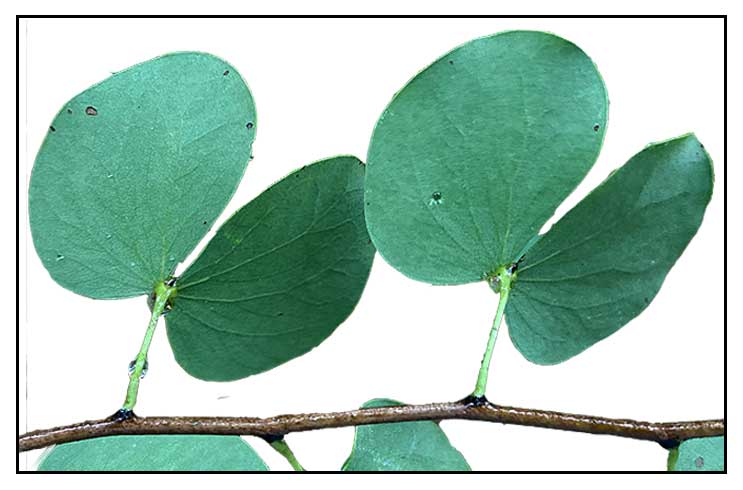
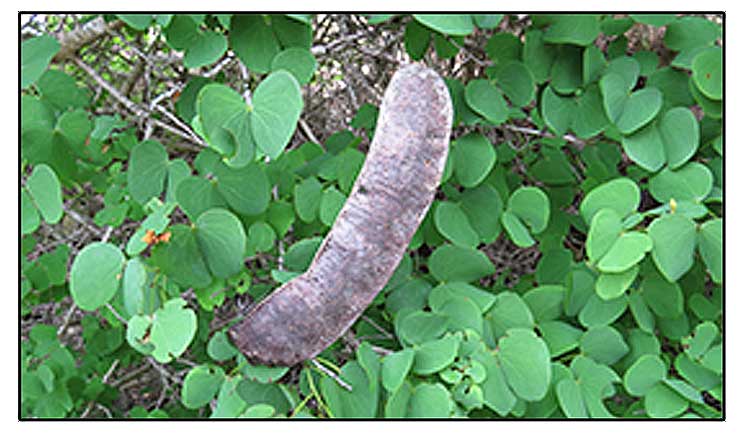
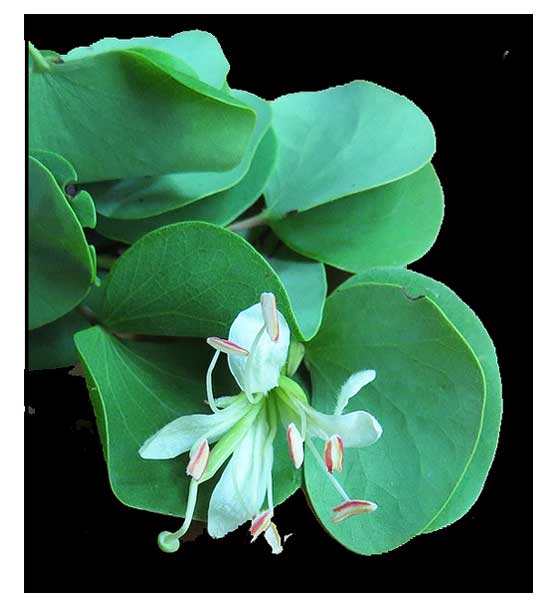
• Growth form: A large woody liana or vine (with stem diameters reaching up to 6 cm) or flower and fruit compactly as a shrub. Tendrils are typically present on branches. Leaves: Leaves: Distinctive butterfly-like (bifoliolate) compound leaves made of two leaflets (measuring about 18–45 x 12–35 mm) with 3–5 basal veins and a tiny terminal club-like gland. [1, 2] Flowers: Flowers: Woolly pubescent petals (approx. 20 x 8 mm), 10 dimorphic stamens, and a peltate stigma. Fruit and Seeds: Curved, flat pods (10–20 x 2–3 cm) containing 6 to 13 hard, flat seeds. (Australian Tropical Rainforest Plants)

Distribution
- Native to the Philippines. (1)
- In Basilan, Bohol, Busuanga, Cebu, Coron, Dumaran, Negros, Palawan, Panay, Sibutu, Siquijor; in Luzon: Batangas, Quezon, Zambales; in Minda nao: Davao Oriental.
- In coastal areas, in sandy soil, as well as among rocks and tidal forests. (1)
-
POWO lists it as native to India and Sri Lanka. (2)

Constituents
- Study of roots isolated six new metabolites: lysiphans A-F (1-6), along with 8 known compounds (7-14). Vine stem yielded lysiphan C (3) and compound 7, along with 5 known isolates (15-19). (see study below) (4)

Properties
- Study suggested antioxidant, aromatase inhibitory properties.

Parts used
Roots, stems, leaves.

Uses

Edibility
- No reliable reports found on edibility.
Folkloric
- In the Philippines, used against blood spitting, bleeding in general, and dysentery. (3)

Studies
• Antioxidant / Aromatase Inhibitory / Vine Stems:
The dichloromethane and MeOH extracts of roots have shown antioxidant activity, while the DCM extract of vine stems have shown aromatase inhibition. Seeking responsible bioactive components, study of roots isolated six new metabolites: lysiphans A-F (1-6), along with 8 known compounds (7-14). Vine stem yielded lysiphan C (3) and compound 7, along with 5 known isolates (15-19). Lysiphan B (2) exhibited antioxidant activity with IC50 of 28.8 µM in DPPH assay, 3.5 µM in xanthine/xanthine oxidase (XXO) assay, and 1.5 ORAC units in oxygen radical absorbance capacity (ORAC) assay. Compounds 12, 13, and 16 exhibited very strong aromatase inhibitor activity with IC50s of 0.3, 4.7, and 0.9 µM, respectively. Compound 16 also strong strong ORAC activity of 1.9 ORAC units. (4)

Availability
- Wild-crafted.

November 2026

                                                 PHOTOS / ILLUSTRATIONS
OTHER IMAGE SOURCE: Illustration: Bauhinia binata / Franciso Manuel Blanco / Flora de Filipinas / Public Domain / Click on image or link to go to source page / Wikimedia Species
OTHER IMAGE SOURCE: Bauhinia binata leaves / by ryanthughes / CC BY-NC 4.0 International / Image modified / Click on image or link to go to source page / iNaturalist
OTHER IMAGE SOURCE: Bauhinia binata leaves and pod / by kerrycoleman / CC BY-NC 4.0 International / Image modified / Click on image or link to go to source page / iNaturalist
OTHER IMAGE SOURCE: Bauhinia binata leaves and flowers / by kerrycoleman / CC BY-NC 4.0 International / Image modified / Click on image or link to go to source page / iNaturalist

Additional Sources and Suggested Readings
(1)
Fabaceae: Lysiphyllum binatum / Co's Digital Flora Database
(2)
Lysiphyllum binatum
/ KEW: Plants of the World Online
(3)
Bauhinia / PROSEA Medicinal Plants
(4)
Chemical profile and biological activities of Lysiphyllum binatum (Blanco) de Wit / Surasak Kheawchaum, Sanit Thongnest, Jutatip Boonsombat, Paratchata Batsomboon et al / J Nat Med., 2025; 79(1): pp 45-58 / DOI: 10.1007/s11418-024-01844-9
(5)
Lysiphyllum / Wikipedia

•

DOI: It is not uncommon for links on studies/sources to change. Copying and pasting the information on the search window or using the DOI (if available) will often redirect to the new link page. (Citing and Using a (DOI) Digital Object Identifier)

                                                            List of Understudied Philippine Medicinal Plants
                                          New plant names needed
The compilation now numbers over 1,830 medicinal plants. While I believe there are hundreds more that can be added to the collection, they are becoming more difficult to find. If you have a plant to suggest for inclusion, native or introduced, please email the info: scientific name (most helpful), local plant name (if known), any known folkloric medicinal use, and, if possible, a photo. Your help will be greatly appreciated.
•

•
HOME      •      SEARCH      •      EMAIL    •     ABOUT