
HOME      •      SEARCH      •      EMAIL    •     ABOUT


Family Nephrolepidaceae
Asian sword fern
Bayangbang

Nephrolepis brownii (Desv.) Hovenkamp & Miyam.
ROUGH SWORD FERN / BROWN'S SWORD FERN
Mao ye shen jue

Scientific names Common names
Aspidium amoa Hook. Bayangbang (Tagalog) •
Aspidium floccigerum Blume Asian sword fern (Engl.)
Aspidium schkuhrii Blume Brown's sword fern (Engl.)
Davalia multiflora Roxb. Rough sword fern (New Zealand)
Nephrodium brownii Desv.  
Nephrodium regulare Desv.  
Nephrolepis acutangula C.Presl  
Nephrolepis brownii (Desv.) Hovenkamp & Miyam.  
Nephrolepis floccigera (Blume) T.Moore  
Nephrolepis mayi May  
N. multiflora (Rosb.) F.M.Jarrett ex C.V.Morton  
Nephrolepis pubescens Copel.  
Nephrolepis tomentosa Alderw.  
Nephrolepis westonii Craig  
Nephrolepis brownii is an accepted species. KEW: Plants of the World Online
Note: Common in the confusing ecosystem Philippine plant names, Tagalog names bayangbang and bayabang, and Bisaya name alolokdo are shared by several of the native Nephrolepis species. Likewise, English common names are shared between species: rough sword fern by N. brownii and N. hirsutula. The search for scientific studies are done using scientific names.

Other vernacular names
CHINA: Mao ye shen jue.
SRI LANKA: Rilla.

Gen info
- Nephrolepidaceae is a small, unique family of ferns that contains only one genus, Nephrolepis. In other classifications, it is place in Dryopteridaceae. Species in the genus include plants commonly known as Boston fern, and its most famous member is the popular Boston fern.
- Of the 30-some species in the family, Co's Digital Flora of the Philippines lists 8 native species: Nephrolepis acutifolia, N. biserrata, N. brownii, N. cordifolia, N. falcata, N. hirsutula, N. radicans, and N. undulata; and possibly present, N. falciformis. (3) The ferns share same general features.
- Etymology: The genus name Nephrolepis derives from Greek words nephros (kidney) and lepis (scale), alluding to the kidney-shaped indusia that cover the sori on the fern's fronds. The specific epithet brownii honors the Scottish botanist Robert Brown (1773-1858), who accompanied Matthew Finders on his expedition to Australia and later served as librarian and keeper of the natural history collections at the British Museum. (4)

Botany
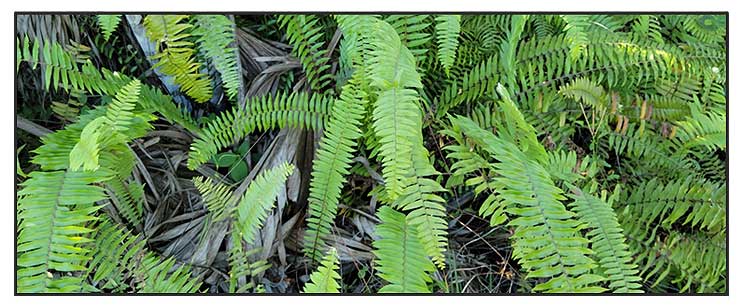
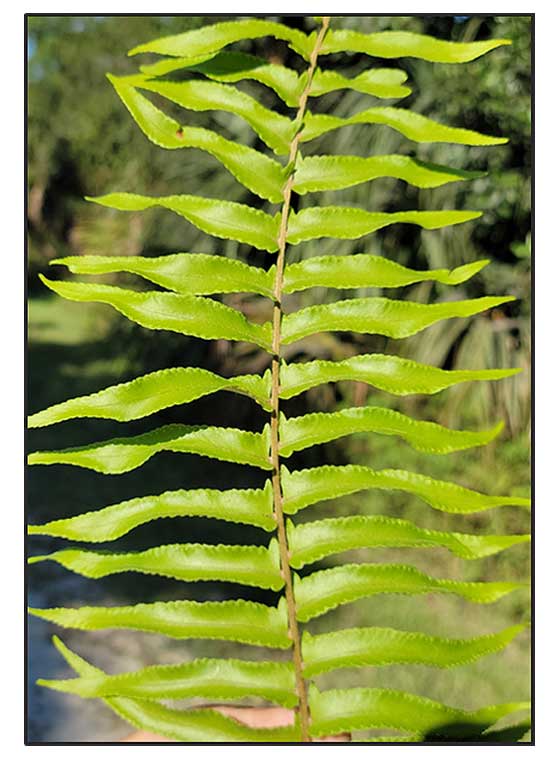
Nephrolepis brownii is a perennial herbaceous fern that grows to approximately 3 feet (0.91 m) in height, forming tufts of 5 to 6 fronds supported by long-creeping rhizomes. The rhizomes are slender, measuring 1.5–2.5 mm in thickness, and produce runners that often form stilts to support upright portions, branching at divaricate angles; they are terrestrial but can also adopt an epiphytic habit, with scales on the runners being sparse, appressed, or spreading, and tubers absent. The fronds are evergreen, erect to arching, and pinnate, reaching lengths of 70–130 cm with stipes 14–37 cm long, straw-colored to medium brown, and either glabrous or sparsely scaled at the base. The lamina is linear-elliptic to linear-oblanceolate, tapering gradually at the base over 25–35 cm, with margins shallowly crenate to crenate and texture chartaceous to herbaceous; it is largely glabrous but may bear sparse light brown scales and multicellular hairs. Pinnae are alternate, numbering 20–40 pairs, with the longest measuring 3.4–12.3 cm long and 0.5–1.5 cm wide, linear-triangular to lanceolate, and slightly falcate; proximal pinnae are markedly reduced with cordate bases, while acroscopic bases feature prominent truncate to auriculate segments that often overlap and conceal the rachis, which is winged, grooved, and covered in dense light brown to hyaline scales with ciliate acumen. (4)

• A key distinguishing feature of N. brownii is the dense covering of dark brown, appressed scales with pale margins at the mature petiole base, contrasting with the lighter reddish-brown, single-colored scales of native species like N. exaltata. (4)

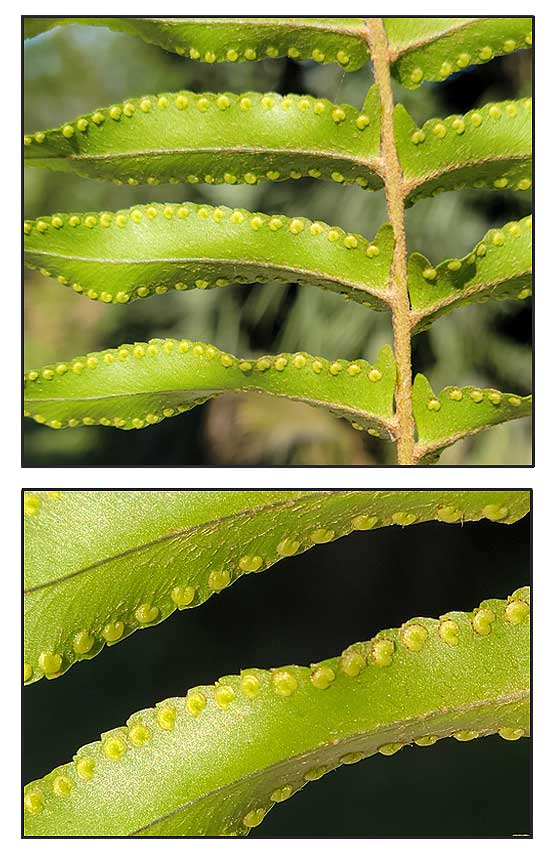
• N. brownii can be distinguished from other Australian Nephrolepis by the presence of triangular auricle on the acroscopic side of the pinnae bases combined with hairs being present on the upper costa and sori being submedial. (6)

Distribution
- Native to the Philippines. (1) (3)
- In Luzon, Visayas, and Mindanao. 0-1700 m. (3)
- Also native to Andaman Is., Assam, Bangladesh, Bismarck Archipelago, Borneo, Cambodia, China South-Central, China Southeast, Christmas I., Cook Is., Fiji, Hainan, India, Jawa, Kazan-retto, Kermadec Is., Laccadive Is., Laos, Lesser Sunda Is., Malaya, Marianas, Myanmar, Nansei-shoto, New Caledonia, New Guinea, Nicobar Is., Ogasawara-shoto, Pitcairn Is., Queensland, Society Is., Solomon Is., Sri Lanka, Sulawesi, Taiwan, Thailand, Tonga, Tuamotu, Tubuai Is., Vanuatu, Vietnam. (1)
- The fern thrives in thickets, clearings, open banks, roadsides, pastures, and shaded, well-drained soils, often forming dense growth up to 3 feet tall with overlappin pinnae that conceal the rachis.
- Invasiveness: Listed as an aggressive exotic, particularly in Florida, where it is listed as a Category I invasive species by the Florida Invasive Species Council. (4) Forms on other plants and rocks, choking out the underlying native plants and hindering new growth. (7)

Properties
- Studies have suggested antioxidant, antidiabetic properties.

Parts used
Leaves, stems.

Uses

Edibility
- No reports or info on edibility.
- Unlike other related species that produce edible,starchy tubers, N. brownii doses not produce these tubers.
Folkloric
- No reported medicinal use in the Philippines.
- Decoction of leaves and roots used for treatment of urinary retention. (•)
Others

- Decorative: Used for landscape gardening, decoration, and floral arrangements. ()

Studies
Antidiabetic / Antioxidant / Leaves:
Study evaluated the leaf extract of N. brownii for antioxidant and antidiabetic activities. Results showed substantial antioxidant potential of aqueous extract using DPPH radical scavenging assay with 70% inhibition at 1000 µg/mL, comparable to antioxidant activity of ascorbic acid. Extract showed concentration dependent inhibition of α-amylase (IC50 of 67.70 µg/mL) and α-glucosidase (IC50 of 76.37 µg/mL), although slighted less potent than acarbose. (5)

Availability
- Wild-crafted.

July 2026

                                                 PHOTOS / ILLUSTRATIONS
IMAGE SOURCE: Brown's Sword Fern (Nephrolepis brownii) / © Jay Horn / Some rights reserved / CC BY 4.0 ./ Image modified / Click on image or link to go to source page / iNaturalist
OTHER IMAGE SOURCE: Brown's Sword Fern (Nephrolepis brownii) / © Jay Horn / Some rights reserved / CC BY 4.0 International / Image modified / Click on image or link to go to source page / iNaturalist
OTHER IMAGE SOURCE: Brown's Sword Fern (Nephrolepis brownii) - Close-up of leaves / © Jay Horn / Some rights reserved / CC BY 4.0 International / Image modified / Click on image or link to go to source page / iNaturalist

Additional Sources and Suggested Readings
(1)
Nephrolepis brownii / KEW: Plants of the World Online
(2)
Nephrolepis / Wikipedia

(3)
Nephrolepidaceae / Co's Digital Flora of the Philippines
(4)
Nephrolepis brownii / Grokipedia
(5)
Exploring the therapeutic potential of leaf extract of Nephrolepis brownii (Desv.) Hovenkamp & Miyam.: An integrative study on antioxidant and anti-diabetic activities / Geetha MD, KS Shyam, KA Majoj, SK Jaya Chitra et al / Plant Science Today, 2025; 12(3) / DOI:10.14719/pst.2025.12.3
(6)
Nephrolepis brownii / Ausstralian Tropical Ferns and Lycophytes
(7)
Nephrolepis brownii / FLIP: Florida Invasive Plants

DOI: It is not uncommon for links on studies/sources to change. Copying and pasting the information on the search window or using the DOI (if available) will often redirect to the new link page. (Citing and Using a (DOI) Digital Object Identifier)

                                                            List of Understudied Philippine Medicinal Plants
                                          New plant names needed
The compilation now numbers over 1,750 medicinal plants. While I believe there are hundreds more that can be added to the collection, they are becoming more difficult to find. If you have a plant to suggest for inclusion, native or introduced, please email the info: scientific name (most helpful), local plant name (if known), any known folkloric medicinal use, and, if possible, a photo. Your help will be greatly appreciated.

HOME      •      SEARCH      •      EMAIL    •     ABOUT