 Gen info Gen info
- Ipomoea is the largest genus in the plant family Convolvulaceae, with over 600 species. It is a large and diverse group with names that include morning glory (the most common), water convolvulus, bindweed, moonflower, among others.
- Ipomoea violacea is a perennial species of Ipomoea occurring worldwide with the exception of the European continent.
- Etymology: The genus name Ipomoea derives from Ancient Greek ἴψ, meaning 'woodworm", and homoios, meaning "resembling", referring to its twining habit. (1) The flowers open at night, hence, the name 'moonflower'. Etymology: The genus name Ipomoea derives from Ancient Greek ἴψ, meaning 'woodworm", and homoios, meaning "resembling", referring to its twining habit. (1) The flowers open at night, hence, the name 'moonflower'.
- Taxonomy conflict: Comparison of taxonomy of Ipomoea violacea and I. tricolor shows the two plants belong to different subgenera. Ipomoea violacea should not be used as synonym for Ipomoea tricolor When used as synonym, incorrect usage should be specified by used of the abbreviation 'Auct.' for Auctorum. (Also, Ipomoea tricolor contains ergolines, along with 24 other Ipomoeas. Ipomoea violacea is not among them.) (2)
- Historical snippet: In the 1930's, the Sandoz Pharmaceutical Company of Basle, Switzerland, extracted a number of pharmacologically active substances from the ergot fungus, Claviceps purpurea. These substances were lysergic acid derivatives and clavine alkaloids. In 1938, Albert Hofmann of the Sandoz Company, synthesized LSD from ergoline compounds, and in 1960 he discovered lysergic acid and clavine alkaloids in morning glory seeds of Ipomoea violacea Sp. (Hofmann, 1968). (8)
 Botany Botany
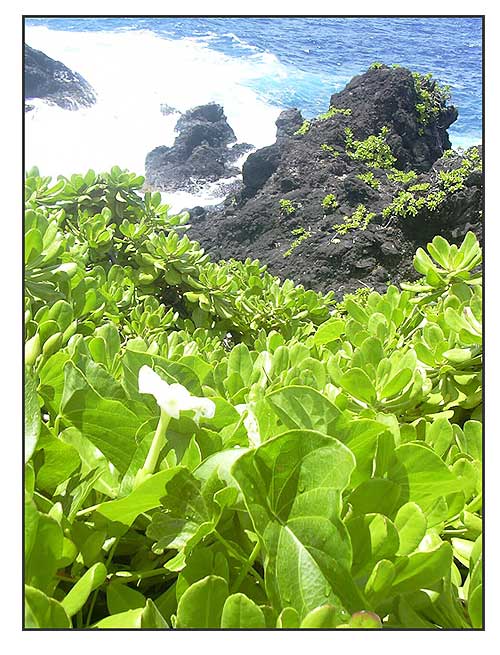
• Plants perennial, woody, twining, glabrous. Stems to 5 m, often longitudinally wrinkled. Petiole 3.5-11 cm; leaf blade circular or ovate, 5-16 X 5-14 cm, base deeply cordate; lobes rounded or rarely angular, apex acuminate, mucronulate; lateral veins 7 or 8 pairs. Inflorescences 1- to few flowered; peduncle often 2.5-4.5(-7) cm. Pedicel 1.5-3 cm, thickened and clavate in fruit. Flowers nocturnal. Sepals ± circular, equal or outer 2 shorter, 1.5-2.5 cm, thinly leathery, apex obtuse or emarginate, mucronulate, enlarged in fruit and reflexed. Corolla white, with green midpetaline bands, salverform, 9-12 cm; limb 8-10 cm in diam. Stamens included; filaments inserted near base of corolla tube. Pistil included; ovary glabrous. Stigma 2-lobed. Capsule pale brown, ovoid to ± globose, 2-2.5 cm, glabrous. Seeds black, 1-1.2 cm, densely short tomentose, edges with ca. 3 mm long sericeous hairs. (Flora of China)
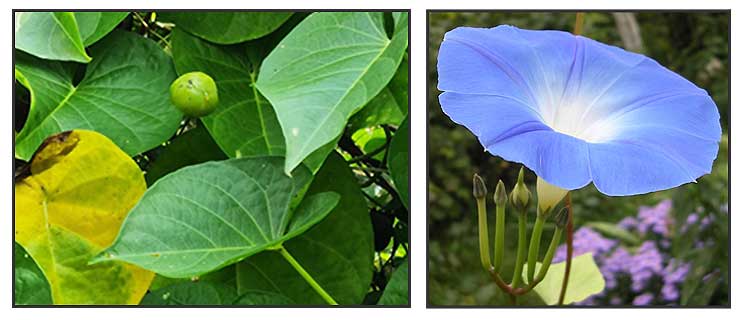
• Flowers range in color from white to blue to purplish.
Distribution
- Native to the
Philippines. (1)
- In
Luzon: Batangas, Bulacan, La Union, NCR, Pampanga; Apulit, Boracay, Mindoro..
- Also native to Aldabra, Andaman Is., Aruba, Assam, Bahamas, Bangladesh, Belize, Bismarck Archipelago, Borneo, Brazil Northeast, Brazil Southeast, Cambodia, Caroline Is., Cayman Is., China Southeast, Christmas I., Cocos (Keeling) Is., Colombia, Comoros, Cook Is., Cuba, Dominican Republic, Fiji, Florida, French Guiana, Ghana, Gilbert Is., Guinea, Guyana, Hainan, Haiti, India, Ivory Coast, Jamaica, Japan, Jawa, Kenya, Leeward Is., Line Is., Madagascar, Malaya, Maluku, Marianas, Marquesas, Marshall Is., Mauritius, Mexico Southeast, Mexico Southwest, Mozambique, Myanmar, Nansei-shoto, Nauru, Netherlands Antilles, New Caledonia, New Guinea, Nicobar Is., Niue, Northern Territory, Ogasawara-shoto, Panamá, Phoenix Is., Pitcairn Is., Puerto Rico, Queensland, Rodrigues, Samoa, Senegal, Seychelles, Society Is., Solomon Is., South China Sea, Sri Lanka, Sumatera, Suriname, Taiwan, Tanzania, Texas, Thailand, Tokelau-Manihiki, Tonga, Trinidad-Tobago, Tuamotu, Tubuai Is., Tuvalu, Vanuatu, Venezuela, Vietnam, Wake I., Wallis-Futuna Is., Western Australia, Windward Is. (1)
Constituents
- The vine bears seeds containing alkaloids d-lysergic and d-isolysergic acids (similar to LSD).
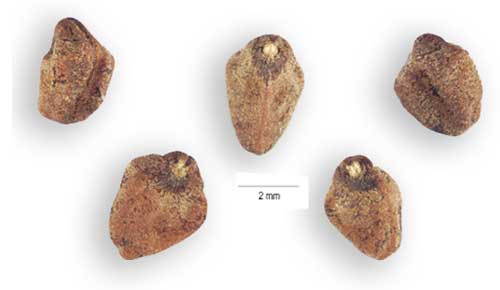
- Study of I. violacea isolated several ergoline alkaloids: chanoclavine, elymoclavine, ergine, erginine, ergometrine, lysergol, penniclavine, besides chanoclavine II and ergometrinine. The main alkaloids in seeds is ergine. The total alkaloid of I. violacea seed is about five times greater than seeds of I. corymbosa (Rivea corymbosa).
Concerns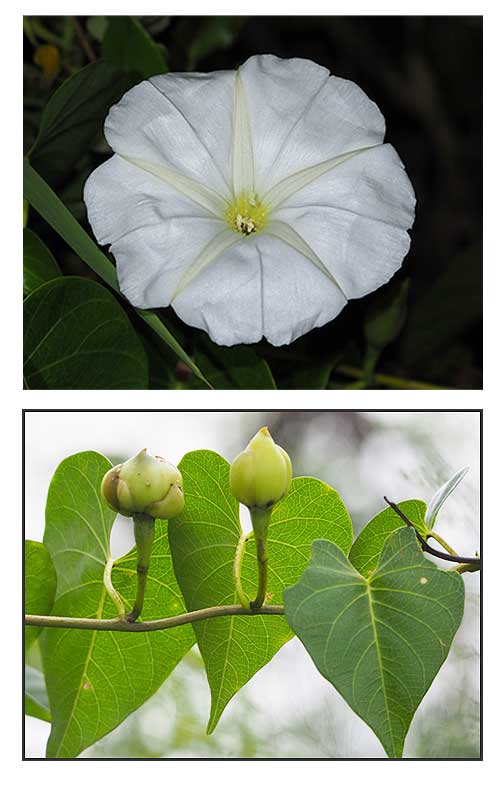
- Study suggests ingestion of Ipomoea seeds poses an unrecognized toxicological risk. Although seeds are not popular as a recreational drug, they are cheap, easy to purchase and can be used as substitute of LSD. (5)
-
Raw seeds contained a little amount of crude form of LSD.
-
Hallucinogenic Effects and Adverse Effects: Ingestion of I. violacea seeds produces effects comparable to those produced by Argyreia nervosa seeds. Effects, while minor, are similar to those of LSD. In general, seeds are ingested whole or broken and immersed in water. Literature data suggest hallucinogenic effects are produced by 10 seeds of Argyreia nervosa (Al-Assmar, 1999) and 150-200 seeds of Morning Glory (Schultes, 1960). Ergine hallucinogenic activity (LSA) can start with 2-5 mg (Schultes & Hoffman, 1980), lasting about 4-8 h, with feelings of tranquility, dysphoria, psychedelic visual effects, color visions. Lethal dose in humans is 14 mg/;kg. LSA can also induce suicidal ideation. Anorexia, nausea, memory loss may occur; dissociative reactions and schizophrenic relapse are major psychotic adverse effects. Fatalities have been reported after ingestion of seeds. Inhibition of metabolism of LSD analogues is inhibited by drugs used in HIV therapy and warns or increased toxicity in those using antiretroviral therapy.
- Although hallucinogenic effects may be gotten from commonly marketed Ipomoea seeds, the amount of seeds needed for that "herbal high" would likely results in gastrointestinal toxicity; and worse, the seeds are often treated with fungicides and other toxic substances. (7)
- Seeds of I. violacea are about 5 times less potent than seeds of A. nervosa.
- There is no uniformity in the dosage of seeds. Different varieties have distinct concentrations of alkaloids, and the plant's potency is affected by growing conditions. (3)
- In addition to the dangers of use for hallucinogenic effects and the potential of ergot poisoning (ergotism), plants are often treated with toxic fungicides and pesticides to prevent spoilage during storage.
Parts used
Seeds, root, leaves.
Uses
Edibility
- Leaves reported edible; boiled or steamed.
- Seeds reportedly edible when young, cooked.
Folkloric
- No reported folkloric medicinal use in the Philippines.
- Root decoction for diuretic, laxative, and expectorant effects.
- Leaves used for headache and indigestion.
Others
- Soap: Raw leaves can be used as soap. (3)
- Recreational: Reports of recreational use of A. violacea ingestion of seeds frequently associated with taking cannabis, hashish, or dextromethorphan. History of abuse was recorded in the 1960s, and current recreational use of the plant is not known. (see study below) (5)
- Cultural / Shamanamic practices: Traditionally used in shamanic ancestral rituals for magical, therapeutic, and religious practices. Used in various traditional medicine practices for divination, although better known for its hallucinogenic effects. (•) Seeds traditionally used by Mexico's Zapotec people for ceremonial and curative purposes. Seeds used as as a mean of communicating with god.
Studies
• Recreational Use of D-Lysergamide from Seeds: Study reports on the recreational use of seeds of plants belonging to the Convolvulaceae family, the effects induced by "druids fantasy", and the re-occurrence of recreational use of Ipomoea violacea and I. tricolor. Ingestion of seeds was frequently associated with the use of cannabis, hashish, and dextrometorphan. Five reported cases of effects induced by I. violacea were associated with eating of seeds, ground or swallowed with non-alcoholic drink, using 6-7 seeds or 5-10 grams, 4 of 5 taken with cannabis and hashish. GI side effects included nausea (4), abdominal pain (1), vomiting (1).( Positive emotional effects included: happiness (1), heavenly relaxation (1), feeling of divinity and mental orgasm (1), blissful state (2), and experience of beauty (2). Negative emotional effects included: panic and decreased mood. Other effects included visual distortions, sensitivity to colors, among others. (5)
• Ergot Alkaloids / Hallucinogenic Potential: Naturally occurring and semisynthetic ergot alkaloids play a role in health care or as recreational drugs. in Western and indigenous Mexican societies. Ergot alkaloids in Central American Convolvulaceae like Ipomoea violacea, Turbina corymbosa and Ipomoea asarifolia are colonized by newly described fungal genus Periglandula, which while not culturable in vitro, has shown capacity to synthesize ergot alkaloids. (6)
• Ergot Alkaloids / Hallucinogenic Potential: "Herbal highs" are effects that come from use of some natural plants with central nervous system effects. One such source is Lisergamide, ergine or LSA, from the seeds of Ipomoea violacea. Study analyzed the presence of lysergic acid amide (LSA) in the seeds of Ipomoea violacea from various sources: seized by Italian Police, purchased in the Internet, or sold for ornamental purposes. Analysis revealed that 300 mg of Ipomoea violacea seeds, equivalent to approxi-mately 8 seeds, contained 0.062% of LSA. Previous studies have suggested ingestion of 250 seeds would lead to a dose of approximately 6 mg of LSA, capable of producing hallucinogenic effects. (7)
• Correlation Between Defoliation and Decrease Indole Alkaloid Content in Seeds: Study evaluated the phenomenon of progressive defoliation and gradual decrease of indole alkaloid content in I. violacea seeds, when approach grafted to Ipomoea nil. Results demonstrated the leaves as the principal sites of alkaloid biosynthesis, followed by translocation through the plant with major accumulation in the seeds. Study also suggested: (1) Roots are not involved in alkaloid biosynthesis. (2) Stems are not site of alkaloid synthesis. (3) Meristematic tissue of growing points may not play a role in biosynthesis of indoles, and (4) Seeds are not the site of alkaloid biosynthesis since they remain normal in appearance throughout the experiment. (10)
Availability
- Wild-crafted.
- Herbal products in the cybermarket.
|