Gen info
- Zingiberaceae, the ginger family, is a family of flowering plants containing 59 genera and about 1600 species, distributed globally in the tropics and subtropics. The family has been supporting humans through food, spices, medicine, ornamentation, cosmetics, and various socio-cultural-religious activities across traditional and modern societies. The earliest fossils of the family date back to the Campanian age (late-Cretaceous). (3)
-
Meistera is an Asian genus of plants in the family Zingiberaceae.
-
Meistera muricarpa is a species of flowering plant in the ginger family, Zingiberaceae. It was originally described by Adolp Daniel Edward Elmer.
- Taxonomic conflict & confusion: Prior literatures misidentified populations in China, Laos and Vietnam as Meisteria muricarpa. Recent botanical studies have clarified those populations to belong to a completely distinct species, Meisteria vespertilio. True M. muricarpa is entirely restricted to the Philippines. (6)
 Botany
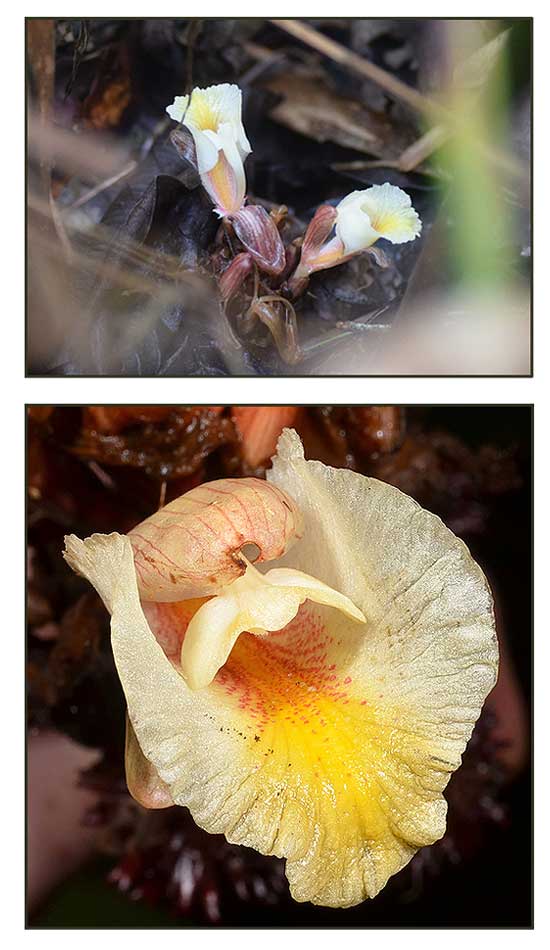
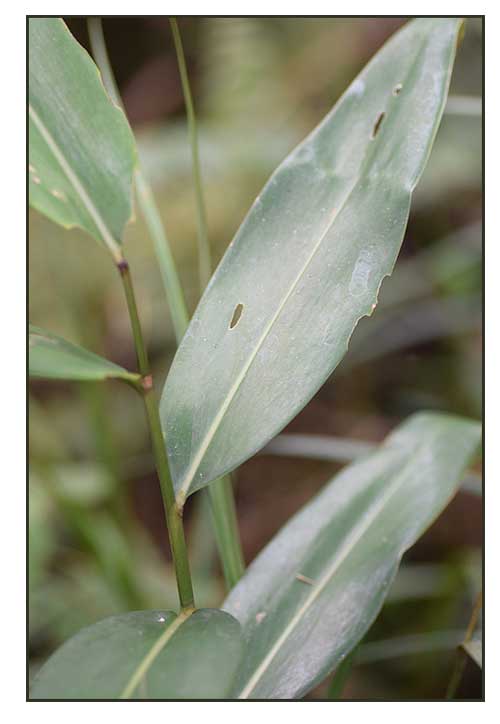
• Terrestrial perennial herb, arching, forming loose clumps, reaching up to 2–2.5 m tall. Stilt roots absent. Rhizomes below ground, pinkish to brownish, 2.4–2.8 × 3.6–3.9 cm diam. Swollen base brownish, glabrous, 7–7.2 cm. Lamina 11–39 x 2.5–7.3 cm, lanceolate, dark green, glabrous, reduced towards the base of the leafy shoot; leaf apex acuminate, 1.7–1.9 cm, glabrous; leaf base cuneate, glabrous; leaf margin entire, wavy, brownish. Leaf sheath green, 5.5 cm distance per node. Ligule 0.5 cm x 1.1 cm, green, truncate to retuse, glabrous. Petiole subsessile, 1–2 mm, green, glabrous. Leaf sheath dark green towards the base, light green towards the apex, glabrous, 4.6–5.1 cm x 1.8–2.1 cm. Inflorescence arising near the base of the leafy shoot or from the rhizome, peduncle nodding at various degrees, sometimes subterranean, 7–10.5 × 3–3.5 cm, with 1–2 flowers open at a time. Bracts ovate, imbricate, narrow to truncate apex, 1.8–2.1 × 1.3–1.6 cm, brown, wider at the base, margin entire, glabrous. Bracteoles lanceolate, narrower towards apex, 1.9–2.1 × 0.4–0.5 cm, 2-toothedapex, brown, apex round, margin entire, glabrous. Calyx tubular, 1.8–2 × 0.4–0.5 cm, creamy white to light pink, 3-toothed at the apex, glabrous. Dorsal corolla lobe 2.2–2.3 × 2.1–2.2 cm, narrower towards apex, creamy white to light brown, with pronounced nerves, margin entire, apex cucullate, glabrous. Lateral corolla lobe 1.7–1.8 × 2.1–2.2 cm, narrower towards apex, creamy white to light brown, with pronounced nerves, margin entire, apex cucullate, glabrous; corolla tube 1.7–1.9 × 0.3–0.5 cm, creamy white, glabrous. Labellum spatulate, 3.2–3.6 × 2.3–2.5 cm, creamy white to yellowish with yellow at the center occupying from the base to the apex, red streaks and marks at the center from the base up to the 70% portion of the labellum’s length, apex undulate, forming trilobed at the center of the tip, glabrous, without auricles at the base. Appendages linear, 0.7–0.8 cm, white. Stamen 4.8–5 × 1.5 cm, arching towards the labellum, shorter than the labellum; filament 4.3–4.4 × 2 cm, white, glabrous; anther trilobed, 0.8 × 1.5 cm, creamy white with yellowish margin, glabrous, thecae 8 × 4 mm, dehiscent in the upper half, golden-brown, glabrous. Style 3.7–3.9 cm long, white, glabrous; stigma triangular, ca. 1.5 mm wide, creamy white; epigynous gland linear, 6 × 1 mm, yellow, glabrous; ovary subglobose, 3.4–4.0 × 4 mm, white, glabrous. Infructescence 6.5–8 × 4.5–5 cm, bracts persistent, brown, spreading. Fruit oblong to spherical, 3.3–3.5 × 2.9–3.2 cm, red, muricate or echinate ornamentation, with persistent calyx; seed irregular to subglobose, numerous, 3–4 mm long × 3. (4)
 Distribution
- Distribution conflicts: Native to the Philippines. (1)
-
Listed as endemic at Leonardo Co's Digital Flora Database. (7)
- In Leyte; in Luzon: Bataan, Isabela, Quezon; in Mindanao: Agusan del Norte, Bukidnon, Cotobato, Davao Oriental, Davao del Sur, Misamis Oriental, Surigao del Norte, Zamboanga del Sur. (7)
- Per POWO: Also native to China Southeast, Hainan, Laos, Vietnam. (1)
- Conflict on taxonomy: M. muricarpa was once confused with M. vespertilio until 2021, when Ye et al. clarified that the M. muricarpa reported in China, Laos, and Vietnam was misidentified.
(see article for descriptive differences) (see study below: 4) (6)
Constituents
- Fruits showed higher TPC and TAA than leaves, while the leaves showed higher TFC than the fruits. Fruits yielded 6.99 mg GAE/g sample of phenolics, while the leaves showed 2.45 mg GAE/g sample . (see study below) (5)
- Qualitative screening of leaves, rhizomes, and fruits revealed alkaloids, carbohydrates, glycosides, fixed oils, fats, saponins, tannins, and proteins.
(5)
Properties
- Studies have suggested antioxidant properties.
Parts used
Roots, leaves, fruits.
Uses
Edibility
- Seeds reportedly edible.
- Fruits of the species in Bukidnon eaten by Asian palm civet (Paradoxurus hermaphroditus), locally known as "milo," and some rodents.
Folkloric
- In Bukidnon, Mindanao, seeds from ripe fruits used as remedy for stomach-related illnesses.
- Decoction of rhizomes used for treatment of cough.
Studies
• Morphologic and Taxonomic Identity: Study reports on the description and taxonomic identity of Meistera muricarpa in the Philippines. Study provides information on habitat, ecology updated distribution, phenology, taxonomic key, comparison tables, and color photographs. The study confirms the distinct status of M. muricarpa as an endemic species in the Philippines, setting it apart from other Meisteria species worldwide. (4)
• Antioxidant / Leaves and Fruits: Study evaluated the total phenolic content (TPC), total flavonoid content (TFC) and total antioxidant activity (TAA) of ethanolic fruit and leaf extracts, Results showed the fruits had higher TPC and TAA than leaves, while the leaves showed higher TFC than the fruits. Fruits yielded 6.99 mg GAE/g sample of phenolics, while the leaves showed 2.45 mg GAE/g sample. Fruits showed higher antioxidant activity with 21.13 mg AAE/g sample than the leaves with 8.28 mg AAE/g sample. Strong positive linear correlation (r-0.99, p<0.001) was seen with TPC, TFC, and TAA. Results suggest the leaves and fruits of M. muricarpa has potential valuable source of natural antioxidants. (see constituents above. (5)
Availability
- Wild-crafted. |