 Gen info Gen info
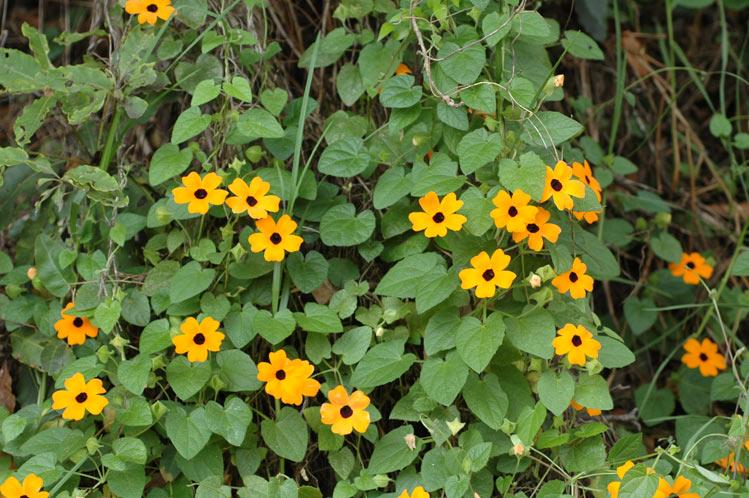
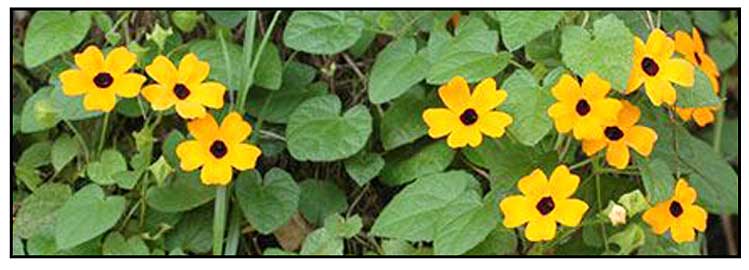
- Thunbergia alata, commonly known as black-eyed Susan vine, is a herbaceous perennial climbing plant species in the family Acanthaceae.
- Etymology: The genus Thunbergia honors Carl Peter Thunberg (1743-1828), a Swedish doctor who studied under Carl Linnaeus.
- The common name 'Black-eyed Susan' is believed to have come from a character from many traditional ballads and songs. One is the Ballad of Black-eyed Susan by John Gay, where Susan boards a ship in-dock asking sailors where her lover Sweet William has gone. Black-eyed Susan is also a name of species of flowers in the Genus Rudbeckia.
 Botany Botany
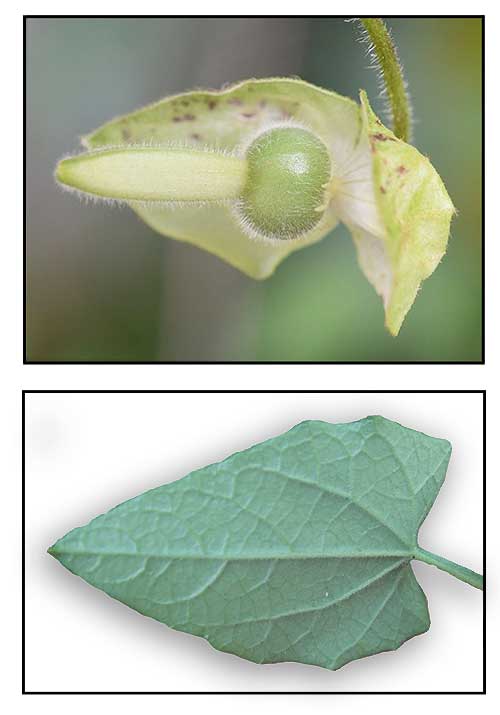
• Growth form: Herbaceous vine with a creeping growth habit. Foliage: Heart-shaped or arrow-shaped leaves with smooth or toothed edges. Leaves are covered in soft hairs. Flowers:Yellow to orange, star-shaped flowers are composed of 5 squarish to obovate petals. Petal tips are approximately truncate, but have a curved indentation in the middle. The inside of the floral tube is lined with a purplish black or dark maroon color. Flowers occur singly in the leaf axils. The flowers reflect UV light in a pattern that helps pollinating insects find the center of the flower. Fruit: Fruit is approximately round, but has a long, pointed beak like that of a bird. (Flora & Fauna Web)
• Thunbergia alata has a vine habit, and can grow to a height of 5 meters (16 ft) high in warmer zones, or much less as a container plant or as an annual. It has twining stems with heart or arrow-shaped leaves. Leaves are 3 1/2 to 7 1/2 centimeters long and 2 1/2 centimeters wide, triangular to heart-shaped, with wavy edges, and hairy on both surfaces. Leaf blades sit on up to six and a half centimeters long petioles, which attach at a distance of four and a half to 13 centimeters on the one to one and a quarter millimeter thick stem axis. Flowers are hairy, mostly orange-yellow, five petals and appear throughout the growing season, which grow on up to 8 1/2 centimeters long inflorescence axes, typically warm orange with a characteristic dark spot in the center. The central two centimeter long corolla tube is black-violet. Each of the single flowers has two triangular to oval, hairy bracts that taper towards the outside, 18 to 20 mm long and 9 to 10 mm wide. Serrated calyx is about two millimeters long and has between 15 and 17 awl-shaped lobes. Corolla tube measures around 4 cm and shows five 2 centimeter large corolla lobes with right-hand covering buds on the outside.
Distribution
- Thoroughly naturalized
in waste places and thickets in the lowlands. (2)
-
Also cultivated.
- Native to Botswana, Burundi, Cameroon, Central African Republic, Congo, Djibouti, DR Congo, Eritrea, Eswatini, Ethiopia, Ghana, Guinea, Ivory Coast, Kenya, KwaZulu-Natal, Liberia, Madagascar, Malawi, Mozambique, Nigeria, Northern Provinces, Rwanda, Sierra Leone, Somalia, Sudan-South Sudan, Tanzania, Uganda, Zambia, Zimbabwe. (1)
- In many countries, an aggressive invasive plants with its fast-climbing habits. In Columbia, considered one of the ten most problematic invasive species.
Constituents
- Phytochemical studies have yielded phenolic compounds such as caffeoylmalic, feruloylmalic, and p-coumaroylmalic acids, iridoid glycosides such as alatoside and thunaloside, stilbericoside, 6-epi-stilbericoside, and thunbergioside. (5)
- Phytochemical screening of hexane extract of leaves yielded alkaloids, flavonoids, saponins, glycosides, tannins, and terpenoids; methanol extract yielded alkaloids, saponins, tannins, and terpenoids.
(see study below) (8)
- Crude ethanolic stem and leaf extracts yielded saponins, terpenes, and flavonoids, with rutin and chlorogenic acid as main components of stems and leaves, respectively. (see study below) (9)
- Phytochemical screening of aqueous leaf extract revealed flavonoids, saponins, glycoside steroids, and phenolic substances such as caffeoylmalic acid, feruloylmalic acid, and tannins.
(see study below) (11)
P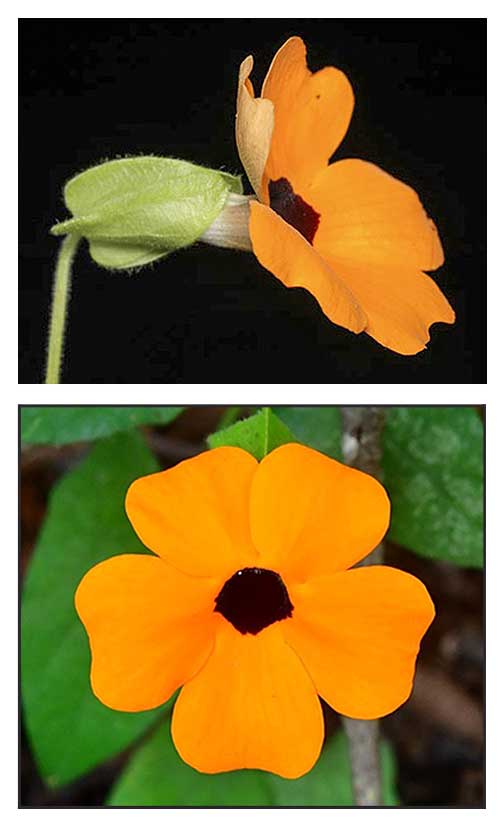 roperties roperties
- Studies have suggested anti-inflammatory, antidepressant, antibacterial, antifungal, antiurolithiatic properties.
Parts used
Leaves, sap, stems.
Uses
Edibility
- Leaves are edible: cooked and eaten as vegetable.
Folkloric
- No reported folkloric medicinal use in the Philippines.
- Traditionally used for inflammatory diseases. In Uganda, infusion of leaves and stems used for treatment of fever and malaria. Infusion of leaves used for diarrhea. In Kenya, leaf infusion used for treatment of cough, flu, and backache. Topical application of pounded leaves used for treatment of skin abscesses. (5)
- In East African countries, used for treatment of diverse inflammatory diseases with fever, cough, diarrhea, and as aphrodisiac and treatment of premature ejaculation. (7)
- In African traditional medicine, used for treatment of culture-bound syndromes such as "susto" (fright) or "espanto" (fearfulness). (8)
-
Leaves applied to head for treatment of headache. Leaf sap, combined with that of Hyptis pectinata, drunk for treatment of internal hemorrhoids or for early rectal cancer. Leaf sap used as eye drops for treatment of inflammation. (4)
- Used for treatment of snake bites. Poultice of leaves applied on wounds.
- In Columbia, flower and leaves used for treatment of snake bites.
- In Ethiopia, crushed leaves mixed with water and filtered, used for internal parasites. (12)
- In Uganda, leaf ash mixed with jelly and smeared on tumors. (13)
Others
- Agroforestry: Used as hedge plant and ground cover. Also makes for a good screen to cover unsightly dead trees or walls.
- Veterinary: Used as stock feed and treatment of gall sickness and ear problems in cattle.
Studies
• Anti-Inflammatory / Leaves and stems: Thunbergia alata has been traditionally used to treat inflammatory diseases with fever, cough, or diarrhea. Study evaluated the anti-inflammatory effects of methanol extract of T. alata leaves and stems (MTA) in macrophages. The MTA selectively inhibited excessive production of inflammatory mediators in LPS-stimulated murine macrophages by reducing activity of ERK and STAT3, suggesting an important role of MTA in the modulation of severe inflammation. (5)
• Protective Against Diclofena-Induced Kidney Damage / Flowers: Study evaluated the therapeutic effects of Thunbergia alata and T. erecta flowers on diclofenac-inuced renal injury. Diclofena induced significant deterioration of all kidney parameters in addition to renal tissue contents of inflammatory markers. Flower extracts of Ta and Te showed clear improvement confirmed by histopathological examinations and immunohistochemical determination of VEGF, Nrf2, and TGF-ß1 expression. (6)
• Anti-Depressant / Aerial Parts: Study evaluated the neuropharmacological profile of aqueous extract of aerial parts of T. alata in behavioral mouse models, focusing on its antidepressant-like actions, its possible mechanisms of action, following the hypothesis that secondary metabolites may interact with brain monoamine systems, especially serotonin. The extract significantly reduced immobility time of mice in both tail suspension test (TST) and forced swimming test (FST), without affecting locomotor activity, as did prototypical antidepressant desipramine. T. alata inhibited MAO-A and B activity. LD50 was >2000 mg/kg; high doses did not produce change inn organ morphology. Results showed T. alata produces antidepressant effects mediated by monoamine brain levels, especially serotonin. The findings of safety and efficacy supports its potential for treatment of depression. (7)
• Antimicrobial / Leaves: T. alata ethanolic leaf extract showed antibacterial activity in the order of S. areus ≥ S. pyogenes ≥ P. aeruginosa. MIC values ranges from 20x10-3 mg/ml to 4.8 x 10⁻³ mg/ml. Bacterial inhibition showed regrowth of S. pyogenes after 36 hours, suggesting bacteriostatic nature. Phytochemical screening of hexane extract of leaves yielded alkaloids, flavonoids, saponins, glycosides, tannins, and terpenoids; methanol extract yielded alkaloids, saponins, tannins, and terpenoids. (8) Thunbergia alata chloroform extract of leaves showed antibacterial activities against Pseudomonas aeruginosa and significant activity in higher concentration of ethanolic leaf extract against Salmonella typhi. (8)
• Antifungal / Stems and Leaves: Study evaluated crude ethanolic stem and leaf extracts of T. alata for in vitro antimycotic activity activity against Candida strains. Leaf extracts exhibited moderate antimycotic activity, with MICs between 5.00 mg/mL and 12.25 mg/mL against C. albicans and C. auris strains. (see constituents above) (9)
• Antiurolithiatic / Stems and Leaves: Study evaluated the inhibitory potency of crude extracts of dried powder plant parts of Thunbergia alata, Hedychium marginatum, and Orthosiphon spiralis on formation of calcium phosphate (CP) and growth of calcium oxalate monohydrate (COM) crystals in vitro. Among the three plants, All plant extracts showed antiurolithiatic property. Thunbergia alata showed highest inhibitory effect for CP and COM stone formation in the aqueous medium. (10)
• Effect on Male Reproductive Parameters / Aphrodisiac / Leaves: Study evaluate the effects of aqueous leaf extract of T. alata on male reproductive parameters in male Wistar rats. Treatment of male rats significantly enhanced the selected reproductive parameters and sexual behavior of male rates at 500 mg/kg and 1000 mg/kg. No mortality or behavioral, neurological, or autonomic profile changes were observed up to highest dose of 2000 mg/kbw. suggest short-term use for this purpose is safe. Use of 1000 mg/kbw dose suggested enhanced libido, which may be due to anterior pituitary hormones and serum testosterone triggering the dopaminergic pathway, increasing sexual desire and behavior. Intromission frequency also increased. The aphrodisiac potential of the extract was pronounced at 1000 mg/kbw. Efficacy may be due to presence of bioactive substances like flavonoids, alkaloids, saponins and glycoside phenols acting centrally or by peripheral means. Results has potential for extrapolation to humans. (11)
• Silver Nanoparticles / Antimicrobial / Fruit: Study reports on the eco-friendly, cost efficient synthesis of silver nanoparticles using fruit extract of T. alata. Agar well diffusion assay and MICs showed the AgNPs possess very good antimicrobial activity. The AgNPs showed antibacterial activity against Gram(+) S. aureus, B. subtilis, B. polymyxa and Gram(-) E. coli,, S. typhi, Vibrio cholera, and antifungal activity against Aspergillus niger and Candida albicans. The AgNPs showed great potential as antimicrobial agent against human pathogenic multidrug-resistant microbes. (12)
Availability
- Wild-crafted.
- Seeds in the cybermarket. |