HOME      •      SEARCH      •      EMAIL    •     ABOUT


Family Convolvulaceae
Bonamia
Bonamia semidigyna (Roxb.) Hallier f.

Scientific names Common names
Bonamia semidigyna (Roxb.) Hallier f. Bonamia
Breweria roxburghii Choisy.  
Breweria semidiguna (Roxb.) Kuntze  
Convulvulus semidigynus Roxb.  
Ipomoea semidigyna (Roxb.) Sweet  
Accepted infraspecfics (2)  
Bonamia semidigyna var. farinacea Hallier f.  
Lettsomia bancana Miq.  
Bonamia semidigyna var. semidigyna  
Bonamia cordata (Hallier f.) Hallier f.  
Bonamia semidigyna var. ambigua Hallier f.  
Bonamia semidigyna f. ambigua (Hallier f.) Myint & D.B.Ward  
Breweria cordata Blume  
Breweria madagascariensis Choisy  
Calycobolus cordatus (Hallier f.) Heine  
Prevostea cordata Hallier f.  
Note: There is a dearth of info on vernacular names. Bonamia semidigyna is the only species of the genus found in the Philippines, and am using Bonamia as page-title for now. (Stuart)
Bonamia semidigyna is an accepted species. KEW: Plants of the World Online

Other vernacular names
BANGLADESH: Chikon gandhobhaduli.
MALAYSIA: Aroj baloe.
SRI LANKA: Bu-wasa-thel-kola (Sinhala).
THAILAND: Fon san ha, Chingcho khon daeng.

Gen info
- Bonamia is a genus of flowering plant family Convolvulaceae, commonly known as the bindweed. family. Members of the genus as commonly known as the lady's nightcap.
- Etymology: The genus name Bonamia honors the French physician and botanist Francois Bonamy (1710-1786). (2)

Botany
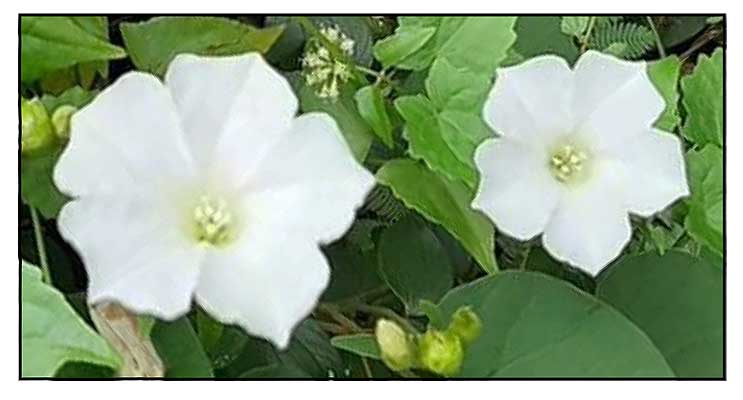
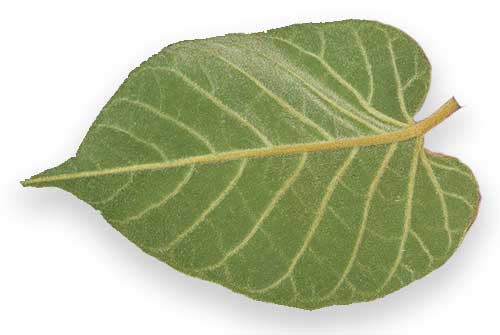
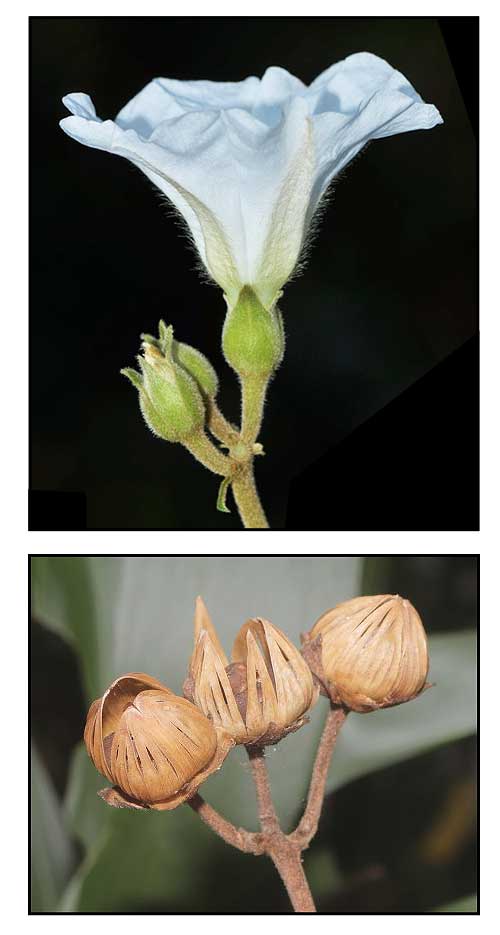
Woody climber, all parts densely reddish brown tomentose; stems to 15 m. Leaves ovate, 6.5–15 by 4–10 cm, base cordate to truncate, apex shortly acuminate to cuspidate, mucronate, upper side glabrescent, underside densely hairy; lateral veins 5 or 6 per side; petiole 1.8–6.0 cm long. Inflorescence axillary, 2–7-flowered, umbelliform cymes; peduncles 4–14 cm; pedicels 4–15 mm; lower bracts foliose, to 2 cm long. Flower: sepals subequal, 8–14 mm long, short tomentose, acute-acuminate, outer 2 ovate to ovate-oblong, upper margin wavy or reflexed, inner 3 broadly ovate, shorter, margins scarious; corolla campanulate-funnelform, 2.5–4.5 cm, white, midpetaline bands hairy outside, otherwise glabrous; stamens included, filaments sparsely pilose basally, anthers oblong; pistil included, ovary hairy, style bifid. Capsule ovoid to subglobose, ca 12 mm, apex hairy, apiculate, 4-valved, valves splitting longitudinally into several segments. Seeds broadly ovoid-trigonous, 5–6 mm long, black-brown, finely reticulate, glabrous. (Flora of Thailand)

Distribution
- Native to the Philippines.
- Also native to Bangladesh, Borneo, Cambodia, Comoros, India, Jawa, Laos, Madagascar, Malaya, Maluku, Myanmar, New Guinea, Sri Lanka, Sulawesi, Sumatera, Thailand, Vietnam. (1)

Constituents
- Phytochemical screening of methanol extract of leaves revealed alkaloids, flavonoids, terpenoids, tannins, saponins, phenolics, steroids, sterols, quinones, with absence of cardiac glycosides, proteins, cholesterol, carbohydrates, oxalate, coumarins and emodins. (see study below) (4)
- Ethyl acetate fraction of leaves revealed alkaloids, flavonoids, tannins, saponins, phenols, terpenoids, quinones, oxalate, coumarins, and emodins, with absence of carbohydrates, proteins, cholesterol, cardiac glycosides sterols, and steroids. Quantitative analysis showed significant amount of polyphenol contents. (see study below)
(4)
- Quantitative analysis of dried plant methanol extract and ethyl acetate fractions showed: Total phenolic content of 261.72 and 288.44 mg GAE/g, total flavonoid content 45.48 and 108.93 mg QE/g, and condensed tannin content 62.91 and 7.57 mg CAE/g dried plant, respectively. (4)

Properties
- Studies suggest anthelmintic, antioxidant, antibacterial, cytotoxic properties.

Parts used
Leaves.

Uses

Edibility
- No reports found on edibility.
Folkloric
- No reported folkloric medicinal use in the Philippines.
- In Bangladesh, leaf paste applied to affected areas of lymphatic filariasis (elephantiasis). (4)
Others

- Fodder: Fruit used as cattle fodder.

Studies
Antioxidant / Leaves:
Study evaluated crude methanol extract of B. semidigyna leaves and fractions in different experimental models. In antioxidant assays using DPPH, H2O2 scavenging activity, ferric reducing power and total antioxidant capacity assays, the crude methanolic extract and ethyl acetate Fx showed most potent activity. IC50s for ME and EAFx were 57.44 and 28.92 µg/ml for DPPH, and 89.72 and 51.02 µg/ml for H2O2 assays. (4)
Antibacterial / Leaves: Among all extractives, ME and EAFx showed significant activity by disc diffusion assay against S. aureus, S. typhi, and S. paratyphi. Petroleum ether and chloroform fractions showed high potential activity against B. cereus and S. paratyphi. Only the petroleum ether and EAFx showed activity against E. coli. Zones of inhibition were low compared to kanamycin. (4)
Anthelmintic / Leaves: Methanolic extract of and fractions showed significant dose-dependent anthelmintic activity using aquarium worm Tubifex tubifex using doses of 5, 8, and 10 mg/ml. At 10 mg/ml, all extractives showed shortest time of paralysis and death. (4)
Cytotoxicity / Leaves: Study evaluated cytotoxicity by Brine shrimp lethality bioassay. Among all extractives the petroleum ether fraction showed highest LC50 (median lethal concentration) of 322.30 µg/ml, followed by ME, n-hexane and ethyl acetate fractions. The significant antioxidant, antibacterial and anthelmintic activities were probably attributable to high polyphenol contents. (4)

Availability
Wildcrafted.

February 2026

                                                 PHOTOS / ILLUSTRATIONS
IMAGE SOURCE: Bonamia semidigyna / © Sajith Gajanayake / 3 images / Non-commercial use / Images modifed / Click on image or link to go to source page / Flora of Sri Lanka
OTHER IMAGE SOURCE: Bonamia semidigyna flower / © BKF - Forest Herbarium / Non-ommercial use / Images modifed / Click on image or link to go to source page / Forest Herbarium Post

Additional Sources and Suggested Readings
(1)
Bonamia semidigyna / KEW: Plants of the World Online
(2)

Bonamia / Wikipedia
(4)
Evaluation of Bonamia semidigyna (Roxb.) for antioxidant, antibacterial, anthelmintic and cytotoxic properties with the involvement of polyphenols / Md Adnan, Md Nazim Uddin Chy, Afroza Tahamina, Sajib Rudra, Raju Das, ATM Mostafa Kamal et al / Oriental Pharmacy and Experimental Medicine, 2018; Vol 19: pp 187-199 / DOI: 10.1007/S13596-018-0334-X

DOI: It is not uncommon for links on studies/sources to change. Copying and pasting the information on the search window or using the DOI (if available) will often redirect to the new link page. (Citing and Using a (DOI) Digital Object Identifier)

                                                            List of Understudied Philippine Medicinal Plants
                                          New plant names needed
The compilation now numbers over 1,750 medicinal plants. While I believe there are hundreds more that can be added to the collection, they are becoming more difficult to find. If you have a plant to suggest for inclusion, native or introduced, please email the info: scientific name (most helpful), local plant name (if known), any known folkloric medicinal use, and, if possible, a photo. Your help will be greatly appreciated.

HOME      •      SEARCH      •      EMAIL    •     ABOUT