 |

Family • Convolvulaceae
Bulakan
Buwakan
Decalobanthus peltatus (L.) A.R.Simões & Staples
MERREMIA / PELTATE MORNING GLORY
| Scientific names | Common names |
| Chironia capsularis Blanco | Anukol (Aklan) |
| Chironia lanosanthera Blanco | Budakin (Bag.) |
| Convolvulus nymphaeifolius D.Dietr. | Bulakan (Tag., Bis.) |
| Convolvulus peltatus L. | Buwakan (Tag.) |
| Decalobanthus peltatus (L.) A.R.Simõwa & Staples | Bulak-bulakan (Bik.) |
| Ipomoea menispermacea Domin | Burakan (S. L. Bis., Sul.) |
| Ipomoea nymphaefolia Blume | Tampinita (Sub.) |
| Ipomoea peltata (L.) Choisy | Merremia (Engl.) |
| Merremia nymphaeifolia (Blume) Hallier f. | Big leaf merremia (Engl.) |
| Merremia peltata (L.) Merr. | Peltate morning glory (Engl.) |
| Operculina peltata (L.) Hallier f. | |
| Spiranthera peltata (L.) Bojer ex Desjardins | |
| Bulak-bulakan is a shared common name of (1) Merremia peltata, bulakan, and (2) Thespesia lampas, common mallow. | |
| Merremia peltata (L.) Merr. is a synonym of Decalobanthus peltatus. | |
| Decalobanthus peltatus is an accepted species. KEW: Plants of the World Online | |
| Other vernacular names |
| CHAMORRO: Laon, Lagoun, Lagun. |
| COMOROS: Vahi bé, Decalobanthe pelté, |
| FIJIAN: Veliyana, Viliviwa, Viliyawa, Wa bula, Wa mbula, Wa ndamu. |
| FRENCH POLYNESIAN: Pohue. |
| GERMAN: Niaouli oelbaum. |
| GUAM: Lagun. |
| INDONESIAN: Akar, Kembung. |
| PALAUAN: Kebeas, Teb el yas. |
| PAPUA NEW GUINEA: Aukut, Bangpuk, Nangumareng, Wararamang. |
| SAMOAN: Fue lautetele, Fue vao. |
| TAHITIAN: Pohue. |
| TONGAN: Fue mea. |
Distribution Constituents Properties Parts used Studies Availability |
 Gen info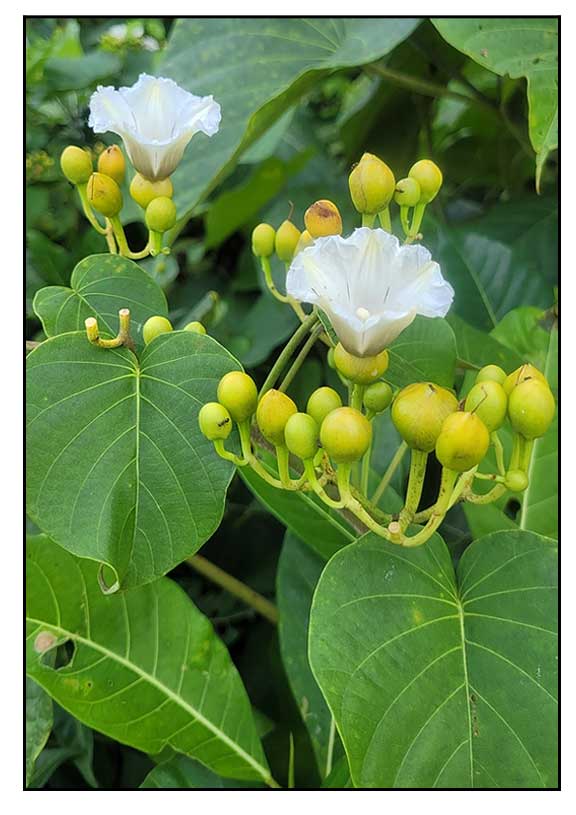
 Uses
Uses 
Updated March 2026 / November 2018 / December 2016

 |
PHOTOS / ILLUSTRATIONS |
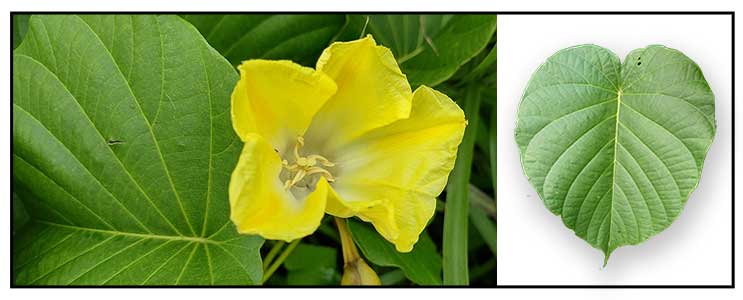
| IMAGE SOURCE: Decalobanthus peltatus / Dana Lee Ling / Public Domain / No rights reserved / Click on image or link to go to source page / iNaturalist |
| OTHER IMAGE SOURCE: Decalobanthus peltatus / © Pavel Smirnoc / Some rights reserved / CC BY 4.0 International / Image modified / Click on image or link to go to source page / iNaturalist |
| OTHER IMAGE SOURCE: Decalobanthus peltatus leaf / © Mike Bowie / Some rights reserved / CC BY 4.0 International / Image modified / Click on image or link to go to source page / iNaturalist |
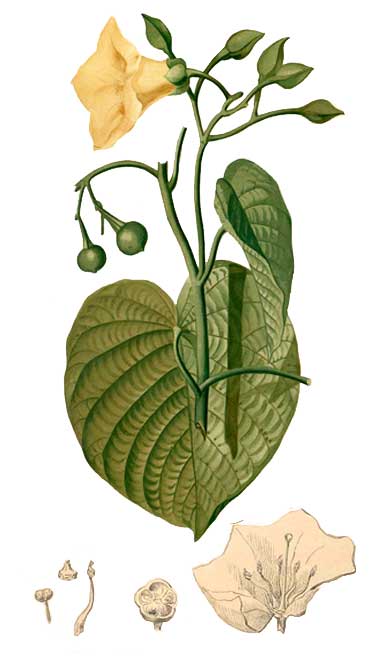
| OTHER IMAGE SOURCE: Convolvulaceae spp Blanco2.261-original.png/ Flora de Filipinas / Franciso Manuel Blanco (OSA), 1880-1883 / Public Domain Wikimedia Commons |
| OTHER IMAGE SOURCE: Decalobanthus peltatus / © John Sullivan / Some rights reserved / CC BY 4.0 International / Image modified / Click on image or link to go to source page / Wikimedia Commons |
Additional
Sources and Suggested Readings |
• |
DOI: It is not uncommon for links on studies/sources to change. Copying and pasting the information on the search window or using the DOI (if available) will often redirect to the new link page. (Citing and Using a (DOI) Digital Object Identifier) |
| List of Understudied Philippine Medicinal Plants |
| New plant names needed The compilation now numbers over 1,750 medicinal plants. While I believe there are hundreds more that can be added to the collection, they are becoming more difficult to find. If you have a plant to suggest for inclusion, native or introduced, please email the info: scientific name (most helpful), local plant name (if known), any known folkloric medicinal use, and, if possible, a photo. Your help will be greatly appreciated. |
• |
 |
|

