
HOME      •      SEARCH      •      EMAIL    •     ABOUT


Family Apocynaceae
Bulalakaw
Hoya multiflora Blume
SHOOTING STAR HOYA
Feng chu chao

Scientific names Common names
Asclepias carnosa Blanco Amutung (Ilokano)
Asclepias stellata Burm. ex Decne. Balic-balic (Tagalog)
Centrostemma cyrtoceras Meisn. Balik-balik (Tag.)
Centrostemma elegans Blume Bulalakaw (Tagalog)
Centrostemma floribunda Bosse Timbang-timbang (Dumagat)
Centrostemma laurifolium Blume Many-flowered hoya (Wngl.)
Centrostemma lindleyanum Decne. Shooting star hoya )Engl.)
Centrostemma micranthum Blume Shooting stars (Engl.)
Centrostemma multiflorum (Blume) Decne.  
Centrostemma platypetalum Merr.  
Centrostemma yunanense P.T.Li  
Cyrtoceras coriaceum Heynh.  
Cyrtoceras elegans (Bkume) Miq.  
Cyrtoceras floribundum Maund  
Cyrtoceras laurifolium Miq.  
Cyrtoceras lindleyanum (Decne.) Miq.  
Cyrtoceras micranthum (Blume) Miq.  
Cyrtoceras multiflorum (Blume) Heynh.  
Cyrtoceras reflexum Benn.  
Cyrtoceras uncinatum Teijsm. & Binn.  
Hoya celebica Boerl.  
Hoya coriacea Lindl.  
Hoya constantinii P.T.Li  
Hoya elegans (Blume) Boerl.  
Hoya gongshanica P.T.Li  
Hoya javanica Boerl.  
Hoya lii C.M.Burton  
Hoya lindleyana (Decne.) Fern.-Vill.  
Hoya reticulata Constantin  
Hoya multiflora Blume is an accepted species. KEW: Plants of the World Online

Other vernacular names
CHINESE: Feng chu chao, Fengchuwo, Liuxing qiulan.
ESTONIAN: Kollane vahalill.
FINNISH: Tähtiposliinikukka.
INDONESIAN: Chukangkang (Sundanese).

Gen info
- Apocynaceae is a family of flowering plants that includes trees, shrubs, herbs, stem succulents, and vines, usually known as the dogbane family, because some taxa were used as dog poison. Notable members include oleander, dogbanes, milkweeds, wax plants, and periwinkles.
- Hoya us a genus of over 500 species of plants in the dogbane family, Apocynaceae, commonly known as waxflowers. They are most epiphytic or lithophytic vines. (3)
- Taxonomy: The genus was first formally described in 1810 by botanist Robert Brown in his book Prodromus Florae Novae Hollandiae et Insulae Van Diemen. The name honors Thomas Hoy , the gardener for the Duke of Northumberland. The first Hoya species described was Hoya carnosa. (3)
- Hoya multiflora, commonly known as shooting stars, is a species of evergreen tropical plants in the oleander and frangipani family Apocynaceae.
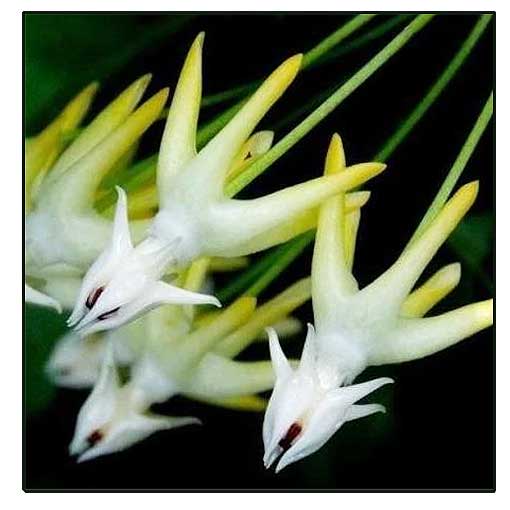
- Etymology: The genus name Hoya honors the 18th-century English botanist Thomas Hoy. The specific epithet multiflora derives from Latin, meaning "many flowered," referring to the large clusters of flowers, often 30-40 individual arrow-shaped blooms per inflorescence that point downward like falling stars.

Botany
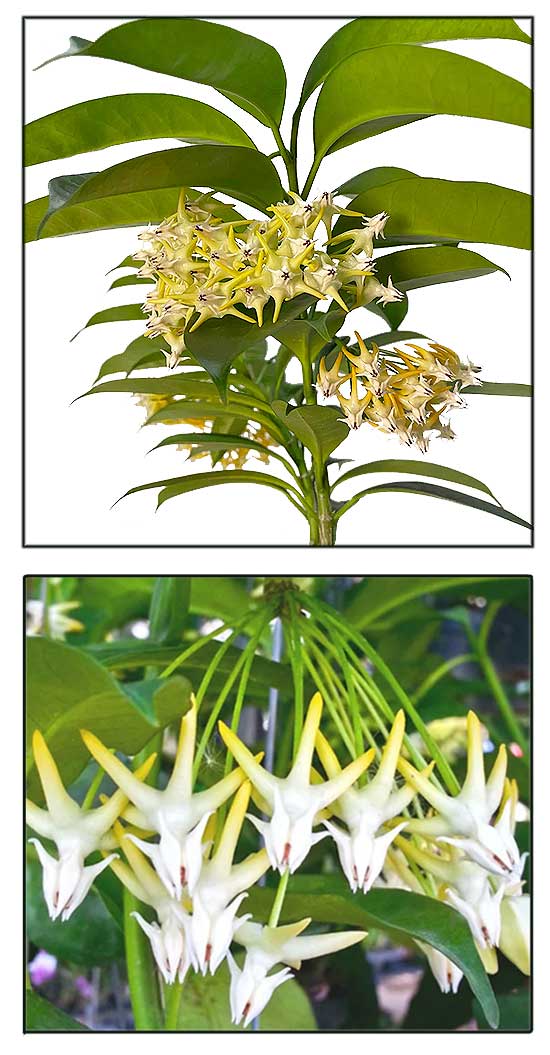
Growth form: An epiphytic shrub which can grow up to 2.5 m tall. Foliage: Leaf blade is elliptic, measuring 12 - 20 cm x 2 - 7 cm, base cuneate and apex acuminate, with pinnate venation. Petiole is 1 - 2 cm long. Stems: Stems can be erect or decumbent, pale gray in color, but turn yellowish when dry with persistent leaf scars. Flowers: Flowers are borne on clusters, 20 - 50 flowers per cluster, which has short peduncle of 2 - 5 cm long. Sweet-scented the flower is 1.5 - 2.5 cm in diameter, with reflexed white to cream corolla lobes and yellow to pale orange apices. Fruit: Fruit is linear, around 20 cm long and 6 mm wide. Habitat: Found growing as epiphytes on trees in lowland, and hilly mixed dipterocarp forests, mangroves and limestone forest. (Flora & Fauna Web)

• Plants glabrous throughout except for corolla throat. Stems erect or decumbent, to 2.5 m tall, pale gray, yellowish when dry, with persistent leaf scars. Petiole 1-2 cm; leaf blade oblong-lanceolate, 8-18 × 2-6 cm, thick papery when dried, base cuneate, apex obtusely acuminate; lateral veins obscure. Inflorescences extra-axillary, subterminal, or terminal, hemispherical, many flowered; peduncle stout, 1.5-3 cm. Pedicel 3.5-7 cm. Sepals ovate, ca. 2.5 × 1.7 mm; glands many, linear. Corolla yellowish white with orange lobe apices, 1.6-1.8 cm, strongly reflexed from base; limb ca. 6 mm, throat white villous; lobes oblong-triangular, ca. 1.2 × 0.8 cm. Corona on distinct stalk; lobes yellow, narrowly lanceolate, 8-9 mm, outer angles extended into acuminate spurs, inner angles acuminate, higher than stigma head. Follicles linear-lanceolate in outline, 12-18 cm. Seeds ovate, ca. 4 × 2 mm; coma to 5 cm. 
(Flora of China)

Distribution
- Native to the Philippines. (1) (2)
- Epiphytic or pseudo-epiphytic on trees in primary forests at low and medium elevation. (2)
- In Babuyan Isls, Dinagat; in Luzon: Albay, Apayao, Cagayan, Camarines Sur, Cavite, Laguna, Nueva Viscaya, Quezon, Rizal, Sorsogon, Masbate; Mindoro; in Mindanao: Davao, Davao Oriental, Misamis Oriental; Surigao. Mindoro, Negros, Palawan, Panay, Polillo, Samar, Siargao. (2)
- Also native to
Assam, Bangladesh, Borneo, Cambodia, China South-Central, China Southeast, Jawa, Laos, Malaya, Myanmar, New Guinea, Sulawesi, Sumatera, Thailand, Vietnam. (1)

Constituents
- Study of dichloromethane extracts of Hoya multiflora isolated lupeol (1a), α-amyrin (1b), ß-amyrin (1c), lupeol acetate (2a), α-amyrin acetate (2b), and ß-amyrin acetate (2c) from stems; and 1b, bauerenol (3), squalene (4), lutein (5), β-sitosterol (6a), and stigmasterol (6b) from the leaves. (6)

Properties
- Sweet-scented flowers.
- Minor risk
: Considered pet-safe. Borken stems and leaves may yield a milky latex that can occasionally cause mild skin irritation for sensitive individuals. May cause mild stomach upset if consumed.
- Study suggested antimicrobial. antioxidant properties.


Uses

Edibility
- Grown as ornamental, not as culinary fare.
- Flowers are reportedly edible; and to boot, one of the tastiest of the Hoya flower varieties. The sweet nectar is reportedly used for infusing in tea or cocktails for its sweetness, for making floral syrups to use in drinks and sweets. However! Make sure the plant has not received insecticide treatments or chemical fertilizers.
Folkloric
- No reported medicinal use in the Philippines.
- Used for treatment of stomachache, cough, toothache, skin diseases, venereal diseases, and as antitoxin. (7)
Others
- Air-purifying: Like other members of the Hoya genus, Hoya multiflora is considered an air-purifying houseplant. The leaves help filter minor indoor pollutants like volatile organic compounds (VOCs) from the air. However for the purpose, scientists say a room needs a goodly number of plants and, to boot, be tightly sealed.

Studies
Antimicrobial:
Study evaluated the antimicrobial activity against two pathogenic bacteria. A total of 18 isolates were obtained. Isolate HMA1 inhibited Escherichia coli; isolate HMD6 inhibited Staphylococcus aureus. Two isolates (HMB1 and HMD4) inhibited both bacteria. MIC of ethyl acetate extract from HMB1 was 0.625 mg/mL, and 0.125 mg/mL for HMD4. (7)
Antioxidant / Endophytic Bacteria: Endophytic bacteria isolated from plant tissues can produce the same secondary metabolites as the host plant. Study evaluated the antioxidant activities of two endophytic bacteria, i.e. Bacillus siamensis HMB1 and Bacillus aryabhattai HMD4 cultures, derived from H. multiflora, and to identify their cellular effects on Schizosaccharomyces pombe. Results showed both cultures had antioxidant activities, with HMB1 showing highest IC50 (51.18 mg/ml). In vitro HMD4 bacterial crude extract ib 250 ppm showed highest resistance effect and significantly enhanced S. pombe growth. LC-MS analysis suggested a total of 14 compounds with antioxidant activity. (8)

Availability
- Wild-crafted.
- Ornamental houseplant.

- Plants in the cybermarket
.

August 2026

                                                 PHOTOS / ILLUSTRATIONS
IMAGE SOURCE: Hoya multiflora / by Scott Zona / Some rights reserved / CC BY 4.0 International / Image modified / Click on image or link to go to source page / Wikipedia
OTHER IMAGE SOURCE: Hoya multiflora / HOYA MULTIFLORA CARE / Non-commercial use / Image modified / Click on image or link to go to source page / OHIO TROPICS
OTHER IMAGE SOURCE: Hoya multiflora / Vermont Hoyas / Non-commercial use / Image modified / Click on image or link to go to source page / VermontHoyas
OTHER IMAGE SOURCE: Hoya multiflora / HOYA STORE AUSTRALIA / Non-commercial use / Image modified / Click on image or link to go to source page / HoyaStoreAustralia

Additional Sources and Suggested Readings
(1)
Hoya multiflora / KEW: Plants of the World Online
(2)
Apocynaceae: Hoya multiflora / Co's Digits al Flora of the Philippine
(3)
Hoya (plant) / Wikipedia

(4)
Hoya multiflora / Wikipedia

(5)
Hoya multiflora / National Parks: FLORA & FAUNA WEB
(6)
Terpenoids and sterols from Hoya multiflora Blume / Virgilia D Ebajo, Chien Chang Shen, Consolacion Y Ragasa / Journal of Applied Pharmaceutical Science, 2015; 5(4): pp 33-39 /
DOI: 10.7324/JAPS.2015.50406
(7)
Characterization, identification, and analysis of bioactive compound of endophytic bacteria from Hoya multiflora Blume / Dewinta Nur Alvionita, Sri Rahayu, Nisa Rachmania Mubarik / BIODIVERSITAS, 2020; 21(1): pp 195-202 / ISSN: 1412-033X / eISSN: 2085-4722 / DOI: 10.13057/biodiv/d210125
(8)
Antioxidant Activity of Endophytic Bacteria Derived from Hoya multiflora Blume Plant and Their Cellular Activities on Schizosaccharomyces pombe / Nabila Pudjas, Nisa Rachmania Mubarik, Rika Indri Astuti, Lisdar Idwan Sudirman / HAYATI Journal of Biosciences, 2022; 29(2): pp 2114-221 /
DOI: 10.4308/hjb.29.2.214-221

DOI: It is not uncommon for links on studies/sources to change. Copying and pasting the information on the search window or using the DOI (if available) will often redirect to the new link page. (Citing and Using a (DOI) Digital Object Identifier)

                                                            List of Understudied Philippine Medicinal Plants
                                          New plant names needed
The compilation now numbers over 1,750 medicinal plants. While I believe there are hundreds more that can be added to the collection, they are becoming more difficult to find. If you have a plant to suggest for inclusion, native or introduced, please email the info: scientific name (most helpful), local plant name (if known), any known folkloric medicinal use, and, if possible, a photo. Your help will be greatly appreciated.

HOME      •      SEARCH      •      EMAIL    •     ABOUT