 Gen info Gen info
- Uraria is a genus of plants in the legume family, Fabaceae. It includes 24 species of shrubs and subshrubs.
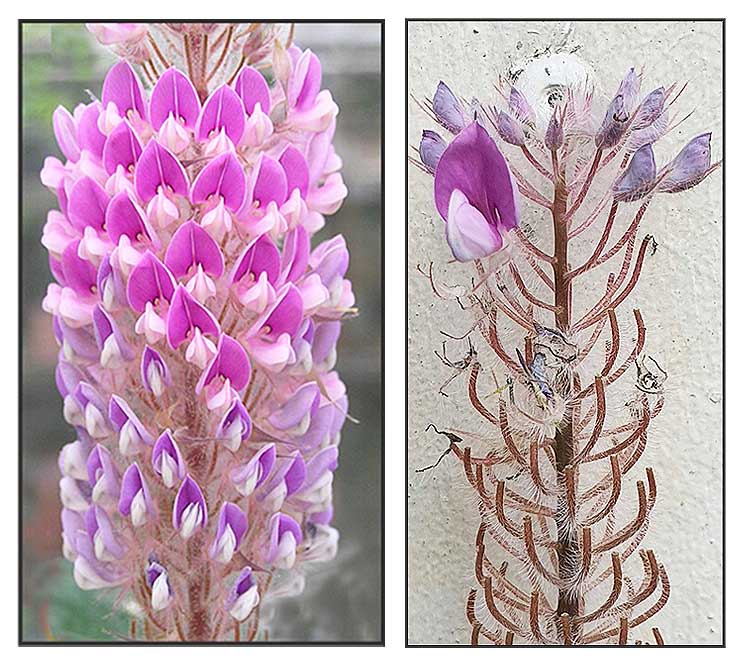
- Etymology: The genus name Uraria likely refers to its distinctive, long, hairy flower spike, which resembles a bushy tail, hence, the common names Cat's tail or Asian foxtail. The specific epithet crinita derives from Latin, meaning "hairy", likely referring to the inflorescence's long white hairs. The common names of Cat's tail and Asian foxtail refers to the inflorescence's resemblance to a bushy tail.
 Botany Botany
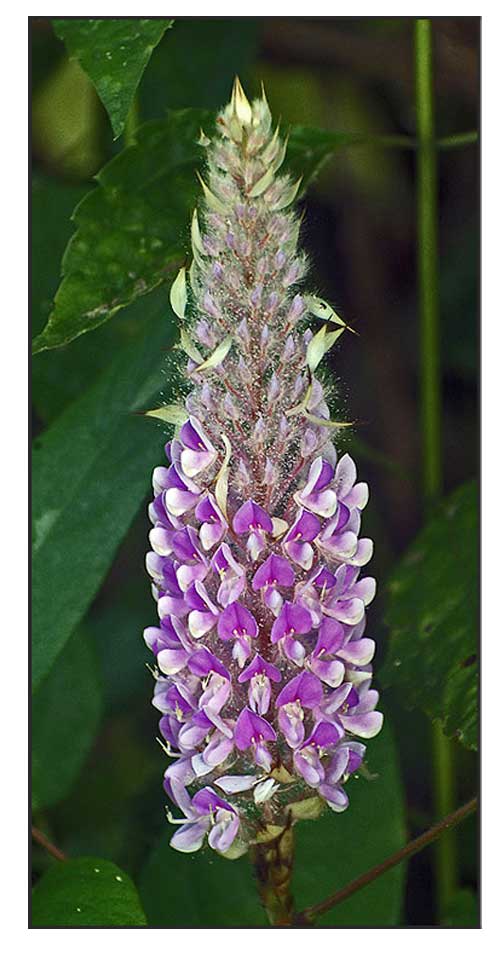
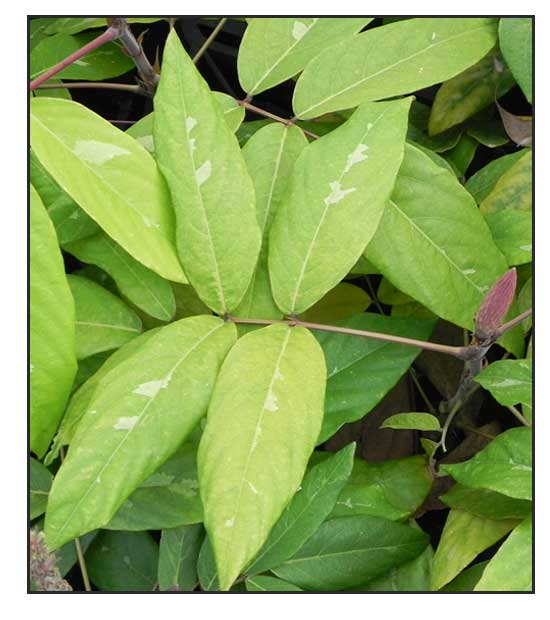
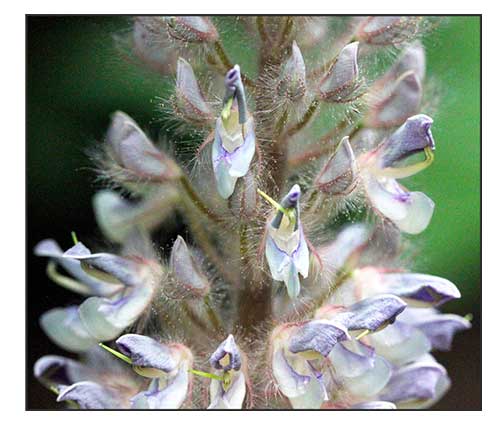
• Growth form: A woody shrub with erect stems and long bushy inflorescence. Foliage: Leaves are pinnately compound with about 2 - 3 pairs of lateral leaflets and 1 slightly larger terminal leaflet. Leaflets are oblong to narrowly ovate (6 - 15 cm long, 3 - 8 cm wide). The petioles are often long (5.5 - 15 cm). Stems: Stem covered in soft, short, gray hairs. Flowers: Flowers have one large ovate petal that hangs over 3 smaller petals. (0.6 - 0.9 cm wide). Flowers are arranged on an inflorescence known as a raceme (an inflorescence with stalked flowers carried along 1 main axis). The inflorescence is light purple and shaped like a cone (15 - 30 cm long). This species flowers from April to September. Fruit: Fruit is an elliptic pod lightly covered in soft, short hairs. (Flora & Fauna Web)
• Erect subshrub, 0.5-2 m tall. Branches terete, densely pubescent. Leaves pinnately compound, upper leaves 3-7-foliolate, lower ones 3-foliolate; petiole 10-13 cm long, pubescent; stipules free, about 1 cm long; stipels 3 mm long; leaflets ovate to lanceolate, 8-16 cm × 1.5-5.5 cm, apex acute, glabrous above, hairy beneath. Inflorescence a terminal, cylindrical, densely flowered raceme, (7-)12-30(-50) cm long; lower bracts empty, upper ones with 2 flowers, lanceolate, 10-20 mm × 3-6 mm; pedicel 3-15 mm long; with long bristles.Calyx tube short, 2 upper teeth up to 6 mm long, 3 lower teeth up to 7 mm long; corolla purplish pink; standard obovate, 6-10 mm × 6-8 mm, glabrous; wings shorter than keel, clawed; keel 7-9 mm long, clawed; stamens 10, diadelphous.Pod 2-4(-7)-jointed, constricted between joints, indehiscent, shiny black, hairy. Seed reniform-globose, compressed, 1.5-2 mm in diameter, brown. (PROSEA)
Distribution
- Native to the Philippines. (1)
- In Batanes; in Luzon: Ifugao, Kalinga; in Mindanao: Misamis Oriental.
- Also native to Assam, Bangladesh, Cambodia, Caroline Is., China South-Central, China Southeast, East Himalaya, Hainan, Jawa, Laos, Malaya, Myanmar, Nansei-shoto, Sumatera, Taiwan, Thailand, Vietnam. (2)
- Occurs in disturbed areas, roadsides, and thickets; at altitudes from 0-900 m. (7)
- In Thailand, considered a weed in rubber plantations.
(7)
 Constituents Constituents
- Plant constituents included flavonoids, triterpenes, megastigmanes, and nucleosides.
- Study of n-butanol extract of
whole plant isolated four flavone glycosides including apigenin 7-O-ß-glucoside (1), chrysoeriol 7-O-ß-glucoside (2), rhoifolin (3), and 3'-methoxyapiin (4). (6)
- Study of roots isolated two new triterpene glycosides, 24-deoxyoxytrogenin 3-O-α-L-rhamnopyranosyl (1→2)[β-D-glucopyranosyl]-β-D-galactopyranosyl (1→2)-β-D-glucuronopyranoside and sophoradiol 3-O-α-L-rhamnopyranosyl (1→2)-β-D-glucuronopyranosyl (1→2)-β-D-glucuronopyranoside with four known glycosides. (10)
- Study of roots by column chromatography isolated 14 compounds, identified as: β-sitosterol (1), octadecanoicacid(2), palmitic acid(3), β-daucosterol(4), (24R)-stigmast-7, 22(E)-dien-3α-ol(5), 2-(acetylamino)benzoic acid, methyl ester (6), betulin (7), m-hydroxybenzoic acid (8), 5,7-dihydroxy-2′-methoxy-3′,4′- methylenedioxyisoflavanone (9), sucrose (10), sophoradiol (11), genistein (12), genistin (13), and silybin (14). (13)
- Study of methanol extract afforded a new 3- hydroxyisoflavanone, 3,5,7,2',4'-pentahydroxyisoflavanone (1), two new monoaryl glucosides, 3,4-dimethoxyphenyl 1-O-(6'-O-acetyl)-β-D-glucopyranoside (2) and 3,4,5-trimethoxyphenyl 1-O-(6'-O-acetyl)-β-D-glucopyranoside (3), in addition to three known compounds, 3'-O-methylorobol (4), robusflavone B (5), and apigenin (6). (see study below) (14)
- Study of whole plant isolated a new isoflavone, (3S)-5,7-dihydroxy-2',3',4'-trimethoxy-6,5'-diprenylisoflavanone (1) and eight known compounds including five flavones (2-6), two triterpenes (7-8) and a steroid (9). (see study below) (15)
- Study of ethyl acetate, n-butanol, and aqueous fractions of 95% ethanol crude extract of U. crinita isolated a new active flavone glycoside, apigenin 6-C-β-D-apiofuranosyl(1→2)-α-D-xylopyranoside (3) and ten known components with stimulatory activity on human osteoblast cell.
(see study below) (16)
- Study of Uraria picta roots isolated two isoflavanones, 5,7-dihydroxy-2'-methoxy-3',4'-methylenedioxyisoflavanone (2) and 4',5-dihydroxy-2',3'-dimethoxy-7-(5- hydroxyoxy-chromen-7yl)-isoflavanone (4) along with six known compounds including isoflavanones, triterpenes and steroids. (see study below) (19)
Properties
- Studies have suggested neuroprotective, osteogenic, antihyperglycemic, antihyperlipidemic, cytotoxicity, anticancer, blowfly repellent, antidiabetic, antimicrobial properties.
Parts used
Whole plant, leaves, roots.
 Uses Uses
Edibility
- Widely used as popular folk drink in Taiwan and China. The aqueous extract is referred to as "ginseng-like" herbal tea.
- In Vietnam, used as vegetable.
Folkloric
- No reported folkloric medicinal use in the Philippines.
- In Chinese medicine, used for treatment of swellings and ulcers. (3)
- Various plant parts used for a range of conditions like dysentery and diarrhea, enlarged spleen and tumors, pustules and fistulae. Whole plant used to stop bleeding, reduce fever, and to relieve cough and for treatment of intestinal worms. Sometimes used as carminative for children. Crushed leaves applied externally for head lice. (3)
- in China, root is traditionally used to regulate digestive activity, for deworming, and treatment of diarrhea. Also used for its detoxifying action, to reduce swelling, and for antitussive effects. (5)
- In Vietnam, used for treatment of lung disorders, sprains, bruises, diarrhea and rheumatism. (8)
- In Laos, considered a tonic plant. Whole plant decoction used after childbirth. Leaves are applied to wounds, reported to stop bleeding. In China, used for convulsions, headaches, abdominal pains and uterine descent. In Thailand, used for eliminating lice and intestinal worms; root decoction also used for colon cancer. (9)
- In Indonesia, decoction of roots used as mouthwash in gingivitis. (20)
- In Bangladesh, juice and decoction of leaf and root taken orally for tetanus, hysteria, and against evil spirits. (21)
Others
- Agroforestry: Used as green manure and as cover crop. (3)
Studies
• Neuroprotective / Manganese Chloride-Induced Apoptosis in SH-SY5Y Cells: Study evaluated the stress-alleviating neuroprotective effects of U. crinita(7) on a manganese chloride (MnCl2)-induced SH-SY5Y cells model to stimulate ER stress-mediated neurodegeneration. Results showed concentration range of 50-200 µg/ml, the water extract of UC inhibited MnCl2-induced ER stress, oxidative stress, and autophagy levels, restored mitochondrial membrane potential, and prevented neuronal apoptosis. The mechanism may involved upregulation of expression of proteins such as Bcl-2, SirT-1, OPA1, MFN1, MFN2, and P62, while downregulating Bax, cleaved-caspase 3, GRP78, CHOP, p-PERK, p47phox, DRP1, and Beclin-1. Results demonstrate UC exhibits protective effect against MnCl2-induced neuronal apoptosis, suggesting potential as neuroprotective functional food. (4)
• Effect of Post-Harvest Oven Drying / Improved Herbal Tea Ingredients: Uraria crinita is widely used as a popular folk drink. Study evaluated the effect of three drying methods (oven-drying, air-drying, and sun-drying) and oven-drying temperature. Samples processed at 40° showed greater effect on levels of estrogen receptor-alpha activity and nuclear factor erythroid 2-related factor 2 activity, anti-oxidative activity, and COX-2 inhibition. Oven-dried samples showed at least two-fold increase in concentrations of flavonoids, spatholosineside A and triterpenoids. Results showed oven-drying at 40° improved the quality of UC. (5)
• Osteogenic Effects: Osteogenesis plays a vital role in maintenance of bone health, and imbalances in osteogenesis can lead to bone-loss associated diseases. Use of U. crinita as dietary supplement has been used for childhood bone dysplasia. Study evaluated the osteogenic effects of 50% ethanol extract of U. crinita root on primary human osteoblasts (HObs) and used LC-MS/MS for quality control assessment as functional food. Two isoflavones, genistein (5) and 5,7-dihydroxy-3′,5′-dihydroxyiso-flavone (6) increased alkaline phosphatase activity (differentiation stage; isoflavone 2'-hydroxygenistein (4) showed high osteogenic potential among the isolated compounds in HObs. Results showed promotion of osteogenesis-related stages and upregulation of gene expression in a dose-dependent manner. The LC-MS/MS-based phytochemical perspectives may act as reference standards for development of food supplements from U. crinita. (8)
• Antihyperglycemic / Antihyperlipidemic: Study evaluated the antihyperglycemic and antihyper-lipidemic effect of U. crinita water extract (UCWE) in diabetic mice induced by streptozotocin (STZ) in combination with high fat and protein food. Results showed oral administration of UCWE significantly decreased the fasting blood glucose in OGTT, significantly suppressed the increase in blood glucose after glucose challenge, decreased plasma concentration of triglycerides (TG) and free fatty acids (FFA), along with increase concentration of plasma insulin. (12)
• Phenolics / Little or No Cytotoxicity: Study of methanol extract afforded 3 new and 3 old compounds. Compounds 1-6 exhibited weak or no cytotoxicity against KB, Hep0G2, Lu and MCF7 cell lines. (see constituents above) (14)
• Anticancer / Isoflavone: Study of whole plant isolated a new isoflavone, (3S)-5,7-dihydroxy-2',3',4'-trimethoxy-6,5'-diprenylisoflavanone (1) and eight known compounds including five flavones (2-6), two triterpenes (7-8) and a steroid (9). The compounds were evaluated for cytotoxicity against four human cancer cell lines: KB (mouth epidermal carcinoma), HepG2 (hepatocellular carcinoma), Lu (Lung carcinoma) and MCF7 (breast carcinoma). Compound 1 showed cytotoxicity against tested cell lines with IC50s of 33.2, 29.4, 59.6 and 66.8 µM, respectively. (16)
• Stimulation of Osteogenic Activity in Human Osteoblast Cells: Study of ethyl acetate, n-butanol, and aqueous fractions of 95% ethanol crude extract of U. crinita isolated a new active flavone glycoside, apigenin 6-C-β-D-apiofuranosyl(1→2)-α-D-xylopyranoside (3) and ten known components with stimulatory activity on human osteoblast cell. Compound 3 at 100 µM significant increased alkaline phosphatase activity (114.10%), mineralization (150.10%), along with osteopontin (1.39 ± 0.01-fold), bone morphogenetic protein-2 (BMP-2, 1.30 ± 0.04-fold), and runt-related transcription factor 2 (Runx2, 1.43 ± 0.10-fold) mRNA expression through activation of the BMP-2/Runx2 pathway. Dalbergioidin (1) and byzantionoside B (9) displayed similar effects. Results suggest U. crinita and active components have potential for stimulation of bone formation and regeneration. (17)
• Blowfly Larvae Repellent in Fermented Fish: Study evaluated the lethality and repellent effect of three plant species viz., Uraria crinita, Bambusa multiplex, and Tadehagi triquetrum against blowfly larvae in fermenting fish. Fresh material added on top of fermenting fish repelled 54%, 50%, and 37%, and killed 28%, 22% and 40% of fly larvae. The three species showed efficacy in repelling and killing larvae in the production of fermented fish, and may be essential in augmenting food safety during traditional fermentation in open jars. (18)
• Antimicrobial Isoflavanones: Study of Uraria picta roots isolated two isoflavanones, 5,7-dihydroxy-2'-methoxy-3',4'-methylenedioxyisoflavanone (2) and 4',5-dihydroxy-2',3'-dimethoxy-7-(5- hydroxyoxy-chromen-7yl)-isoflavanone (4) along with six known compounds including isoflavanones, triterpenes and steroids. The MICs for these compounds were in the range of 12.5 to 200 µg/ml against Gram(-) and Gram(+) bacteria and fungi. (19)
Availability
- Wild-crafted.
- Ornamental cultivation.
|





.jpg)