  Gen info Gen info
- Parmentiera cereifera, the candle tree, is a species of tree in the family Bignoniaceae. It is endemic in Panama, but is a commonly cultivated specimen in botanical gardens.
- Etymology and historical snippet: The genus name Parmentiera honors Antoine Augustine Parmentier (1737-1831), a French agronomist and military
pharmacist whose claim to botanical fame was the introduction of the potato in France. At that time, the French called it "hog feed" and was thought to cause leprosy, and, thus, officially banned, Parmentier's efforts led to the lifting of the ban. The specific epithet cereifera means "wax producing". (10)
Botany
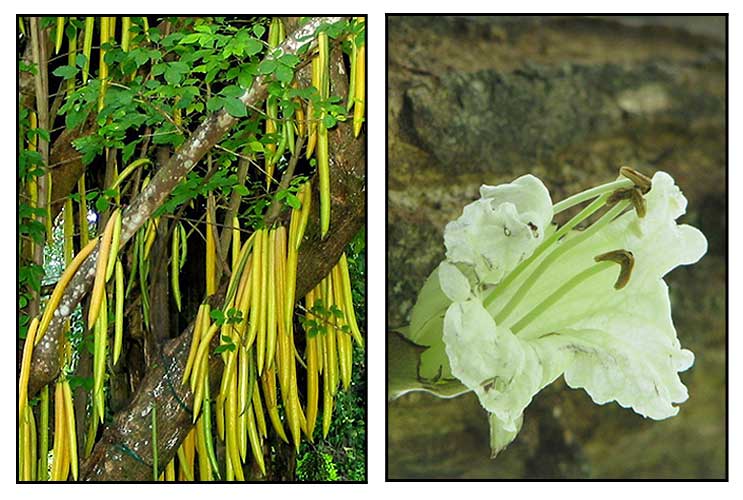
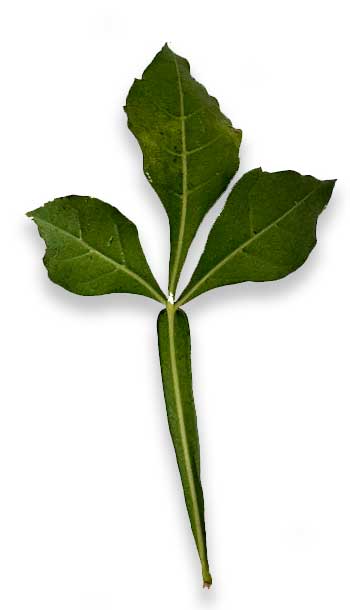
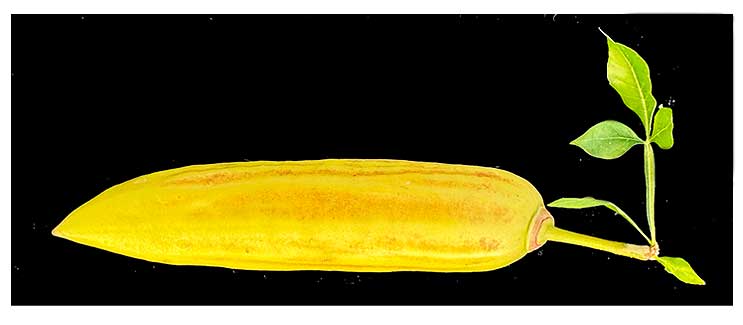
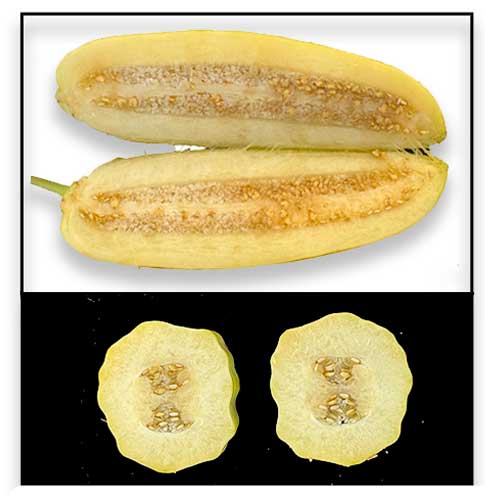
• Tree grows up to 6 m tall. The leaves are arranged oppositely, each made up of three leaflets. They are borne on winged petioles up to 5 cm long. Flower is solitary or borne in a cluster of up to four. The five-lobed corolla is greenish white. Fruit is a taper-shaped berry up to 60 cm long, fleshy and edible, green, ripening yellow, and waxy in texture. Record length is 120 cm long while only 2.5 cm wide. (2)
• Growth form: Medium sized tree. Foliage: Leaves compound, with 3 leaflets, mid- dark green. Flowers: Flowers 5-6cm across, greenish white, marked with red lines in the throat. Fruit: Fruits 15- 60cm long, leathery, yellow when ripe, with numerous seeds embedded within the pulp. (Flora & Fauna Web)
 Distribution Distribution
- Cultivated.
- Endemic to Panama.
- Common cultivated specimen in botanical gardens, as a curiosity or ornamental plant; sometimes, for its edible fruit.
- IUCN Red List of Threatened Species: Listed as 'Endangered" in 1998.
Constituents
- Study of methanolic extract of leaves and stems isolated two new phenolic acid glycosides, parmentins A (1) and B (2), along with a mixture of beta-sitosterol and stigmasterol (3), beta-sitosterol glucoside (4), isovanillic acid (5), vanillic acid (6), and p-hydroxybenzoic acid (7). (4)
- Preliminary phytochemical screening of methanol extract of leaves showed presence of flavonoids, saponins, tannins, triterpenoids, and steroids. (see study below)
(6)
- Phytochemical screening of bark extract yielded flavonoids, saponins, terpenoids, and triterpenoids, with absence of anthraquinone, tannins, steroids, phlobatanins,and cardiac glycoside.
(8)
 Properties Properties
- Studies have suggested antibacterial, antifungal, antioxidant, thrombolytic, membrane stabilizing, anti-inflammatory, antimicrobial, antihyperglycemic, gastroprotective properties.
Parts used
Leaves, fruits.
Uses
Edibility
- Fruit is edible; raw, cooked, or pickled. Ripe, it exudes a fragrance akin to apples, and a mild, sweet- taste reminiscent of sugarcane or bell pepper.
- Seeds reportedly edible.
Folkloric
- No reported folkloric medicinal use in the Philippines.
- Leaves steeped in boiling water to make healing herbal tea for throat and ear infections.
- In ancient Mayan medicine, fruits consumed as digestive cleanser.
Others
- Fodder: Fruit used as cattle fodder.
Studies
• Anti-Inflammatory / Membrane Stabilizing / Fruits, Bark: Study of various crude methanolic (ME) extract, hexane (HXSF) soluble fraction, carbon tetrachloride (CTCSF) soluble fraction, aqueous (AQSF) and chloroform (CSF) soluble fraction of fruits of P. cereifera showed strong membrane stabilizing activity. Bark and fruit extracts showed significant membrane stabilizing activity ranging from 38.49% to 28.84%. Total phenolic content ranged from 3.0 -5.4 gm GAE/ 100 g dried extract. (5)
• Antioxidant / Thrombolytic / Antimicrobial / Cytotoxicity / Leaves: Study evaluated P. cereifera methanol extract of leaves for antioxidant activity, thrombolytic, cytotoxic, and antimicrobial activities. The ME exhibited significant radical scavenging activity in DPPH assay with IC50 of 21.95 µg/ml. Thrombolytic and membrane stabilizing activities assessed using human erythrocyte showed results comparable with standard streptokinase (SK) and standard anti-inflammatory drug, ASA, respectively. The ME showed significant toxicity to A. salina with LC50s ranging from 6.07 to 7.83 µg/ml compared to standard Vincristine sulphate (LC50 0.45 µg/ml). Chloroform soluble fraction showed moderate antibacterial activity against some test microorganisms. (see constituents above) (6)
• Antimicrobial / Fruits: Antimicrobial screening of crude methanolic extracts of fruits and fractions demonstrated strong antimicrobial activity against 17 pathogenic microorganisms used in screening viz. Gram(+): Bacillus cereus, B. megaterium, B. subtilis, S. aureus, Sarcina lutea; Gram (-): E. coli, Pseudomonas aeruginosa, Salmonella paratyphi, S. typhi, Shigella boydii, S. dysenteriae, Vibrio parahemolyticus, V. mimicus; Fungi: Candida albicans, Aspergillus niger, Sacharomyces cerevisiae. (7)
• Anti-Inflammatory, Antihyperglycemic, Gastroprotective / Flowers and Stem Bark: Study evaluated methanol extracts of leaves, stems, flowers, and stem bark for anti-inflammatory, antihyper-glycemic, and gastroprotective activities using animal models. ME of MLS13 (mixture of leaves and stems-1:3) showed highest anti-inflammatory activity (p<0.001) in yeast-induced paw edema, while ME of stem bark showed highest activity (p<0.001) in carrageenan-induced paw edema. MEs of flowers (p<0.001) and ethyl acetate fraction (p<0.01) exhibited significant antihyperglycemic effect in alloxan-induced diabetic rats. A petroleum ether fraction showed highest gastroprotective effect (p<0.001) in indomethacin-induced ulcer method. MLS13 showed no toxicity up to 5 gm/kg. (9)
Availability
- Cultivated.
- Seeds, seedlings in the cybermarket. |